Nobody moved.
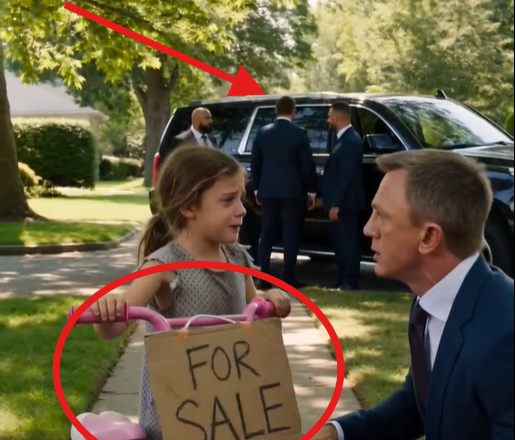
Not the men standing beside the black SUV parked at the curb. Not the birds perched in the oak trees lining the sidewalk. Not even the little girl clutching the handlebars of a bright pink bicycle like it was the last solid thing left in her world.
Because her words had just changed the entire street.
She had said something so quietly, so plainly, that it took a moment for it to fully land. But when it did, every single person on that sidewalk felt the weight of it.
The wealthy man had stopped halfway through tearing the handwritten price sign from the bicycle’s handlebars. His fingers tightened around the cardboard. The air between them went completely still.
Then slowly, deliberately, he turned back toward the bike.
Not the way a man looks at something he wants to buy. The way a man looks at something that might hold a secret he’s been afraid to find.
He crouched down again, lower than before, close enough to see the small details that a desperate child would never think to point out as selling features. His eyes moved carefully across the frame. He noticed a scratched silver bell near the left handlebar. A faded ribbon tied loosely beneath the grip on the right side, its color worn down by weather and time. And on the underside of the frame, nearly hidden beneath a thin layer of road dust and age, there was a tiny carved mark.
Two small initials.
The man’s expression went completely still.
Because he knew that mark.
Long before the tailored suits, before the black SUVs, before the kind of money that made entire neighborhoods go quiet when he arrived, there had been a different life. A simpler one. And in that life, there had been a younger brother. Stubborn and wild, always working with his hands, always building or repairing something. That brother had a habit of carving his initials into everything he made or gave to the people he loved. Bicycles, toys, handmade furniture. It was his signature. His way of saying, this came from me, and I made it with love.
Then one day, without warning, that brother was gone.
No farewell. No final phone call. No explanation left on the kitchen table. Only silence, a pile of unpaid debts, and rumors that swirled for years without ever settling into anything resembling the truth.
The wealthy man had spent a long time convincing himself that his brother had simply run away from a hard life. That it was a choice. That the silence was intentional.
But now a hungry little girl was standing in front of him on a sidewalk, holding a pink bicycle with his brother’s carved initials underneath the frame.
His voice came out rougher than he intended.
“What was your father’s name?”
The little girl looked down at the pavement. The way she paused before answering told him everything. The name still hurt her to say out loud. Like speaking it made the absence more real.
Then she said it.
And that single name was enough.
The man closed his eyes for just a moment. One breath. One quiet second to absorb what he had just been handed.
The child was telling the truth.
This was no longer a stranger’s story.
This was his own blood, standing barefoot on a city sidewalk, trying to sell the last thing her father ever gave her because there was nothing left to eat at home.
The little girl’s lip trembled as she looked up at him.
“He told me that if he didn’t come back, I should never sell it.”
She swallowed hard.
“But Mommy’s too hungry.”
That sentence broke through every remaining wall between them.
Because in those five words, a child had just revealed the full weight of what she was carrying. She knew exactly what she was doing. She knew she was breaking a promise her father had made her keep. And she was willing to carry that guilt if it meant her mother would not go to bed hungry one more night.
The man rose to his full height and looked back toward the SUV. When he spoke this time, his voice carried none of the detachment of a businessman issuing instructions to employees. It was the voice of a man who had just discovered that his family had been suffering quietly, out of reach, for far too long.
“Bring food. Get the doctor over here. And call the house.”
The suited men moved without hesitation.
The little girl stood frozen on the sidewalk, watching all of it unfold, not quite daring to believe what she was seeing. She had come out here today expecting to lose something. She had not come prepared to gain anything.
The man turned back to her and gently lifted the handwritten price sign from the handlebars. He folded it carefully in half and slipped it into his jacket pocket. Not carelessly. With intention.
Her voice came out barely above a whisper.
“You’re really not buying it?”
He shook his head slowly.
Not with a polished smile. Not with the practiced warmth of a man accustomed to being generous in front of an audience.
With something much older and quieter than that.
“No,” he said simply. “I’m taking you home.”
That was the moment the little girl stopped holding herself together.
The tears that came were not the careful, bargaining tears of a child trying to soften a stranger. They were not the frightened tears of someone bracing for disappointment. These were the tears that rise up when relief arrives so suddenly and so completely that the body does not know how to receive it gracefully.
The bright pink bicycle stood in the afternoon sunlight exactly where it had been placed that morning, still upright, still waiting.
But it was no longer something she had to give away.
It had become the thing that brought her father’s family back to her. The scratched bell. The faded ribbon. The two small initials carved into the underside of the frame by hands that had loved her before she was old enough to remember.
Sometimes the things we almost lose are the very things that lead us home.