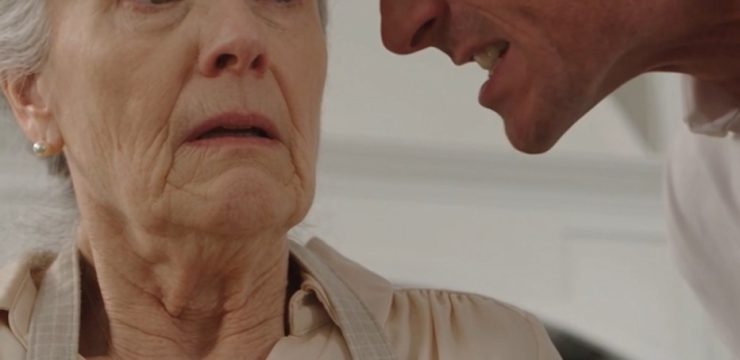
For three stunned heartbeats I just stood there in the middle of Chicago O’Hare, surrounded by rolling suitcases, stale coffee, and strangers who suddenly knew more about my family than they should. Then I did what everyone expected the “nice” grandmother to do.
I silently nodded.
I turned around.
And I walked away like I was nothing more than an Uber driver who’d dropped them off at the curb.
But a minute later, when I was far enough from their gate that I couldn’t hear Jessica’s cheerful voice or my grandchildren’s nervous giggles, I did something no one in that terminal saw coming. It wasn’t dramatic in the movie sense—no shouting, no thrown drinks, no scene for security to break up.
It was quieter than that.
Colder than that.
And it was the one decision that would make them scream and beg me to undo it… not just for that trip, but for the rest of their lives.
Before we continue, I just want to say thank you for taking the time to hear my story. If you’re comfortable, let me know where you’re listening from and what time it is where you are. I’ve spent my whole life hearing heart monitors and hospital pagers; these days, I like picturing people in different cities, in different time zones, reading this on their phones over coffee or in bed.
Now, let me tell you my story.
The alarm went off at 3:30 a.m., but I was already awake.
I’d been awake for hours, too excited to sleep, mentally running through the checklist for our family trip to Hawaii. Ten days. Maui. The whole family together. My son, my daughter-in-law, my grandchildren. The kind of multigenerational vacation you see in airline commercials, except this one was real and it was mine.
I’m Dr. Margaret Hayes, sixty-seven years old, a retired cardiologist who spent forty years saving lives at Chicago Memorial Hospital on the Near South Side. I built a successful private practice in the Gold Coast, pioneered several minimally invasive cardiac procedures, published over fifty research papers, testified as an expert witness in more malpractice cases than I care to remember—and yes, I made quite a bit of money doing it.
But none of that mattered as much to me as this trip.
This wasn’t about my career or my bank account. This was about family. About my son Kevin. His wife Jessica. And my two precious grandchildren, Tyler and Emma.
I’d been planning this vacation for six months from my brownstone in Lincoln Park, laptop open on the kitchen island while Lake Michigan winds rattled the windows. I cross-checked school calendars and Chicago weather, pored over TripAdvisor reviews, argued with myself about oceanfront versus partial ocean view, and talked to three different concierges on Maui before I was satisfied.
In the end, I booked us into an upscale resort in Wailea—oceanfront suites, on-site kids’ club, lazy river, the kind of place where families from all over the United States fly in with matching Lululemon luggage and sunhats that say “Mama” in cursive. I arranged luau reservations, snorkeling trips, a helicopter tour of the island, and a special day trip along the Road to Hana.
Ten days of memory-making with the people I loved most.
Total cost: forty-seven thousand dollars.
Worth every penny, I told myself, to see my grandchildren’s faces when they saw the Pacific Ocean for the first time. Worth every airline mile, every early-morning call with a travel concierge sitting somewhere in a glass office in Honolulu or Los Angeles.
I didn’t just throw money at a travel agent and call it a day. I curated this trip.
Tyler, eight years old, is obsessed with sea turtles. I booked a special marine biology excursion run by a local nonprofit where kids can learn about honu conservation and watch volunteers tag turtles.
Emma, six years old, loves princesses and dolphins. I found a dolphin encounter program at a reputable facility, read every review to make sure it wasn’t exploitative, and reserved dinner at a restaurant where she could dress up in a little blue dress and feel like she’d stepped into her own fairy tale. I even ordered a tiny plastic tiara off Amazon, shipped it to my house in Chicago, and packed it in my carry-on.
Everything perfect. Everything planned with love.
I showered, put on comfortable travel clothes—black leggings, a soft Northwestern sweatshirt, the running shoes I use for my four-mile jogs along the lakefront—and double-checked my suitcase one more time. Passport. Wallet. Printed confirmations even though everything is in an app now. My cardiology brain doesn’t trust a single point of failure.
At 5:00 a.m., a black sedan from a local car service pulled up in front of my brownstone. The driver loaded my suitcase into the trunk while I locked the front door of my house that I’d bought years ago when the hospital bonuses were coming in strong and the Chicago housing market was still forgiving.
We drove down Lake Shore Drive toward O’Hare International Airport, the lights of the Chicago skyline shimmering over Lake Michigan, the Willis Tower and John Hancock Building just silhouettes against a still-dark sky. Even after all these years, that drive still makes me feel lucky to have lived my whole life in this city.
We were all meeting at O’Hare at 6:00 a.m. for our 8:15 flight to Honolulu, then on to Maui. Hawaiian Airlines. I’d upgraded all five tickets to business class—lie-flat seats, real silverware, little orchids on the trays. I wanted this to be special.
I arrived at the airport at 5:45, rolling my suitcase through Terminal 3, past the Starbucks with the line already snaking out, past families in Disney sweatshirts headed to Orlando, past bleary-eyed business travelers clutching briefcases and cold brew.
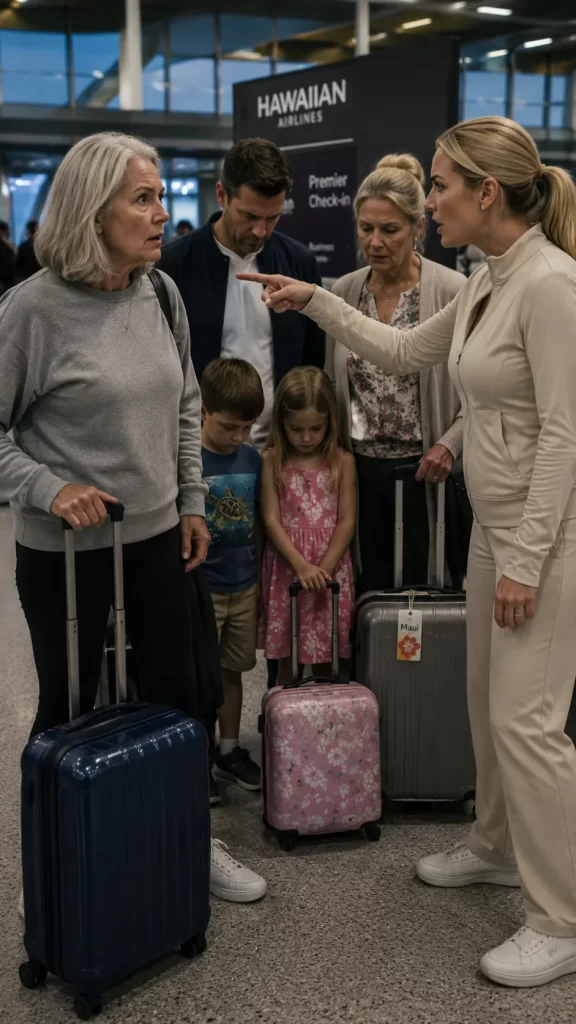
I scanned the crowds near the Hawaiian Airlines check-in counter and spotted them.
Kevin, my thirty-eight-year-old son, tall with his father’s broad shoulders, dark hair starting to show a few gray strands at the temples. The boy I raised alone after my husband, Thomas, died of a heart attack when Kevin was just ten years old.
Jessica, his wife of ten years, thirty-five, blonde, always immaculately dressed even at dawn. Before the kids were born, she worked in marketing for a tech startup downtown. Now she stayed home full-time, managing PTA committees and Instagram stories.
Tyler and Emma were bouncing despite the early hour, each wearing the new outfits I’d bought them specifically for this trip: Tyler in a T-shirt with cartoon sea turtles, Emma in a pink sundress with little white hibiscus flowers printed all over it. They had little matching kids’ carry-ons, also bought by me, with airplane stickers already on the sides.
And someone else.
Jessica’s mother stood beside her with a cream-colored suitcase, a straw hat clipped neatly to the handle, and the unmistakable expression of someone who had not arrived at an airport merely to say goodbye.
My eyes moved from her luggage to Jessica.
Jessica smiled.
Too quickly.
“Surprise.”
I waited.
Kevin looked at the floor.
The children went strangely quiet.
Jessica touched her mother’s arm as if presenting the final detail of a plan everyone had already approved.
“Mom’s coming with us.”
For a moment, the airport seemed to lose its sound. I could see mouths moving at the neighboring counters, suitcase wheels turning, departure boards flickering overhead, but all I heard was the low hum inside my own chest.
“I booked five tickets,” I said.
Jessica’s smile tightened.
“I know.”
I looked at Kevin.
“Then where is she sitting?”
That was when my son finally raised his eyes.
Not all the way.
Just enough.
“Mom, we were going to explain.”
I felt something inside me become very still.
Jessica stepped in before he could continue.
“We moved things around. My mom hasn’t had a real vacation in years, and she’s been under so much stress. We thought this would be good for her.”
“We?”
Kevin swallowed.
Jessica continued.
“She can use your business-class seat.”
I honestly thought I had misheard her.
“My seat.”
“It makes the most sense.”
Her tone was calm. Practical. Almost generous.
“You travel all the time. You know airports. You can take a later flight, or fly economy and meet us there. Mom gets anxious flying alone.”
Behind Jessica, her mother shifted her weight.
She wasn’t smiling anymore.
I looked toward Tyler.
He was studying the carpet.
Emma had both hands wrapped around the handle of her pink carry-on.
That hurt more than Jessica’s words.
Because suddenly I understood the nervous giggling I had heard when I approached.
They had known something was happening.
Maybe not everything.
But something.
“How long have you known?” I asked Kevin.
His face changed.
That tiny movement told me more than his answer could have.
“Mom—”
“How long?”
Jessica exhaled sharply.
“Margaret, please don’t make this into a thing.”
A thing.
Forty-seven thousand dollars.
Six months of planning.
A trip I had built around their children.
And I was making it into a thing.
Jessica glanced toward the security line as if my reaction, rather than what she had done, was the inconvenience threatening the morning.
“We just figured you’d understand.”
That sentence landed differently.
Not because it was cruel.
Because it was familiar.
You’ll understand.
I had heard versions of it for years.
When birthday dinners were changed after I had made reservations.
When Christmas plans shifted because Jessica’s family needed them more.
When Kevin called because something at their house needed repairing and he was temporarily short.
When I babysat after twelve-hour hospital consulting days because their sitter canceled.
Margaret will understand.
Mom will understand.
Grandma won’t mind.
I looked at my son.
There are moments when your child becomes a stranger without changing physically at all.
Same eyes.
Same face.
Same slight crease between the eyebrows he’d had since childhood whenever he knew he had disappointed me.
But that morning, I saw a thirty-eight-year-old man who had allowed his mother to finance a family vacation, watched his wife quietly replace her, and then come to the airport hoping shame would keep that mother cooperative.
I nodded once.
“All right.”
Kevin blinked.
Jessica’s shoulders relaxed immediately.
“Thank you.”
That was the moment something in me finally broke cleanly enough that it no longer hurt.
I turned my suitcase around.
“Mom?”
I kept walking.
Kevin followed me several steps.
“Where are you going?”
“Home.”
“But the trip—”
“You have your travel companion.”
Jessica came after him.
“Margaret, don’t be dramatic.”
I stopped.
People moved around us in streams, dragging luggage toward security while a recorded announcement reminded passengers not to leave their belongings unattended.
I looked at Jessica.
Then at Kevin.
“I’m not being dramatic.”
My voice was so calm that Kevin’s face became frightened.
“I’m removing myself from a situation where I am clearly unnecessary.”
Emma suddenly called, “Grandma?”
My composure nearly failed.
Nearly.
I turned toward her.
Her mouth trembled.
“Aren’t you coming to see the dolphins?”
Jessica reached for her shoulder.
I bent down until Emma and I were eye level.
“I love you very much.”
“But—”
“I know.”
I kissed her forehead.
Then Tyler stepped forward and wrapped both arms around me so suddenly that my suitcase tipped against my leg.
“I wanted you to see the turtles,” he whispered.
That almost did it.
I held him.
For one terrible second, every instinct I had as a mother and grandmother told me to surrender.
Take the economy seat.
Smile through it.
Save the vacation for the children.
Absorb the insult so everyone else could remain comfortable.
I had spent forty years treating emergencies.
I knew the difference between saving someone and enabling the thing that was hurting them.
I stood.
Jessica folded her arms.
“So what are we supposed to do now?”
Not Are you okay?
Not I’m sorry.
What are we supposed to do now?
That was the final piece.
I rolled my suitcase away.
Once I reached a quieter stretch of the terminal, I sat beside a window overlooking the runway.
My hands were trembling.
Not dramatically.
Just enough that I had to unlock my phone twice.
The first call went to the travel concierge.
I canceled the Wailea resort reservation.
Then the luau.
The helicopter tour.
The Road to Hana driver.
The snorkeling excursion.
The marine biology program.
The dolphin encounter.
Every reservation had been made under my name and paid through my accounts.
The woman on the phone kept asking whether I was certain.
“Yes.”
Then I called the airline.
I asked them to separate my reservation from the others and cancel my itinerary.
I did not touch the tickets belonging to Kevin, Jessica, the children, or Jessica’s mother.
They could still fly.
I simply stopped financing what happened after they landed.
My third call was to my attorney.
That conversation lasted eleven minutes.
For years, Kevin had been the primary beneficiary of my estate, with provisions for the grandchildren.
By the time I hung up, I had scheduled an appointment for the following morning.
I wasn’t disinheriting my grandchildren.
Quite the opposite.
I was going to protect what belonged to them.
Whatever I eventually left Tyler and Emma would go into trusts controlled by an independent fiduciary.
Kevin would no longer manage those funds.
Jessica would never touch them.
And Kevin’s portion of my estate would be reduced substantially, with the remainder directed toward the cardiac foundation I had supported for years.
My money had spent too long speaking for me.
I decided that morning it would never speak louder than my dignity again.
My phone started ringing before I reached baggage claim.
Kevin.
I let it ring.
Then Jessica.
Then Kevin again.
A text appeared.
MOM CALL ME NOW.
Another.
THE HOTEL SAYS THE RESERVATION IS CANCELED.
Then:
WHAT DID YOU DO?
I stared at those words for several seconds.
Exactly what you taught me to do, I thought.
I stopped assuming family meant entitlement.
I didn’t answer.
At 7:34, Kevin found me near the baggage service desk.
His face was pale.
Jessica was behind him.
Her mother stood several yards away with Tyler and Emma.
“What did you do?” Jessica demanded.
Kevin turned sharply toward her.
“Stop.”
It was the first time all morning I had heard him speak to her that way.
Jessica stared at him.
He looked at me.
“Mom, please restore the hotel.”
“No.”
“We’ll fix the seat.”
“This isn’t about a seat anymore.”
His mouth opened, then closed.
Jessica stepped forward.
“You’re punishing the children because you’re angry at me.”
“No.”
My voice remained quiet.
“I’m refusing to reward adults who made a decision about me without me.”
“We can pay you back.”
“You can pay for your own vacation.”
Silence.
Jessica’s face hardened.
Then her mother spoke.
“I’m not going.”
Everybody turned.
She was holding the handle of her suitcase with both hands.
Jessica frowned.
“Mom.”
“No.”
Her mother’s eyes met mine briefly before dropping.
“I thought Margaret invited me.”
Something shifted in Kevin’s expression.
Jessica went still.
Her mother continued.
“You told me she wanted me to come. You said she had decided she didn’t like long flights anymore and offered me her seat.”
Kevin slowly turned toward his wife.
“Jessica.”
The single word carried more weight than shouting would have.
Jessica’s face flushed.
“I was going to explain.”
“To who?” Kevin asked. “Your mother or mine?”
“Kevin, not here.”
“No. Here.”
Tyler moved closer to his sister.
I saw it and immediately stepped between the adults and the children.
“Not in front of them.”
Kevin’s jaw tightened.
Then he nodded.
Jessica’s mother crouched beside Emma and gently took her hand.
“I’m sorry,” she whispered.
Jessica looked from one face to another and seemed to realize, perhaps for the first time, that nobody was stepping in to smooth this over for her.
“You’re all acting like I committed some horrible crime.”
“No,” I said. “You made a choice.”
Her eyes snapped toward mine.
“And now everyone else gets to make theirs.”
The boarding announcement sounded overhead.
Final call.
No one moved.
Jessica stared toward security.
Her mother pulled the straw hat from her suitcase and held it against her chest.
“I’m going home.”
Kevin rubbed both hands over his face.
Then he looked at Tyler and Emma.
“We’re all going home.”
Jessica’s head jerked around.
“What?”
“I said we’re going home.”
“We’ll lose the tickets.”
“That seems like a very small thing right now.”
For once, Jessica had no answer.
We rode back into Chicago separately.
I went home alone.
The little plastic tiara was still inside my carry-on.
When I unpacked, I placed it on my kitchen island beside the unused Maui confirmations and stood there until the late-afternoon light disappeared from the room.
The next morning, I kept my appointment with my attorney.
I signed the new estate documents.
I established the grandchildren’s trusts exactly as I had decided.
I removed Kevin as executor.
I gave him no speech about it.
No threat.
No lesson.
A boundary stops being a boundary when it exists only to frighten someone into behaving.
For nearly two weeks, Kevin called every day.
I answered on the fifteenth.
He didn’t ask about money.
He didn’t ask about Maui.
He said, “I’m sorry I let you stand there alone.”
My throat tightened.
“I wasn’t alone.”
“I know.”
His voice cracked.
“That’s what makes it worse. You had me. I just wasn’t acting like your son.”
We sat in silence.
Then he told me something I had not known.
Jessica had proposed bringing her mother months earlier.
Kevin had said no.
She brought it up repeatedly.
Eventually, he stopped arguing.
Then, the night before the flight, she told him the change was already arranged and that her mother believed I had agreed.
Kevin had known enough to stop it.
He hadn’t.
“I kept telling myself you’d forgive us,” he said.
“I probably would have.”
“I know.”
Another silence.
“That was the problem.”
Those words mattered.
Not because they repaired anything.
Because for the first time, my son understood that forgiveness should never be treated like advance permission to hurt someone.
Jessica did not apologize for three months.
Her first messages blamed stress.
Then misunderstanding.
Then me.
I stopped responding.
Eventually, her mother came to my brownstone alone.
She carried no suitcase that time.
Only a bakery box from a little place in Evanston.
“I owe you an apology,” she said.
“You were lied to.”
“I still should have asked you.”
We drank coffee at my kitchen table.
Two women who had nearly been turned into rivals by somebody else’s dishonesty.
Before she left, she touched the edge of her cup and said quietly, “I would never have taken your seat if I had known.”
“I believe you.”
Her shoulders dropped.
Sometimes forgiveness is not dramatic.
Sometimes it is simply giving another person permission to stop carrying shame that was never entirely theirs.
Kevin and Jessica began counseling.
I did not involve myself in their marriage.
That was another boundary I learned to respect.
Jessica eventually came to see me.
No makeup.
No perfect clothes.
No polished explanation.
She sat on the same side of the kitchen island where I had once planned the Hawaii trip.
“I thought because you had so much, taking something from you didn’t really count,” she said.
I looked at her.
She swallowed.
“That sounds terrible when I say it out loud.”
“It sounded terrible at the airport too.”
She lowered her eyes.
“I know.”
I didn’t tell her everything was fine.
It wasn’t.
I didn’t restore her access to anything financial.
I didn’t change my estate plan.
Forgiveness and access are not the same thing.
Trust returned slowly, measured not in apologies but in behavior.
Kevin stopped asking me to rescue problems he could solve himself.
Jessica stopped assuming my time was available.
They called before visiting.
They asked instead of informed.
And when I said no, nobody punished me for it.
Six months after O’Hare, Tyler came over for dinner.
While I was clearing plates, he hovered beside my carry-on closet.
“Grandma?”
“Yes?”
“Were you mad at us at the airport?”
The question stopped me.
I put the dish down.
“No.”
He looked unconvinced.
“We were laughing before you came because Mom told us you were taking another plane and were going to surprise us in Hawaii.”
I stared at him.
Those nervous giggles.
For six months, I had remembered them as evidence that even my grandchildren had known I was being replaced.
They hadn’t.
They had been children waiting for a surprise.
Tyler reached into his backpack.
He pulled out a folded sheet of paper.
Inside was a drawing he had made months earlier.
Five stick figures stood beside blue waves beneath an enormous yellow sun.
All five.
Me included.
Emma had drawn a crooked purple crown over my head.
Across the bottom, in the uneven handwriting of children, were the words:
GRANDMA’S BEST TRIP EVER.
I covered my mouth.
Tyler looked alarmed.
“Are you crying?”
I laughed through it.
“A little.”
“Why?”
I pulled him against me.
“Because sometimes you can be wrong about the part that hurts the most.”
That summer, I booked Maui again.
Not forty-seven thousand dollars.
Not business class for everyone.
Not a carefully engineered fantasy of perfect family life.
Kevin paid for his own ticket.
Jessica paid for hers.
Their mother stayed home happily and sent the children twenty dollars each for souvenirs.
I paid for myself.
And because I wanted to—not because anyone expected me to—I paid for Tyler and Emma.
We stayed somewhere smaller.
We skipped the helicopter.
We ate breakfast barefoot on a balcony while wind moved through the palms.
Tyler finally saw his sea turtles.
Emma wore the little blue dress.
On our last evening, we walked down toward the water as the sun began sinking into the Pacific.
I had forgotten about the plastic tiara.
Emma hadn’t.
She pulled it from her little beach bag, stood on her toes, and placed it carefully on my head.
“That’s yours,” I told her.
She shook her head.
“No. You planned Hawaii.”
Then she took my hand.
Tyler grabbed the other one.
A few steps behind us, Kevin and Jessica walked quietly together.
Nobody hurried me.
Nobody asked me to move.
Nobody expected me to give up my place.
The tide washed over our feet, warm and silver beneath the last light, and for the first time in a very long while, I understood that being loved and being needed were not the same thing.
I had spent most of my life making myself indispensable.
That summer, with two small hands holding mine and the ridiculous plastic tiara slipping sideways in the ocean breeze, I discovered something better.
I was no longer standing beside my family because of what I could pay for, arrange, repair, or surrender.
I was there because they had finally learned to make room for me.
And as the sun disappeared beyond Maui, Emma reached up, straightened the little crown on my head, and whispered, “There. Now it’s perfect.”