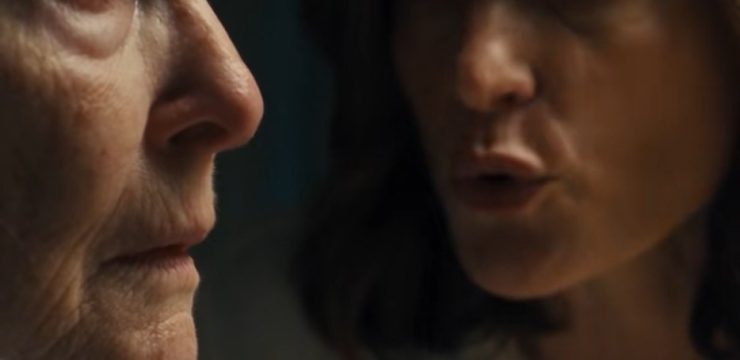
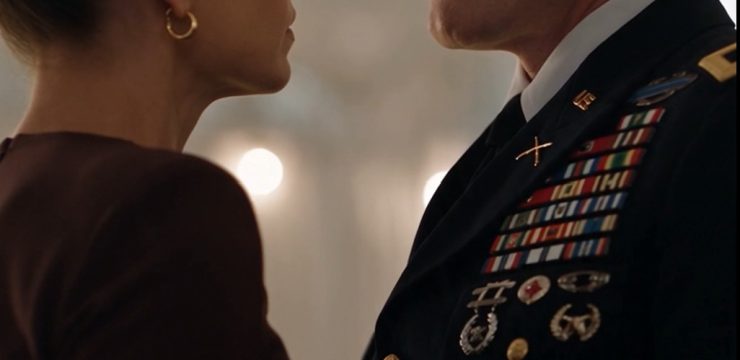
The insult landed loudly enough to turn heads.
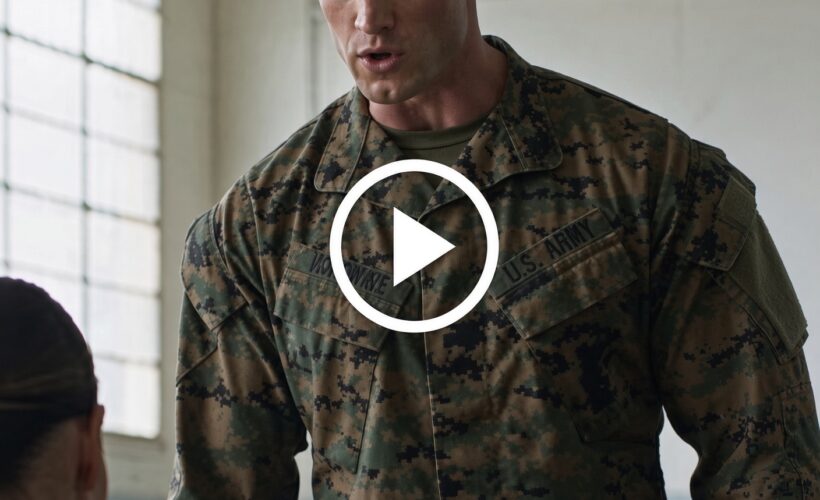
“Didn’t think they’d let someone like you eat with the rest of us.”
For half a second, the mess hall seemed to hold its breath. The smell of overcooked rice and cheap coffee still hung in the air, trays still scraped against tables, but two rows of soldiers had already gone quiet enough to hear what came next.
She gave him nothing.
Her eyes stayed on the orange in her hands as her fingers worked beneath the peel. Slow. Precise. Almost unnervingly calm, as though separating the rind from the fruit mattered more than the man standing over her.
He had walked straight to her table wearing that effortless smile—the one that suggested he was used to owning every room he entered.
Now the smile tightened.
“You always this quiet, Captain?”
She pulled another strip of peel loose.
The soft rip of citrus skin sounded strangely sharp against the low hum of the room. Juice slipped over her thumb, catching the fluorescent light before disappearing against her hand.
She didn’t wipe it away.
Four soldiers at the next table had stopped pretending not to watch. One leaned back slightly. Another hid a grin behind his coffee cup.
They were waiting.
Maybe for her to embarrass him.
Maybe for something worse.
But the Captain remained still, and somehow her silence began doing more damage than any comeback could have.
His weight shifted.
Only slightly.
Enough to show that he felt it.
The grin stayed on his face, but it no longer looked natural. His eyes flicked briefly toward the soldiers nearby before returning to her.
Then he leaned closer.
Not enough to touch her. Just enough to make the conversation feel private.
“I heard what happened last week.”
Her fingers stopped.
One second.
That was all.
But everyone watching noticed.
The muscles along his jaw tightened as though he had finally found the crack he had been searching for. He seemed ready to push harder, to turn whatever he knew into another joke.
Instead, she calmly removed the last piece of peel.
She separated one bright orange slice from the fruit and placed it on her tray.
Carefully.
Deliberately.
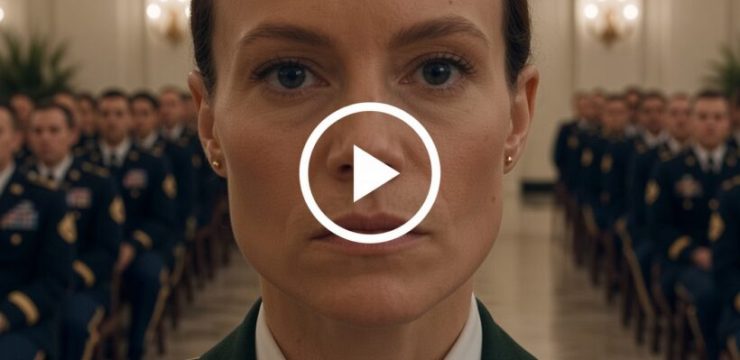
Only then did she raise her head.
Her eyes met his.
Ice-blue. Steady. Completely unreadable.
Something changed in his face.
The confidence didn’t disappear all at once. It drained away in pieces—the slight curl of his mouth, the looseness in his shoulders, the careless amusement in his eyes.
She stared at him as though she wasn’t seeing the man standing in front of her.
She was seeing everything behind him.
Everything he thought was buried.
Everything he had assumed nobody in this building could possibly know.
The mess hall faded around them.
Forks stopped moving. Conversations dissolved into murmurs and then silence. Even the soldiers who had been grinning moments earlier were no longer smiling.
He swallowed.
Her expression didn’t change.
No anger.
No fear.
That seemed to unsettle him most.
He opened his mouth, probably reaching for another sarcastic remark, something that could drag the moment back onto familiar ground.
Nothing came.
His eyes searched hers.
For recognition.
For confusion.
For anything that would tell him he still controlled what was happening.
He found none of it.
When he finally spoke again, the swagger was gone from his voice.
What remained was quieter.
And far more dangerous.
“You remember me, don’t you?”
She didn’t answer.
Not yet.
She simply held his stare while the silence stretched between them, heavy with something none of the soldiers around them understood.
For the first time since he had entered the mess hall, he no longer looked like a man enjoying himself.
He looked like a man who had suddenly realized this encounter had started long before he walked through that door.
And whatever she said next was going to change everything. 👇
Her thumb pressed into the orange slice until a bead of juice appeared along its edge.
“I remember your voice.”
The words were barely louder than a breath, but the man straightened as though she had struck him.
She set the slice down.
“I remember hearing it over the radio when you ordered the team to keep moving.”
His face tightened.
Nobody at the neighboring table moved.
“You have me confused with somebody else.”
“No.”
One word.
Quiet. Certain.
His eyes darted toward the doorway now.
That was when one of the four soldiers rose from the next table.
The scrape of his chair against the floor was painfully loud.
The man glanced at him. “Sit down.”
The soldier didn’t.
A second chair scraped backward.
Then a third.
Then the fourth.
For the first time, the Captain looked away from the man in front of her and toward them.
There was no triumph in their faces.
Only nerves.
One soldier’s hands were trembling badly enough that he tucked them behind his back.
The man laughed once, but there was no humor in it.
“What is this?”
The Captain stood.
She was not especially tall, but the movement changed the entire room. The man instinctively stepped back, and that single step seemed to surprise him more than anyone else.
“Last week,” she said, “Private Mason told you the route wasn’t cleared.”
His jaw flexed.
“You told him to continue anyway.”
“That isn’t what happened.”
“He told you twice.”
The soldier with trembling hands looked at the floor.
Then he spoke.
“Three times, sir.”
The man turned toward him.
The expression that crossed his face lasted less than a second, but everyone saw it.
Not confusion.
Recognition.
“You need to be very careful,” he said.
The soldier’s breathing changed.
The Captain moved between them.
“No. He doesn’t.”
The man stared at her.
She reached into the breast pocket of her uniform and removed a folded sheet of paper.
She did not hand it to him.
“You changed the written sequence after Mason was taken to medical. You said he ignored instructions.”
“That’s what happened.”
“Then you asked four soldiers to sign the revised statement.”
No one breathed.
He looked at the four men behind her.
One of them slowly shook his head.
“We signed it,” he said. “At first.”
The man seized on the admission immediately.
“There. You heard him.”
“But we kept the first one.”
The man froze.
The soldier swallowed.
“The original.”
Something in the room broke.
Not loudly.
There was no shout, no dramatic crash. Just a visible collapse in the confidence of a man who had spent too long believing fear was the same thing as loyalty.
The Captain watched him understand.
The first report still existed.
So did the radio log.
And the four men he had counted on to remain frightened were standing together now.
His eyes returned to her.
“This is about before.”
Her face changed then.
Only slightly.
But the hurt underneath the calm finally became visible.
“Yes.”
He shook his head quickly. “That was years ago.”
“I know.”
“You can’t prove anything from years ago.”
“I’m not trying to.”
That stopped him.
She drew a slow breath.
“I spent years wondering whether I should have spoken sooner. Whether I remembered it wrong. Whether I had any right to accuse someone everyone else trusted.”
His mouth opened.
She continued.
“Then I heard you on that radio last week.”
His face lost color.
“Same voice. Same words. Same way of making everyone around you believe the danger belonged to somebody else.”
One of the soldiers glanced toward her.
The Captain’s hand had begun to tremble.
She closed it around the edge of the table.
“I knew exactly who you were.”
For the first time, the man stopped pretending.
His expression hardened.
“So what? You built this because you’ve been holding a grudge?”
“No.”
She looked toward the four soldiers.
“They built it.”
The mess hall doors opened.
Two senior officers entered with a military investigator behind them.
Nobody said anything as they crossed the room.
The man stared at them, then at the Captain, and finally at the soldiers who had risen from their table.
His voice dropped.
“You set me up.”
The Captain shook her head.
“I gave you every opportunity to tell the truth.”
“You think they’re going to believe you?”
“I’m not asking them to believe me.”
She placed the folded paper on the table between them.
“I’m asking them to read both reports.”
The investigator picked it up.
The man’s eyes followed the paper.
Then something ugly flashed across his face.
He turned toward the trembling soldier.
“You have any idea what you’ve done to your career?”
The soldier flinched.
The Captain did not.
She stepped sideways until the man could no longer see him without looking through her.
“That,” she said quietly, “is what you’ve been counting on.”
The investigator asked the man to come with him.
He didn’t move.
For several seconds, he simply stood there, surrounded by the silence he had once known how to control.
Then he looked at the Captain.
“You think this fixes anything?”
Her eyes remained on his.
“No.”
The answer seemed to surprise him.
“It doesn’t fix Mason’s injuries. It doesn’t erase the report you changed. And it doesn’t give back the years people spent wondering whether they were weak because they were afraid of you.”
She paused.
“It just means you don’t get to do it again.”
His shoulders dropped.
It was small.
Almost invisible.
But everyone in the room saw the moment his power disappeared.
He left between the officers without another word.
Nobody cheered.
That surprised the Captain.
She had imagined that moment more than once, though she would never have admitted it. In those private versions, justice had always sounded louder.
Instead, there was only the hum of the ventilation system and the distant clatter of someone setting a tray down in the kitchen.
The trembling soldier sat first.
His knees seemed unable to hold him anymore.
The Captain returned to her chair.
Her orange was still waiting on the tray.
For a while, none of them spoke.
Then the soldier beside her whispered, “I’m sorry.”
She looked at him.
“For signing it.”
His eyes remained on the table.
“I knew it wasn’t right.”
Another soldier swallowed hard.
“So did I.”
The Captain looked at all four men.
“You changed it.”
The first soldier blinked.
“That doesn’t make what we did okay.”
“No.”
She let that answer sit between them.
Then she added, “But courage that comes late is still courage.”
The young man rubbed both palms against his trousers and nodded once.
It was the first time his hands stopped shaking.
The investigation moved quickly once the original statement surfaced.
The radio transmission confirmed the order Mason had described. Time stamps contradicted the revised report. Other soldiers, seeing four men step forward together, began giving statements of their own.
Patterns appeared.
Threats disguised as jokes.
Orders rewritten after the fact.
Mistakes pushed downward toward people too junior to argue.
None of it had begun last week.
But last week was when it finally stopped.
The Captain was called into the command office three days later.
She stood beneath harsh white lights while a colonel closed a thick folder on the desk.
“You understand this may bring questions about the earlier incident too.”
“Yes, sir.”
“And if it does?”
She stared at the folder.
For years she had believed surviving meant keeping certain memories sealed tightly enough that they could no longer reach her.
She finally understood that silence had not buried them.
It had only given them more room.
“Then I’ll answer.”
The colonel studied her for a moment.
Then he nodded.
Months later, the findings became final.
The man lost his position, his authority, and eventually the uniform he had used as protection for far too long.
The official record no longer blamed Mason.
The four soldiers had their statements corrected.
And the Captain’s account of the earlier incident was formally attached to the investigation—not as rumor, not as an emotional accusation, but as part of a documented pattern that could no longer be dismissed.
Mason returned to the unit before winter.
He moved carefully at first, one hand occasionally drifting toward the place along his ribs that still bothered him.
The first morning he entered the mess hall, conversations went quiet.
Mason stopped.
“So this is weird.”
A few soldiers laughed.
The tension broke.
The Captain stood near the coffee station.
Mason walked toward her carrying something behind his back.
“You planning to salute or attack me?” she asked.
“Neither, ma’am.”
He revealed a small paper bag.
Inside were six oranges.
She stared at them.
Mason smiled.
“My mother sent them.”
The Captain’s expression shifted.
“Why?”
“Because I told her about the orange.”
She frowned.
“What orange?”
“The one Thompson left on your tray that morning.”
Her eyes moved toward the table where the four soldiers had been sitting months earlier.
Thompson, the soldier whose hands had trembled, suddenly became intensely interested in his coffee.
The Captain looked back at Mason.
“He left it?”
Mason nodded.
“They knew that guy was coming into the mess hall.”
Her gaze returned to Thompson.
He finally looked up.
“We didn’t know if we could testify yet,” he said. “We were scared.”
His mouth tightened with embarrassment.
“So the orange was all we could manage.”
She said nothing.
Thompson gave a helpless little shrug.
“My grandmother used to say you don’t make important decisions hungry.”
A laugh escaped the Captain before she could stop it.
Not a polite laugh.
A real one.
Several people turned.
She covered her mouth briefly, eyes suddenly bright.
All those months, she had remembered that orange as the object she had used to stay calm while a dangerous man tried to provoke her.
She had never known it was already an act of solidarity.
Before any of them had found the courage to stand.
Before the original report appeared.
Before the truth had become safe enough to say aloud.
Someone had quietly placed a piece of fruit on her tray and hoped she would understand that she was not alone.
She looked at Thompson.
“You could have told me.”
He smiled.
“You looked busy.”
Mason laughed.
Even the Captain shook her head.
She took one orange from the bag and handed another to Thompson.
Then one to each of the other three soldiers.
They sat at the same table where everything had begun.
This time nobody watched from a distance.
Mason complained about the coffee.
Thompson argued that hospital coffee was worse.
Someone stole two orange slices from the Captain’s tray and received a look severe enough to make the entire table laugh.
Outside, pale morning sunlight stretched across the base, warming the frost along the windows.
Inside, the mess hall smelled exactly as it always had—overcooked rice, cheap coffee, citrus.
But nothing about it felt the same.
The Captain peeled the last orange slowly and passed the pieces around the table until there was only one slice left in her hand.
She looked at the soldiers beside her.
No trembling hands.
No lowered eyes.
No one waiting for permission to speak.
She ate the final slice, leaned back in her chair, and listened as their laughter filled the room that had once gone silent with fear.
For the first time in years, she did not feel the need to watch the door.