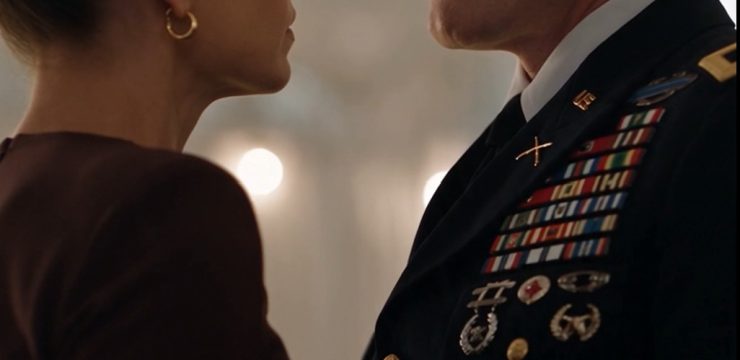
The grand hall seemed to stop breathing the moment the microphone clicked on.
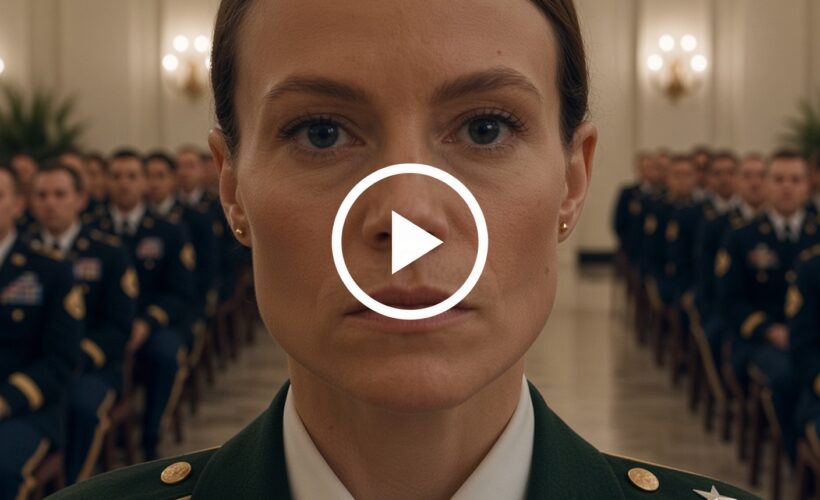
Hundreds of decorated officers sat beneath the bright ceremonial lights, medals catching gold across their uniforms, while one woman remained perfectly still in the center aisle—carrying a truth her own family had never bothered to see.
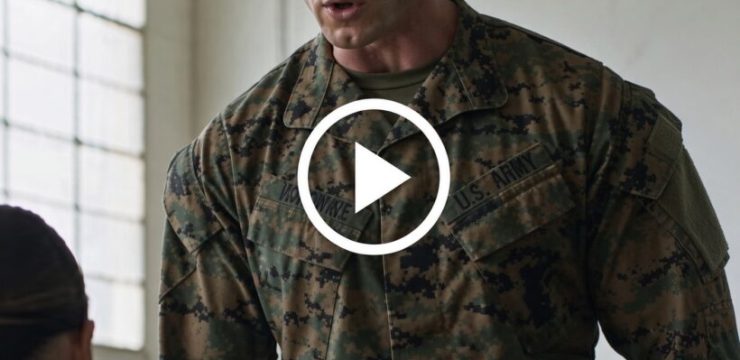
Major Emily Carter stood at attention with her jaw tight and her eyes fixed ahead. Behind her, her mother leaned close enough that no one else could hear.
“Don’t embarrass your brother today.”
Emily gave no reaction.
No argument. No wounded glance. Not even the smallest movement of her shoulders.
She simply kept looking forward.
At the podium, her brother stood beneath the lights as another ribbon was presented to him. Their mother immediately moved toward the stage, her entire expression changing the closer she came to her son.
Pride softened her face in a way Emily had rarely seen directed toward her.
Their mother took the ribbon herself and carefully pinned it to his uniform. Her fingers lingered against his chest while she admired the result.
“Now that is what an officer should look like.”
A quiet murmur of approval passed through the hall.
Emily heard every word.
Her white-gloved hands remained folded neatly in her lap when she finally sat again. Nothing in her face revealed whether the comment had hurt her—or whether she had simply heard too many versions of it to be surprised anymore.
Her brother turned after leaving the podium.
His eyes found Emily almost immediately.
He approached her through the rows of chairs, leaning slightly toward her once he was close enough to speak without drawing attention.
“Mom says you’re being transferred.”
Emily looked at him.
For the first time that morning, something almost unreadable crossed her expression.
“She doesn’t know why I’m here.”
His brows tightened.
Before he could ask another question, a sharp electronic click echoed from the speakers.
Every conversation stopped.
The official at the microphone looked down at the prepared remarks, then out across the room.
“There is one officer whose identity has been withheld until this morning.”
A subtle shift moved through the audience.
Heads lifted.
Officers glanced toward the podium and then toward one another, searching for some hint of what was coming.
Emily’s mother remained near the front, still carrying the confidence of someone certain this ceremony belonged to her son.
Then the voice from the speakers continued.
“Major Emily Carter.”
Silence fell so suddenly that even the smallest movement seemed loud.
Her mother froze.
The smile disappeared from her face.
For several seconds, she did nothing but stare.
Emily’s brother looked from the podium to his sister, his expression changing as the meaning of the announcement began to settle over him. The pride he had carried only moments earlier seemed to fracture into confusion.
Emily never looked at either of them.
She sat with her hands still folded, gaze slightly raised, almost as though she had known the exact words long before anyone else in the hall was allowed to hear them.
Her mother took one uncertain step forward.
The microphone came alive again.
This time, the official’s voice was quieter.
Heavier.
“Please stand.”
Chairs scraped across the floor.
Not one or two.
Hundreds.
All around Emily, officers rose together until the entire grand hall was standing.
She remained seated for one heartbeat longer.
Then another.
Her brother stared at her.
Their mother’s face had gone pale.
Emily finally placed both gloved hands against the arms of her chair and rose slowly to her feet.
In that instant, the room seemed to understand something her family had missed completely: Emily had not come to watch her brother’s moment.
She had been waiting for one of her own.
Her brother whispered her name, barely loud enough to hear.
“Emily…”
She did not turn.
She faced the flag, shoulders straight, expression controlled, while the official at the podium lowered his eyes toward the next line of the announcement.
And when he opened his mouth to reveal what came next, nobody in Emily Carter’s family was prepared for the order that would change everything they thought they knew.
The official did not speak immediately. He let the silence settle until even the rustle of fabric disappeared, then lifted the order in both hands.
“By authority of the Department of the Army, Major Emily Carter is promoted to lieutenant colonel, effective immediately, and is assigned command of the 17th Joint Support Battalion.”
A breath moved through the hall like wind through tall grass.
Emily’s mother pressed one hand to her mouth. Her brother stared at the new insignia waiting on a velvet tray beside the podium, then back at Emily as if he were trying to fit this woman into every version of his sister he had ever believed.
The official continued. The assignment had been restricted until the conclusion of a classified overseas operation Emily had helped coordinate. Her transfer had never been a demotion.
Then came the sentence that broke something deeper than surprise.
“And before we proceed, there is one correction to the record.”
Her brother’s shoulders tightened.
The official glanced toward him. “The commendation presented earlier this morning was restored to the final ceremony program after Major Carter identified an omission in the original action report and submitted supporting documentation through the proper chain of command. She requested that the recognition proceed without reference to her involvement.”
Her mother turned slowly toward her son.
The ribbon she had pinned so proudly seemed suddenly heavier on his chest.
Emily closed her eyes for half a second. That was the only sign that she had not wanted this part said aloud.
Her brother’s voice barely carried. “You did that?”
Emily met his eyes at last. “You earned it.”
Nothing more.
The hall erupted into applause, but the sound landed strangely around the three of them. Her mother clapped once, then stopped, her hands falling apart at her waist. Her brother did not clap at all. He simply watched Emily walk toward the podium.
Two senior officers removed the major’s insignia from her shoulders and replaced it with the silver oak leaves of a lieutenant colonel. Emily stood motionless while the room rose again. When she turned to face the audience, the microphone waited inches from her mouth.
She could have said anything.
Her mother knew it. So did her brother.
Emily looked across the sea of uniforms, then toward the two people who had spent the morning assuming she was there to stand quietly in somebody else’s shadow.
“I’m grateful for the trust placed in me,” she said. Her voice was calm. “And I’m grateful to serve beside people whose work deserves to be seen, whether or not anyone is watching when they do it.”
Her brother lowered his head.
Emily stepped away from the microphone.
She did not punish them publicly. Somehow, that made the silence afterward harder to bear.
The ceremony ended beneath a swell of music and formal handshakes. Officers crowded around Emily with congratulations. Her mother remained near the front row, stranded beside an empty chair.
When the last photographer moved away, she finally approached.
“Emily.”
Emily turned.
Her mother’s lips parted, but no words came. Up close, the confidence from earlier was gone. She looked smaller, not because anyone had humiliated her, but because there was nowhere left to hide from what she had done.
“Why didn’t you tell me?” she finally asked.
Emily’s face did not harden. That would have been easier.
“You never asked.”
Her mother flinched.
“I thought the transfer meant—”
“I know what you thought.”
Her brother stepped beside them. “Mom, stop.”
She turned sharply, instinctively ready to defend herself, but he shook his head.
“No. Don’t explain it into something smaller.” His fingers touched the ribbon on his chest. “You told everyone I was the one carrying the family name. You made me believe she was falling behind.”
“I was proud of you.”
“You were proud of me by making her less.”
The words struck cleanly.
For years, their mother had kept distance between her children through comparison. In that bright hall, the structure finally collapsed because neither child would hold it up anymore.
Her mother looked at Emily. “I didn’t know.”
Emily’s breath left slowly.
“That’s the problem.”
Her mother’s eyes filled, but Emily did not rush forward to comfort her.
“I kept thinking if I became good enough, you’d stop comparing us,” Emily said. “Then I realized there was no rank, no assignment, no ceremony that could fix something I didn’t break.”
Her brother looked away, jaw working.
“I helped,” he said quietly. “I liked being the easy one to be proud of.”
Emily turned toward him.
He swallowed. “I should have asked what was happening with you. I should have noticed how quiet you got whenever Mom started talking about us like we were competing.”
For a moment, Emily seemed ready to dismiss it. Then her shoulders lowered by a fraction.
“You were a kid in it too,” she said. “But we’re not kids anymore.”
He nodded.
Their mother wiped beneath one eye with the side of her finger. “Tell me what to do.”
Emily looked toward the stage, where staff were already collecting programs from the empty chairs.
“Don’t make me teach you how to love me fairly.”
The sentence left no room for performance.
Her mother stared at the floor.
Then, quietly, she said, “Okay.”
It was not forgiveness. It was not repair. But it was the first answer she had given all day that did not contain an excuse.
Her brother reached for the ribbon at his chest as though he might remove it.
Emily caught his wrist.
“Don’t.”
He looked at her.
“You earned that.”
His eyes reddened. “And you made sure I got it.”
“I made sure the record was accurate.”
A broken laugh escaped him. “You really can’t let me have one dramatic moment, can you?”
For the first time that morning, Emily smiled.
It was small. Tired. Real.
Later, in the corridor outside the hall, the senior officer who had made the announcement handed Emily a sealed folder containing her command orders. Her brother noticed a handwritten note clipped to the outside.
He read the first line, then looked at her in disbelief.
It was Emily’s original scheduling request from weeks earlier. She had asked that her brother’s commendation remain before the command announcement and that their mother be permitted to participate in pinning it.
“You planned that?” he asked.
Emily glanced toward their mother, who had gone very still.
“It was your day too,” she said. “I didn’t want my news to take your moment away.”
Her mother’s face folded.
Not dramatically. No sob. No collapse.
Just a woman understanding that the daughter she had warned not to embarrass her brother had quietly protected his proudest moment before her own.
She sat on the wooden bench against the wall and covered her mouth.
Emily did not rescue her from that realization.
But she did not walk away either.
Months passed without miracles. Their mother learned to call without beginning with news about the other sibling. She learned to ask Emily about her command and listen through the answer. When she slipped into comparison, her son stopped her. When apologies became too broad, Emily asked for specifics.
Some conversations ended early. Others lasted until the coffee went cold.
The repair was slow enough to be believable.
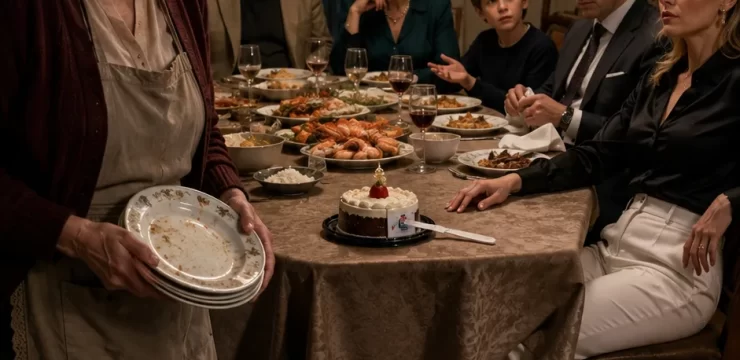
On a quiet Sunday evening, Emily returned home in civilian clothes and found her brother already setting plates on the dining table. Their mother stood near the mantel, adjusting two framed photographs.
One showed her son receiving his ribbon.
The other showed Emily beneath the flag as the silver oak leaves were placed on her shoulders.
The frames were identical.
Their mother noticed Emily looking at them and stepped back without explaining.
Her brother followed Emily’s gaze and smiled faintly.
“No ranking system?” he asked.
Their mother gave him a warning look, then surprised all three of them by laughing.
Emily laughed too.
At dinner, nobody discussed who had achieved more. Her brother complained about terrible coffee at his post. Emily told a story about a new lieutenant who had saluted the wrong person in a parking lot and spent ten minutes trying to recover his dignity. Their mother listened, asked questions, and did not turn either story into a comparison.
When the plates were empty, she reached across the table, hesitated, then rested one hand between her children rather than on either of them.
Emily looked at her brother.
He placed his hand there first.
Emily covered both of theirs with hers.
No medals. No podium. No room full of witnesses.
Just three hands on an old dining table, two framed uniforms standing side by side across the room, and for the first time in years, no one in the family was being asked to stand in someone else’s shadow.