The water hit like a wall of black ice — and the last voice she heard before the lake swallowed her whole belonged to her own son.
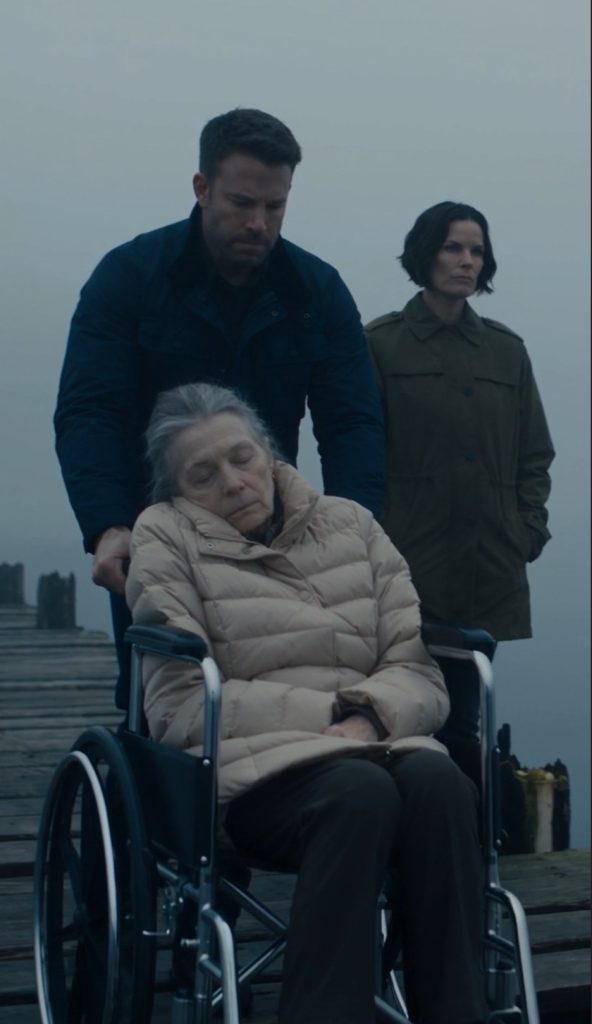
Eight months. That’s how long she had sat perfectly still in that wheelchair, letting them believe the woman she used to be had already disappeared. Head tilted. Hands limp. Eyes unfocused. A body taking up space in a house that no longer felt like hers.
It was the easiest lie she ever told — because she never said a word.
Derek and Amanda didn’t bother whispering anymore. They talked openly at the kitchen table, shuffling papers, circling account numbers, rehearsing what they’d say to the lawyers. Eleven million dollars sat in accounts with her name on them, and her son had already started spending it in his mind.
She heard everything. The complaints. The impatience. Amanda’s voice cutting through the hallway late at night — “How much longer do we have to do this?”
And Derek, her boy, the child she had carried and raised and believed in more than anyone else on this earth — saying nothing back. Which was its own kind of answer.
Still, some stubborn, foolish corner of her heart held on. Not Derek. Not really. He wouldn’t cross that final line.
Then came the afternoon they loaded her into the van without explanation.
The wheelchair jolted along an uneven dirt path. Wind from the lake hit her face first — wet wood, cold air, the distant sound of birds she hadn’t heard in years. Her chest tightened. She knew this place. She had once loved this place.
The dock groaned under the weight of the wheels. Amanda stepped ahead, glancing back with a look that held nothing. No guilt. No hesitation. Just arithmetic.
“She’s barely awake,” Amanda said flatly. “Do it now.”
Derek didn’t move. Not right away. He crouched beside the chair and leaned close, and for one desperate, flickering second, she saw him — really saw him. The boy who used to run into her arms after school. The teenager whose nightmares she’d sit through until dawn. The young man whose tuition she’d paid without ever asking for a single thing in return.
His breath was warm against her ear.
“I’m sorry, Mom.”
Something deep inside her collapsed — not her body, but the last wall she’d built to protect herself from this exact moment.
Then the wheelchair tilted forward.
Sky became water. The dock rose above her head. And the lake took her down.
Cold crushed in from every direction. The chair dragged her deeper, pulling her into darkness while bubbles streamed past her face and her soaked clothes turned to dead weight around her limbs. Her lungs screamed. Her chest locked.
But worse than the cold, worse than the water flooding her ears — was the sound that drifted down from above.
Amanda’s voice. Muffled. Calm.
“She’s gone.”
A pause. Then — steady, satisfied, final:
“The eleven million is ours.”
Silence followed. The kind of silence that exists only underwater, where the world above stops mattering and all that’s left is what lives inside you.
And something did live inside her. Something they had never bothered to look for.
Before the illness. Before the wheelchair. Before Derek and Amanda reduced her to a signature and a bank balance — she had been a swimmer. Not casual. Not recreational. A competitor. A woman who had cut through water before sunrise for decades, whose lungs had been trained to hold when everything else gave out.
Her fingers moved first. Then her legs tightened. Muscle memory fired faster than thought — her body already knew what to do before her mind caught up.
The wheelchair sank into blackness below her.
And in the freezing dark, forty feet beneath the surface, she opened her eyes.
Her arms swept wide. One stroke. Then another. The cold tried to lock her muscles, but her body refused — each pull sharper than the last, each kick driving her upward through water so dark it felt like swimming through ink.
Her lungs burned past anything she had ever known. Not the clean burn of morning training laps, but something deeper, something animal. The kind of fire that exists only when the body understands it is choosing between movement and death.
She didn’t swim toward the dock. She angled sideways, toward the tree line on the far shore where tangled roots hung low over the water. Sixty yards. Maybe seventy. A distance she had once covered in under a minute.
Now it felt like crossing an ocean.
Her head broke the surface between two fallen branches, and she gasped — a raw, shattered sound that tore through her throat and echoed across the empty water. She clung to a root with fingers so numb she couldn’t feel the bark, pressing her face against the wet wood while her chest heaved and her vision swam.
On the far side of the lake, two figures stood at the edge of the dock. Amanda had already turned away. Derek hadn’t. He was staring at the water where the wheelchair had gone under, his hands hanging at his sides, perfectly still.
She watched him from behind the branches. And for the first time in eight months, she let herself feel every single thing she had been holding back.
Not just the betrayal. Not just the grief. But the rage.
It took her twenty minutes to pull herself onto the bank. Her legs barely worked. Her soaked clothes weighed more than her body, and the cold had turned her skin the color of ash. But she crawled through the mud and the dead leaves until she reached the tree line, and then she kept going.
Three hundred yards from the lake, a county road cut through the forest. She had driven it a hundred times when she was well. She collapsed at the shoulder, shivering so violently her teeth cracked against each other.
A pickup truck slowed. Then stopped. A man in a flannel jacket climbed out and froze when he saw her.
“Jesus — ma’am, are you —”
“Call 911,” she said. Her voice was barely a whisper. “And don’t let anyone know I’m alive.”
The paramedics wrapped her in thermal blankets in the back of the ambulance. She gave them one name: Detective Helen Marsh, a woman she had contacted in secret three months earlier — long before the dock, long before the lake. Long before Derek and Amanda believed they had won.
Because she hadn’t simply been listening for eight months.
She had been recording.
A small device taped beneath the armrest of her wheelchair. Every kitchen-table conversation. Every whispered plan. Every account number spoken aloud. Every time Amanda said “once she’s gone” like she was discussing an expired lease. Every time Derek said nothing at all.
Detective Marsh had the files. All of them. Fourteen hours of audio that no lawyer in the country could explain away.
By the time Derek and Amanda returned home that evening, three squad cars were already in the driveway. Amanda saw them first. She stopped the van at the end of the street, and through the windshield Derek watched an officer step off the porch holding a folded warrant.
Amanda reached for the gearshift. Derek grabbed her wrist.
“Don’t,” he said quietly.
It was the first honest word he had spoken in months.
They were arrested separately. Amanda screamed — not in fear, but in fury, the sound of someone realizing the math had finally failed. Derek said nothing. He sat in the back of the cruiser with his head bowed while an officer read him his rights, and his hands trembled the entire time.
The trial lasted eleven days. The recordings played in a silent courtroom. Jurors listened to Amanda’s voice discussing timelines and account transfers with the calm efficiency of someone planning a kitchen renovation. They listened to Derek’s silences — the places where a son should have spoken and didn’t.
Amanda received twenty-two years. Derek received fourteen. The judge paused before reading his sentence and looked at him for a long time, as if trying to understand something that couldn’t be understood.
She was in the courtroom for all of it. Not in a wheelchair. Not slumped or tilted or pretending. She sat upright in the third row wearing a dark blue dress, her hands steady in her lap, and she did not look away from her son — not once — while the verdict was read.
Derek glanced back at her only at the very end, as the bailiff guided him toward the side door. His lips moved, but no sound came out. She read the shape of the word anyway.
Mom.
She didn’t respond. She didn’t nod. She simply held his gaze until the door closed between them, and then she sat alone in that courtroom for a very long time, listening to the silence fill the space where her family used to be.
The months that followed were the quietest of her life. She sold the house. She moved to a small cottage near the coast, a place with wide windows and salt air and a dock that looked out over nothing but open water.
She swam every morning.
Not competitively. Not to prove anything. Just slow laps in the bay at sunrise, her arms pulling through water that was warmer than the lake, her lungs filling easily, her body remembering what it had always known.
It was during one of those mornings — mid-stroke, halfway between the dock and the buoy — that she noticed a letter sitting on the porch railing when she came back in. No return address. Prison postmark.
She almost didn’t open it.
She sat on the porch with a towel around her shoulders and held the envelope for nearly ten minutes, watching the light change over the water, before she finally slid her finger beneath the seal.
Inside was a single sheet of paper. Derek’s handwriting — shaky, uneven, nothing like the confident script she remembered from his college years.
It said: “You were the strongest person I ever knew, and I spent years pretending you weren’t because it made what I was doing feel smaller. I don’t expect you to forgive me. I just needed you to know — when I said I was sorry on that dock, I meant it. I just wasn’t brave enough to stop.”
She folded the letter and placed it on the railing beside her coffee.
She didn’t cry. She didn’t write back. Not that day.
But she didn’t throw it away, either.
Six months later, on a Tuesday morning so ordinary it almost didn’t feel real, she walked into the water again at sunrise. The bay was glass. The sky was pale gold. A heron stood motionless at the far end of the dock like it had been waiting for her.
She floated on her back and stared up at the sky and breathed.
Not because she had to. Not because her body was fighting to survive.
Just because she could.
And for the first time in longer than she could remember, the water didn’t remind her of what she had lost. It reminded her of who she had always been.