The music cut out mid-song. Fourteen people froze in my living room, every one of them staring at me like I’d committed a crime.
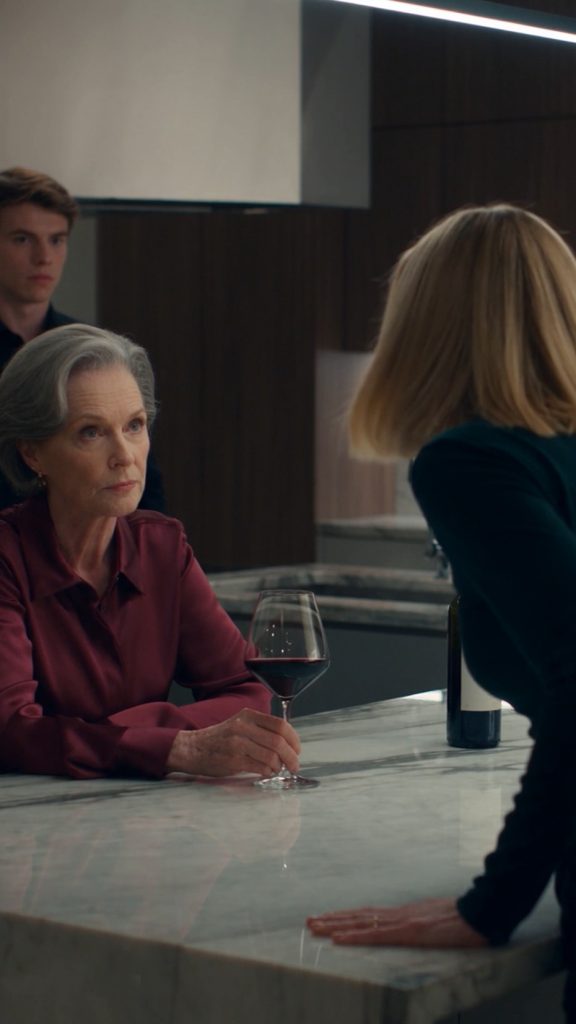
“Where have you been, you useless old woman? My family is starving, and there’s no dinner on the table!”
The words hung in the air. Somewhere behind me, a champagne glass touched down on wood, and that tiny clink sounded like a gunshot.
My son appeared in the kitchen doorway, his face drained of color. He knew. His wife had just crossed a line she could never uncross.
I was sitting at the kitchen island with half a ribeye, roasted asparagus, a slice of sourdough, and a glass of cabernet. The oven was cold. The counters gleamed.
No roast beef. No potatoes. No green beans, no warm rolls, and certainly no chocolate cake from Harper’s favorite bakery.
Because no one had ever asked me to cook for fourteen people.
I lifted my glass and took a slow sip. Then I met her eyes.
“Are you finished?”
Her mouth fell open.
I was sixty-eight that New Year’s Eve. And the house she was screaming in belonged to me, every board and every brick.
David and I bought it thirty-one years ago, just outside Columbus. We refinished the oak floors together. He built the bookshelves in the den with his own hands. I planted the maple by the patio the summer Liam turned eight.
The mortgage was long paid off before David passed. For a while, the silence in those rooms nearly swallowed me. But slowly, I built a life again: my garden, my books, my church friends, Wednesday breakfasts with old coworkers.
I wasn’t lonely. Not until I let them in.
Three weeks after the honeymoon, Liam came to see me alone. He sat across from me and couldn’t quite hold my gaze.
“Our lease is up next month, Mom. We just need a little time to save for a down payment.”
I already knew. “You want to stay here.”
“Temporarily. Four months. Maybe six.”
He was my only child, and I had the room. So I said yes, until the end of December. But I had rules. They would buy their own groceries, clean up after themselves, and ask before bringing crowds into my home.
Harper respected those rules for exactly one week.
Then her shoes began multiplying in the hallway. Dirty dishes piled in my sink. She rearranged my cabinets without a word, then started talking about new curtains, new paint, and which walls should come down to “open things up.”
Every time, Liam had an answer.
“She’s just trying to help.”
“She’s excited.”
“Mom, please. Don’t make it a big deal.”
I’d heard that sentence his whole life. As a boy, he dodged every fight. As a teenager, he once took the blame for something someone else had done, because silence felt easier than the truth.
For years, I called it kindness. I finally understood that kindness without courage becomes permission.
And Harper had taken every inch of it.
Four months earlier, I would have leapt off that stool. I would have apologized, torn through the freezer, and turned her poor planning into my emergency. I used to believe keeping everyone happy was the same as keeping the peace.
But peace that requires one person to keep swallowing disrespect isn’t peace.
It’s surrender.
Behind Harper, her mother Brenda folded her arms, lips pressed tight in borrowed outrage. Liam still wouldn’t look at me.
Harper stabbed a finger toward the empty dining table. “You knew everyone was coming!”
“No,” I said quietly. “You assumed.”
Something flickered across her face. “What?”
“You assumed I would cook.”
The room went silent again. I watched the truth reach her slowly: no one was coming to rescue her party.
Then I looked past her at my son, and I finally saw it clearly. This night had never been about dinner.
For four months, Harper had walked through my home like an heir measuring her inheritance. Tonight, I had decided her rehearsal was over.
I set down my glass, and every eye in the room followed my hand.
Nobody in that house was ready for what I said next. 👇
“It’s eleven-oh-four,” I said, glancing at the clock above the stove. “In fifty-six minutes, it will be January first. Our agreement ends tonight.”
Harper let out a sharp, disbelieving laugh. It bounced off the cold oven and died there. “Agreement? Liam. Tell her.”
Liam didn’t move. His hand was pressed flat against the doorframe, as if the house might tip without him holding it.
It was Brenda who spoke next, and her voice had lost its edge. “What agreement? Harper told us you begged them to move in. She said you were going into a retirement community this spring. That you were signing the house over to them.”
The words landed one at a time. I felt each of them.
I slid off the stool, opened the drawer beside the sink, and took out a folded sheet of paper. I had found it the week before, face-down in the printer tray, and I had carried it in my chest every day since.
“This is an estimate from a contractor,” I said, handing it to Brenda. “For taking down the wall between my kitchen and my dining room. Start date, February. Look at the line that says property owner.”
Brenda read it. Her lips moved without sound. Then her hand began to tremble, and the paper rattled softly in the silence.
“Harper Powell,” she whispered.
“It was just a quote,” Harper snapped. But her eyes went to her mother, then to her uncle, then to the cousins standing near my bookshelves, and I watched her realize that none of them were looking at me anymore.
Her uncle quietly set his champagne glass on a coaster. His wife reached for her coat.
“Liam.” Harper’s voice cracked into something smaller. “Say something.”
My son finally stepped into the kitchen. The light over the island caught the gray already starting at his temples, and for a strange moment I saw David standing there, thirty years younger, gathering himself before something hard.
“You told me she offered to cook,” he said slowly. “You told me she was excited to have everyone here.”
Harper’s jaw tightened. “Does it matter?”
“It matters.” He swallowed. “I told her not to make it a big deal. For four months. And every time, you were the one making it bigger.”
She stared at him as if he’d slapped her. “If you let her humiliate me like this, don’t bother following me out that door.”
The refrigerator hummed. Someone’s phone buzzed on the coffee table and nobody touched it.
I didn’t speak. This was the moment I had wanted for most of his life, and I understood, standing there with my hands folded against my stomach, that I could not do it for him. I had done too many things for him already.
Liam looked at me. Not for permission. Just to see me.
Then he turned back to his wife.
“She didn’t humiliate you, Harper,” he said. “You did this. And I’m done taking the blame for things I didn’t do.”
Something in her face collapsed. Not into tears, but into a stillness that was worse, the look of a person watching a story she had told over and over finally stop working.
She went upstairs without another word. We listened to drawers slamming, to the zipper of a suitcase catching and tearing free.
Brenda set the contractor’s estimate on my counter and smoothed it flat with her palm, as if she were apologizing to the paper. “I’m so sorry,” she said, and her voice broke on the last word. “I thought I raised her better. She can stay with me.”
The relatives left in a slow, embarrassed line. Harper’s aunt stopped to squeeze my hand. A young cousin I’d barely spoken to carried the empty champagne glasses to my sink and rinsed each one before she went.
At 11:52, Harper came down the stairs with her suitcase bumping every step. She didn’t look at me. She stopped in front of Liam, waited, and when he didn’t reach for her, she walked out into the cold.
Her taillights disappeared down the street just as the neighbors’ first fireworks cracked open over the maple.
She never set foot in my house again. By spring, the story she had told fourteen people had followed her everywhere she went, and in March she was the one who filed. Nobody in her family argued.
But that night, it was only Liam and me in a kitchen that still smelled faintly of cabernet and steak.
He sat down at the island across from me, the way he had in September. Then he reached into his pocket and set something on the granite between us.
A single brass key on a paper tag.
“What is that?” I asked.
“An apartment. Two miles from here.” His voice was rough. “I signed the lease on December first. Paid the deposit from my own account. I was going to tell her tonight, after midnight. I thought with people around, she wouldn’t scream.”
I stared at the key. Then at him.
“You kept the agreement,” I whispered.
“I always meant to.” His eyes were wet. “I just didn’t have the courage to say it out loud. I’m sorry, Mom. I’m so sorry I let you stand alone.”
I came around the island and held him, and he folded against me the way he used to when he was eight years old, all elbows and silence. Outside, the neighborhood counted down. Neither of us said the numbers. We just stood in the kitchen David and I had built, breathing, while the year turned over around us.
On New Year’s morning, snow dusted the patio. Liam carried his boxes down the stairs while I made pancakes, and we ate them at the dining table standing exactly where it had always stood, beside a wall that was still whole.
In April, I dug up a small maple seedling that had sprouted in the shade of the old tree and drove it to his new place. We planted it together by his back step, our knees in the mud, laughing when he got the hole crooked.
That evening, I came home to a quiet house. The good kind of quiet.
I poured a glass of cabernet, sat on the patio beneath the maple I had planted thirty-one years ago, and watched the last light move through its new leaves.
The house was mine again.
And for the first time in a very long time, so was I.