I’ll write the continuation, picking up exactly where the story left off.
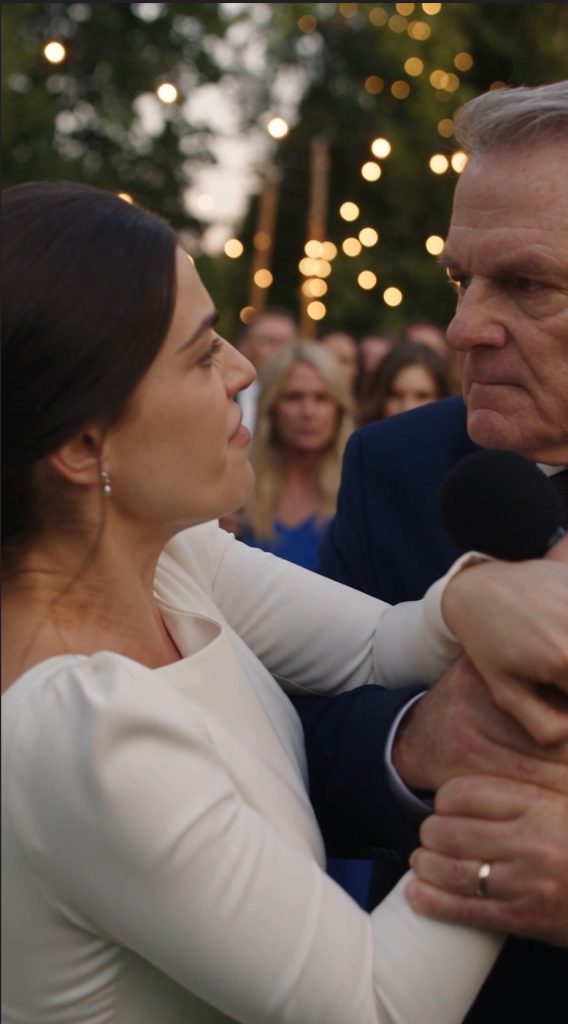
Daniel didn’t stop walking until he was close enough that I could see his jaw shaking.
“Dad, stop,” he said again, quieter this time, like the words were costing him something.
I lowered the microphone but didn’t hand it over. Behind Daniel, Vanessa’s face had gone the color of chalk. Her father Richard had set his champagne glass down on a nearby table so hard the stem cracked.
“Then explain it to me,” I said. “Explain to me why you walked past your mother lying in the mud to go comfort the woman who put her there.”
Daniel’s mouth opened. Closed. His eyes weren’t on me anymore — they were on Vanessa, and something in his expression had shifted from panic into something colder. Something that looked almost like grief.
“I wasn’t comforting her,” he said finally. “I was telling her I saw.”
The words landed strange in the air, like a piece that didn’t fit the picture yet.
“Saw what?” I asked.
Daniel reached into his jacket pocket with a hand that wasn’t quite steady, and pulled out his phone. He turned it toward me, toward the crowd, toward Vanessa, whose face had gone from chalk-white to something closer to gray.
“I filmed it,” he said. “The whole thing. I was standing behind you, Dad. I saw her walk up to Mom. I saw her say something. I heard it.”
Vanessa’s composure finally cracked. “Daniel—”
“Don’t.” His voice wasn’t loud, but it cut through the whole reception like a blade through silk. “Don’t you dare say my name like that right now.”
He pressed play. He didn’t hold the phone up for the crowd — he didn’t need to. He simply turned the volume up, high enough that the nearest guests could hear, and in the stunned quiet of two hundred people holding their breath, Vanessa’s voice came out of the small speaker, sharp and clear.
“Finally out of the way. God, I thought she’d never sit down long enough to move.”
Then the sound of the shove. The gasp. The laugh.
Margaret’s hand found mine. I felt her fingers tighten, not from fear this time, but from something closer to disbelief giving way to vindication.
“I wasn’t whispering something sweet to her,” Daniel said, turning back to me, and now his eyes were wet, and his voice cracked on the next words. “I was telling her I heard every word. I was giving her one chance to walk over to my mother, right there, in front of everyone, and apologize like she meant it. She laughed instead.”
The silence that followed didn’t feel like the awkward hush of a scene gone wrong. It felt like a held breath about to break.
Vanessa took a step back, her heels sinking into the grass, her carefully constructed bridal smile nowhere to be found now. “It was a joke,” she said, too fast, too loud. “It was a stupid — everyone was laughing, it wasn’t — Daniel, you’re twisting this—”
“I’m not twisting anything.” Daniel’s voice had steadied now, and there was something in it I hadn’t heard from my son in years — a kind of clarity, like fog burning off a field at dawn. “You’ve been doing this for months. The comments about Mom’s cane. The thing you said about her dress not being ‘photogenic enough.’ The bracelet.”
Margaret’s breath caught beside me.
“You knew about the bracelet?” she whispered.
Daniel looked at his mother, and for the first time since the shove, his face softened into something achingly tender. “I heard you on the phone with Aunt Carol. I heard what Vanessa called it. I didn’t say anything because I told myself I was imagining the worst in her. I told myself marriage would make her kinder. I was wrong, and I let you carry that alone, and I am so sorry, Mom. I am so sorry.”
Margaret’s cane trembled against the grass. She didn’t speak. She didn’t need to — the tears sliding down her face said everything her voice couldn’t manage yet.
Richard stepped forward now, his face flushed with something between anger and humiliation. “This is absurd. My daughter made a mistake, a small mistake, and you’re going to destroy her wedding day over a video clip taken out of context—”
“Out of context?” I said, and I finally understood why my hands weren’t shaking anymore. Somewhere in the last two minutes, the fear had burned away and left only clarity behind. “Richard, your daughter shoved a sixty-eight-year-old woman into the mud and laughed while she was down. There is no context that fixes that.”
Richard opened his mouth, then closed it, because even he seemed to hear how hollow his own defense sounded once it left his throat.
Vanessa turned in a slow circle, looking at the guests around her — the aunts, the coworkers, the college friends, all of them staring at her now with expressions she had clearly never expected to see turned on her. Whatever mask she had worn for the cameras and the toasts and the months of wedding planning had slipped entirely, and what was underneath it was smaller, uglier, and far more human than the poised bride who had walked down the aisle two hours earlier.
“Daniel,” she said, and her voice had lost its edge now, gone thin and pleading. “Please. We can talk about this. Not here. Not like this.”
“We can talk,” Daniel said. “But not as husband and wife.”
The words fell into the reception like a stone into still water, and the ripples moved through the crowd in a wave of gasps and murmurs.
“I’m not signing anything tonight,” he continued, his voice trembling now but not breaking. “I’m not making a scene bigger than it already is. But I am not going to spend the rest of my life with someone who thinks my mother’s pain is something to laugh at. I should have said something the first time you rolled your eyes at her. I should have said something a dozen times before tonight. I didn’t, and that’s on me. But I am saying something now.”
Vanessa’s eyes filled, and for a moment I almost felt something like pity — until I remembered the sound of that laugh, high and delighted, echoing across the lawn while my wife lay in the mud.
The pity didn’t last.
Richard grabbed his daughter’s arm, murmuring something urgent about leaving, about not making this worse, and for once Vanessa didn’t resist. The two of them moved through the parting crowd like a tide pulling back from shore, past the string lights, past the band still frozen mid-song, until they disappeared around the side of the estate toward the parking lot.
Nobody clapped. Nobody cheered. The reception simply exhaled, all at once, a collective release of breath that had been held far too long.
Daniel turned to his mother.
He didn’t say anything at first. He simply walked to her, knelt in the wet grass beside her ruined dress, and wrapped both arms around her the way he used to when he was small enough to need carrying. Margaret’s hand came up to rest against the back of his head, and she began to cry in earnest now, not from pain but from something that had been held in for far too many months.
“I’m sorry,” he kept saying, into her shoulder, over and over. “I’m sorry I didn’t see it sooner. I’m sorry I let her make you feel small.”
“You saw it,” Margaret whispered, her voice thick. “You saw it tonight. That’s what mattered.”
I stood over the two of them, my jacket still draped around my wife’s shoulders, mud drying against the pale blue fabric, and felt something in my chest finally loosen after months of quiet, polite tension.
Later, long after the guests had gone and the string lights had been switched off one section at a time, the three of us sat together on the back steps of Briarwood Estate, looking out at the lake gone dark and silver under the rising moon.
Daniel had already called a lawyer friend, already begun the quiet, unglamorous work of unwinding a marriage that had lasted less than a single afternoon. There would be papers. There would be awkward conversations with relatives who had traveled for nothing. There would be a long road of untangling gifts and vendors and a wedding album no one would ever want to open again.
But none of that mattered in the moment we were sitting in.
Margaret leaned her head against my shoulder, her cane resting across her knees, her hand finding Daniel’s on the step below us.
“I kept telling myself I was protecting the peace,” she said quietly, watching the water. “I didn’t realize I was just protecting her cruelty.”
“You’re not protecting anything anymore,” Daniel said. “Neither of you have to.”
We sat there a long while, not needing to say much else. The lake was still. The night was cool. Somewhere behind us, someone had left one string of lights on, and it glowed faintly gold against the dark trees, the last small piece of a wedding that had ended before it ever really began — and the first quiet evening of something that finally, truly, felt like home.