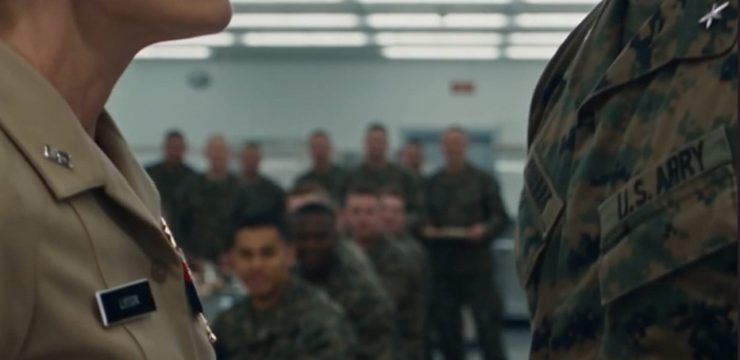
Three dark military vehicles were approaching.
A fourth vehicle followed behind.
Their movement was controlled and deliberate.
Not part of the training exercise.
Derek frowned.
“Who scheduled that convoy?”
No one answered.
He looked toward a sergeant.
“Sergeant Collins.”
“Yes, sir?”
“Who’s coming in?”
“I don’t know, sir.”
“You don’t know?”
“No, sir.”
The lead vehicle slowed at the gate checkpoint, then rolled through without stopping for inspection — a privilege reserved for exactly one kind of visitor.
Derek’s hand drifted toward his collar, adjusting it out of habit, the way men do when they sense they are suddenly being watched by someone who matters.
Sophia didn’t move. She stood with the damaged folder pressed against her chest, water still darkening her jacket, and for the first time since the confrontation began, something like calm settled over her features. Not relief. Anticipation.
The convoy pulled into the gravel lot beside the administration building. Doors opened in sequence, controlled, practiced. Four officers stepped out first, forming a loose perimeter without seeming to try. Then came a fifth figure, older, silver at the temples, three stars catching the morning light on her shoulder.
Derek’s face drained of color.
“That’s—” Sergeant Collins started, then stopped himself.
“General Whitfield,” Derek finished, the name coming out smaller than he meant it to.
The general did not walk toward the administration building. She walked toward the training field. Toward the scattered papers still lifting in the wind. Toward Sophia.
Derek straightened his uniform, smoothing invisible wrinkles, arranging his face into something professional. He had done this a hundred times before — the transformation from tyrant to model officer in the space of a breath. It had always worked.
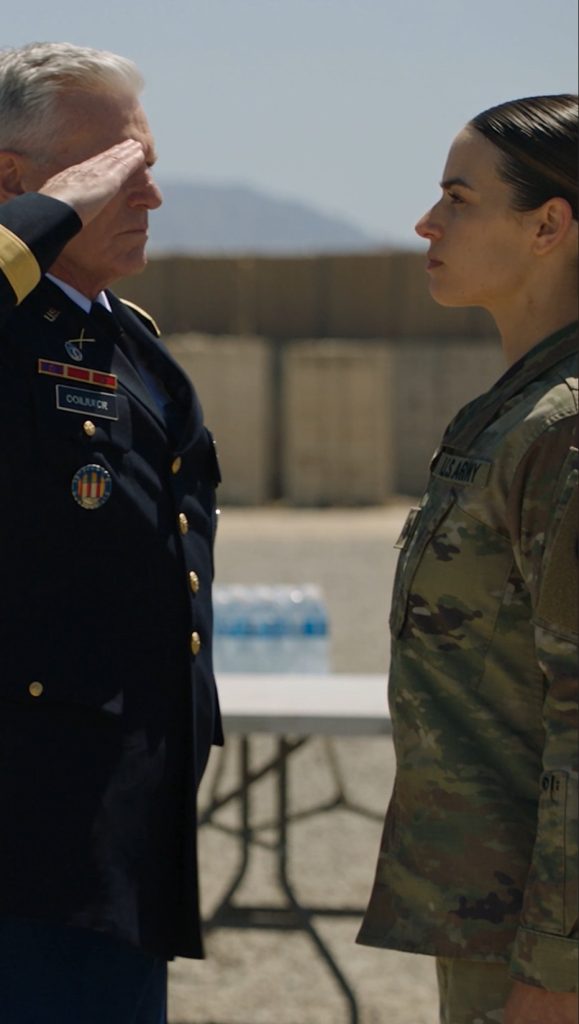
“General Whitfield,” he said, saluting sharply. “We weren’t informed of an inspection visit.”
The general didn’t return the salute right away. Her eyes moved past him, to the folder in Sophia’s hands, to the torn nametag still lying in the dirt, to the soldiers standing too still, too quiet, in a pattern she had seen a thousand times in her career — the specific silence of people who are afraid to speak.
“Lieutenant Reed,” the general said. “Report.”
Derek’s jaw tightened. He hadn’t heard that name spoken with that particular weight before. Reed. Not Sophia. Not lieutenant holding paper. Reed, the way you say a name when you already know exactly who’s attached to it.
Sophia stepped forward and handed over the folder without a single tremor in her hand. “General, the field evaluations for this unit’s training cycle. Several original documents were damaged during the review.” She paused, and the pause was deliberate, surgical. “Captain Mason kicked the table they were resting on.”
A murmur passed through the gathered soldiers, quiet as wind through grass.
“That’s not — ” Derek started.
“I have witnesses,” Sophia said, not raising her voice, not needing to.
The general opened the folder. Her eyes moved down the torn page, the one stamped that morning, the one Derek had assumed was routine. Her expression didn’t change. That was somehow worse than if it had.
“Captain Mason,” the general said, “do you know what these evaluations are for?”
Derek’s mouth opened. Closed. “Routine assessments, ma’am.”
“They’re not routine.” The general closed the folder slowly. “They’re the third-party review requested after this unit filed four separate misconduct complaints against you in the past six months. Complaints this office was told had been resolved at the company level.” She looked up. “By you.”
The color left Derek’s face entirely now.
“Lieutenant Reed was sent by my office,” the general continued, “specifically because soldiers under your command were too afraid to speak on the record. She was assigned to observe. Quietly. Without your knowledge.” A beat. “You made that unnecessary within the first hour.”
Somewhere behind Derek, a private exhaled — the kind of breath a person holds for months without realizing it.
Derek turned toward Sophia, something desperate flickering behind his eyes. “You — you were sent to spy on me.”
“I was sent to find the truth,” Sophia said. “You handed it to me.”
The general’s expression hardened. “Every soldier on this field just watched you strip a fellow officer of her nametag, destroy controlled federal documents, and physically endanger her with that chair.” She turned to the assembled soldiers. “Did I describe that correctly?”
Silence. Then, slowly, a staff sergeant near the equipment rack stepped forward. “Yes, ma’am. That’s exactly what happened.”
Another soldier followed. Then another. Voices that had been swallowed for months finally finding air, finally finding a room where speaking wouldn’t cost them anything.
Derek stood in the middle of it, watching the ground open beneath him, watching every soldier he’d frightened into silence finally stop being afraid.
“General, I can explain—”
“You’ll explain to the board,” she said. “Captain Mason, you’re relieved of command, effective immediately. Escort him to processing.”
The two officers who’d arrived with her moved forward. Derek’s shoulders dropped, some invisible weight finally settling into the truth of what was happening. He looked at Sophia one last time, searching for something — anger, maybe, or an apology he didn’t know how to ask for.
She only looked back at him, steady, unshaken, the way she had all morning. Not cruel. Just finished.
As they led him away, the training field seemed to exhale as one body. Shoulders that had been braced for months finally lowered. A young private wiped his eyes quickly, embarrassed, and nobody looked at him for it.
The general crouched, picked up the crushed nametag from the dirt, and turned it over in her palm before handing it to Sophia. “You’ll want a new one of these.”
“Yes, ma’am.”
“You did good work today, Lieutenant. Quiet work. The hardest kind.”
Sophia looked down at the bent metal in her hand. “I just stood still, ma’am.”
“Standing still while someone shows you exactly who they are,” the general said, “is its own kind of courage. Most people flinch. You didn’t.”
Over the next hour, soldiers who had spent months swallowing their fear came forward one by one, giving statements, some of them crying halfway through, relief and shame tangled together in the same breath. Sergeant Collins admitted he’d seen worse and said nothing, and when he apologized to Sophia directly, his voice cracked on the second sentence.
She told him what she told each of them: that the silence hadn’t been weakness. It had been survival. Nobody blamed a person for surviving.
By late afternoon, the training field had changed shape entirely — not physically, but in the way people moved through it. Soldiers spoke louder. Stood straighter. Someone even laughed near the water station, a real laugh, surprised out of them before they could stop it.
Sophia sat on the edge of the damaged table as the sun dropped lower, jacket finally dry, new nametag pinned crooked because her hands were still a little unsteady with something that wasn’t fear anymore. The general found her there.
“Word will spread fast,” the general said. “About what happened here.”
“I know.”
“Some people will say you set him up.”
Sophia shook her head slowly. “I didn’t set anything up, ma’am. I just didn’t look away.”
The general allowed herself a small, rare smile. “That’s usually all it takes.”
The wind picked up the last of the scattered papers, and this time, soldiers moved to catch them without being asked — gathering the pieces of what had almost been buried, setting them gently back where they belonged, the whole field finally, quietly, breathing free.