Their laughter reached me before the door even clicked shut — and in that sound, I heard exactly how long they’d been waiting for me to die.
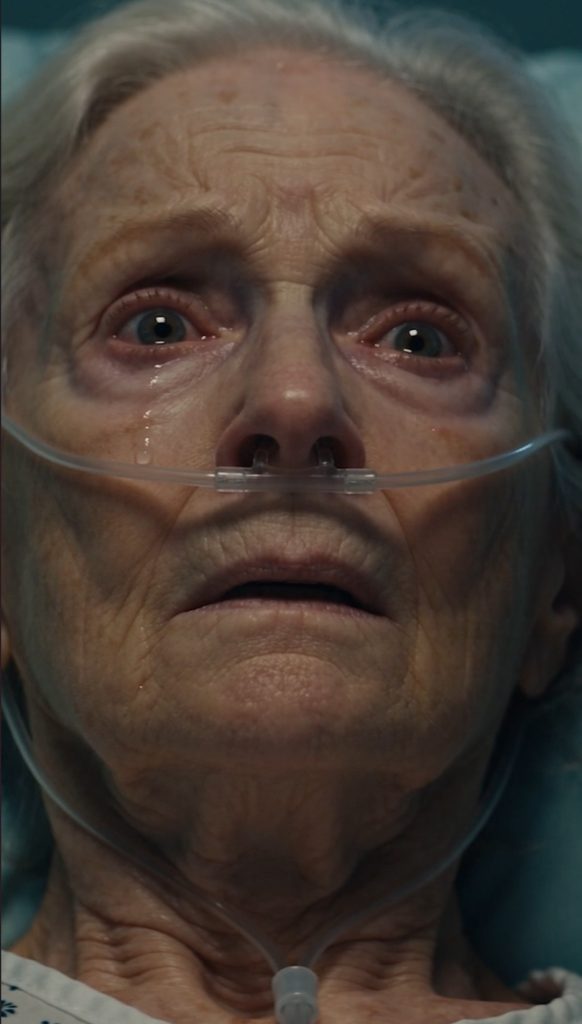
Three days. That’s what Dr. Henry told us. Three days left in a life I’d spent thirty-five years building with my bare hands.
I searched Mark’s face for grief. I found none. What I found instead was relief, dressed up badly as sorrow.
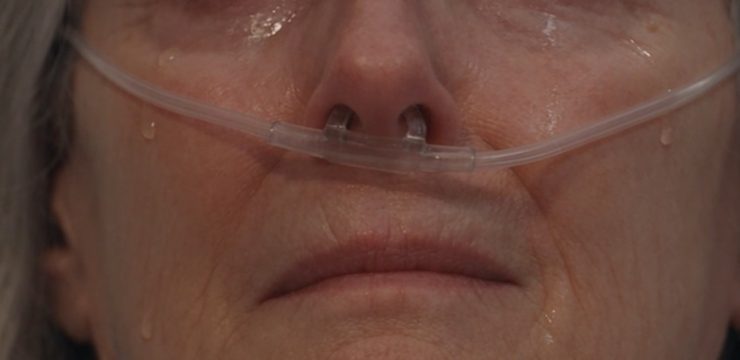
Rachel pressed her palms to her eyes, shoulders shaking in a performance of tears that never actually fell. Between her fingers, I caught the truth — dry eyes, bright with something closer to celebration than heartbreak.
The door shut. And the mask came off.
Mark leaned down, close enough that I could feel his breath against my ear. His grip on my hand wasn’t comfort. It was ownership.
“It’s finally happening, Mom. All your money will be mine and Rachel’s. It’s about time.”
I didn’t move. I didn’t breathe. I let the words land and settle somewhere deep, somewhere that would remember this exactly as it happened.
Rachel stepped closer, all pretense gone now, her voice bright and sharp as glass. “Five million dollars. The real estate portfolio. The tech stocks. It’s all ours finally. We won’t have to pretend anymore.”
Pretend. Thirty-five years of raising him alone after his father died. Eighteen-hour days. A real estate empire built from nothing but stubbornness and grief. And this — this laughter over my dying body — was the return on that investment.
“When can we start the paperwork?” Rachel asked, already halfway into the future.
“The attorney says we can move fast. She’ll probably slip into a coma in a day or two.” Mark said it the way you’d talk about a delayed flight. Then, quieter, almost annoyed: “I don’t want to keep coming here. The smell grosses me out.”
They picked apart my penthouse next — which furniture they’d keep, which they’d sell — while I lay three feet away, apparently already a memory to them.
When they finally left, I let the tears come. But underneath the grief, something else was rising. Something with teeth.
An hour later, the door opened again. This time it was Dr. Henry — my late husband’s doctor, my friend of thirty years — and something in his face had changed completely.
“Helen,” he said, closing the door with deliberate care. “I heard everything. I left the intercom on. It wasn’t an accident.”
I stared at him, my pulse climbing.
“I’ve had suspicions about Mark and Rachel for months. Three weeks ago they came asking about your condition — about what happens to your estate if… ” He didn’t finish the sentence. He didn’t need to.
“Henry. What are you telling me?”
He lowered himself into the chair beside my bed, his voice dropping to almost nothing.
“Your injuries are serious. I won’t pretend otherwise. But your organs are responding better than I expected. With rest and treatment, you have months, Helen. Not three days. I exaggerated the prognosis — I needed to see how they’d react.”
Months. Not three days.
“Why would you do that to me?” I whispered.
“Because I know what you’re capable of. And because you can’t make decisions about your legacy without knowing the truth about the people circling it.”
Then he reached for his phone, and his expression hardened into something I’d never seen on him before.
“There’s more. I had someone quietly look into Mark’s finances.” He met my eyes. “Your son has gambling debts past eight hundred thousand dollars. Rachel’s cards are maxed out. Helen — they’re desperate.”
The machines beside me kept beeping, steady and indifferent, while everything I thought I knew about my own family collapsed in the space of a single sentence.
My hand found the edge of the blanket and gripped it, because I needed something solid to hold onto while the room seemed to tilt around me.
“Show me,” I said. My voice didn’t shake. I was surprised by that.
Henry hesitated, then turned the phone toward me. Bank statements. Overdue notices. A casino membership card photographed beside a stack of markers with Mark’s signature on them. Wire transfers out of an account I didn’t recognize, an account that, when I looked closer, had my name quietly attached to it as a co-signer.
“He forged you onto a line of credit eight months ago,” Henry said gently. “I had my friend check the county records too. It’s real, Helen. It’s all real.”
I closed my eyes. Not from weakness. From the effort of holding myself together.
“I gave him everything,” I said, and for the first time since the accident, my voice cracked open. “I gave up nights, weekends, my own health. I worked myself half to death so he’d never know what it felt like to go without. And he’s been stealing from me while smiling at my bedside.”
“I know,” Henry said. “I’m sorry.”
For a long moment, neither of us spoke. Outside the window, the Miami skyline glittered against the dark, indifferent to the wreckage happening inside this one small room. I watched the lights and let myself feel every part of it — the grief, the fury, the humiliation of having been so blind.
Then something in me steadied. I had spent my whole life building things out of nothing. I could build a response out of this too.
“Henry,” I said. “I need your help with something. And I need you to trust me completely.”
He nodded without hesitation. “Anything.”
“Don’t correct the prognosis yet. Let them keep believing I have three days. I want to see exactly how far they’re willing to go.”
His jaw tightened, but he didn’t argue. “What do you need?”
“Get your investigator friend to pull everything — every transfer, every forged signature, every debt. I want it documented, dated, notarized if you can manage it. And call my attorney. Not the one Mark’s been talking to. Call David Ferris. He’s handled my affairs for twenty years, and he owes me nothing but honesty.”
Two days passed in a strange, suspended quiet. Mark and Rachel visited twice, each time performing grief for the nurses and impatience for me, checking their phones, murmuring about cruise itineraries just loud enough for me to hear. I played my part — weak, drifting, barely present — while underneath, I was wide awake, cataloguing every word.
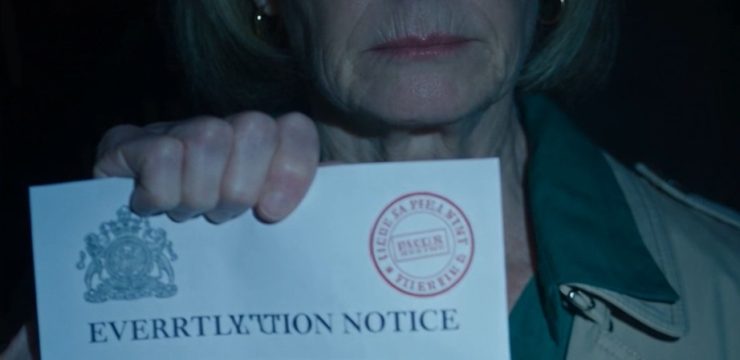
On the third day, David Ferris arrived with a leather folder and a face carved from granite. Henry had already shown him everything. He sat beside my bed and, quietly, without drama, walked me through what needed to happen next — a new will, executed that afternoon, witnessed by hospital staff, ironclad. A trust restructured so that the properties, the stocks, the accounts, would be protected from anyone who’d forged my name once already. And something else: a formal fraud complaint, ready to file the moment I gave the word.
“Are you certain?” David asked. “Once this moves, there’s no taking it back.”
I thought of Mark’s hand on mine, gripping not with love but with hunger. I thought of Rachel choosing cruise cabins over my hospital bed. I thought of eighteen-hour days and a boy I’d raised alone, and how none of that seemed to matter to either of them anymore.
“I’ve never been more certain of anything in my life,” I said.
That evening, I asked Henry to call them both in together. I told the nurse to leave the door slightly open. I wanted witnesses.
Mark and Rachel arrived within the hour, wearing their practiced faces of concern, and settled into the chairs beside my bed like people waiting for a curtain to rise.
“Mom,” Mark said, taking my hand again with that same false tenderness. “How are you feeling?”
“Clearer than I’ve felt in years,” I said.
Something flickered behind his eyes — the first crack of uncertainty.
I nodded to David, who stepped forward and opened his folder. “Mark. Rachel. I think it’s time we discussed the estate. And a few other matters.”
He laid the bank statements on the rolling table between us, one by one, deliberate as a dealer turning over a losing hand. The forged signature. The casino markers. The wire transfers routed through an account with my name quietly attached.
Rachel’s practiced sorrow drained out of her face in real time, replaced by something raw and frightened. Mark went very still, the color leaving his cheeks in a way no performance could fake.
“Mom, I can explain—”
“You forged my signature, Mark,” I said, and my voice, for the first time in days, was steady as stone. “You put my name on debt to cover a habit you never told me about. And three days ago, you stood over what you believed was my deathbed and celebrated.”
The room went silent except for the soft, mechanical rhythm of the monitor beside me — the same sound that had been counting out what they thought were my final hours.
“There is no three days,” I said. “There never was. Dr. Henry lied, because I asked him to, because I needed to see exactly who you both were when you thought no one was watching.”
Rachel’s mouth opened, but no sound came out. Mark simply stared at the papers, as though staring hard enough might make them disappear.
“The new will is signed,” David said quietly. “Witnessed and notarized this afternoon. The trust has been restructured. And Helen has authorized me to file a formal complaint regarding the forged credit line — unless she decides otherwise.”
Every eye in the room turned to me.
I looked at my son — really looked at him, past thirty-five years of memory, past the boy who used to fall asleep against my shoulder on the bus home from double shifts, past the man who had, somewhere along the way, learned to see me only as a number in a bank account.
“I’m not filing it,” I said, and watched relief flood his face before I finished. “Not today. Because I still remember who you were before this. But you will pay every cent of what you stole, on a schedule David draws up, and you will do it without touching another cent of mine until it’s repaid in full. You will get help — real help — for the gambling. And Rachel, you and Mark will find your own home, your own income, your own life, separate from mine, starting this month.”
“Mom, please—” Mark’s voice broke on the word, and for the first time in years, I saw something honest in his face. Not performance. Shame.
“I raised you to stand on your own,” I said, softer now, though the steel never left. “I should have let you do that a long time ago. I loved you so much I forgot to let you grow up. That ends today.”
Rachel said nothing at all. She simply stood, gathered her purse with shaking hands, and walked out without meeting anyone’s eyes — the cruise, the penthouse furniture, the five million dollars, all of it dissolving behind her.
Mark stayed a moment longer. He looked at me — really looked — the way he hadn’t in years.
“I’m sorry,” he said, and this time I believed him, even if belief wasn’t the same as forgiveness. Not yet.
“I know,” I said. “Come back when you mean it with your actions, not just your voice.”
He left. The room emptied. Henry sat back down beside me, and for a long while neither of us spoke.
“You did the right thing,” he finally said.
“I don’t feel triumphant,” I admitted. “I feel like I buried a version of my son today.”
“Maybe,” Henry said gently. “Or maybe you finally gave him the chance to become someone worth being proud of. Sometimes love looks like consequences.”
Months passed differently than either of us expected. My body healed slower than my heart, but it healed. Mark entered a gambling recovery program — quietly, without asking for credit, without asking for money. He wrote me letters instead of texts, actual handwritten pages, admitting things he’d never said aloud. Rachel filed for divorce three weeks after leaving that hospital room; it turned out the debts, and the desperation, had been more hers than his to begin with.
On a warm evening nearly a year later, I sat on the balcony of my penthouse — the one they’d once planned to sell — watching the sun bleed gold and pink across the water. There was a knock at the door. Mark stood there, thinner, steadier, a small velvet box in his hand.
“It’s not money,” he said quickly, catching the look on my face. “It’s Dad’s watch. I found it in storage. I thought — I thought you should have it back. I’m not ready to be trusted with things like that yet. Maybe I never will be. But I wanted you to know I understand that now.”
I took the watch, turned it over in my palm, felt the weight of thirty-five years pass quietly between us.
“Sit with me,” I said, and patted the chair beside mine.
He did. And for the first time since the accident, since the whispered words that had once shattered me, we simply sat together in the fading light, saying nothing, needing nothing — a mother and a son, finally, honestly, home.