Something inside the black bag moved.
For one terrible second, the nurse standing closest to the soaked Labrador thought exhaustion was playing tricks on her. Then the plastic shifted again beneath the straps across his back, and every instinct in her body screamed that this dog had not come to the hospital by accident.
Only minutes earlier, the emergency department had been almost unnaturally quiet.
Rain hammered against the windows, turning the streetlights outside into pale, trembling smears behind the glass. Water rushed along the pavement in silver sheets, and the storm had swallowed most of the usual city noise.
Inside, the night shift was dragging toward its final hours.
One nurse worked through patient files with tired eyes. Another leaned over a stack of unfinished paperwork. Two others spoke quietly near the reception desk, their voices low, almost automatic, the way people talk when they are too exhausted to carry a real conversation.
Nothing seemed wrong.
Then a bark exploded through the entrance.
Heads snapped up.
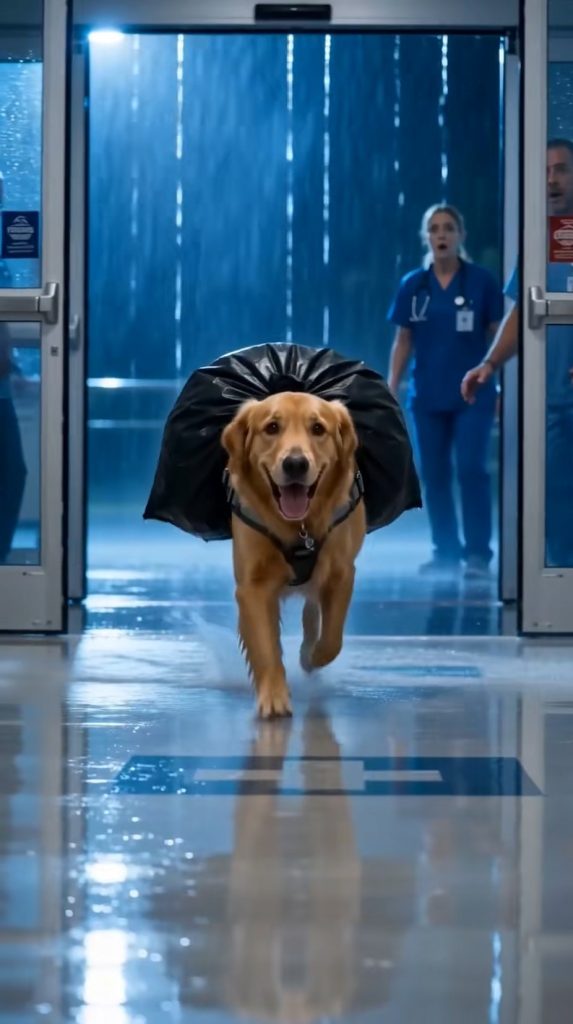
The automatic doors opened, and a large yellow Labrador burst into the emergency department, drenched from nose to tail.
Rainwater streamed from his fur and scattered across the polished floor. His chest rose and fell violently as though he had been running for a long time. His paws slipped on the wet tiles, but he caught himself and pushed forward.
There was something strapped tightly across his back.
A huge black plastic bag.
The security guard reacted first.
“Hey! Stop! Get that dog out of here!”
A chair scraped sharply against the floor as one of the nurses stood.
“Who let a dog into the ER? Someone take him outside.”
But the Labrador refused to leave.
He barked again.
Not with aggression.
With panic.
The sound was raw enough to change the mood in the room.
He rushed toward the reception desk, stopped, then spun back toward the entrance. He stared through the open doors into the storm before turning toward the nurses again.
Back to the door.
Back to them.
Again.
Again.
It was almost as if he were trying to lead someone somewhere.
The guard stepped closer and reached for his collar.
The Labrador dodged sideways.
His claws skidded across the floor. He barked harder, eyes wide, body trembling beneath the weight strapped to his back.
“Easy,” someone murmured.
The storm cracked outside.
For most of the staff, the explanation still seemed simple. The poor animal was terrified. Lost, probably. Maybe separated from his owner during the downpour.
But Emma had stopped listening.
Her attention had settled on the black bag.
Something about the way it rested against the Labrador’s body felt wrong.
Too heavy.
Too carefully secured.
And then she saw it.
A small movement beneath the plastic.
Emma’s breath caught.
She stared harder, afraid to blink.
Nothing.
Maybe she had imagined it.
She had been working for hours. Everyone was exhausted. The fluorescent lights were harsh, the storm was loud, and her mind was begging for sleep.
Then the bag moved again.
This time there was no mistake.
Emma slowly raised one hand.
“Wait.”
The guard froze.
“Don’t touch him.”
Her voice had changed.
Quiet now.
Serious.
The Labrador stopped barking almost instantly.
The sudden silence felt heavier than the noise had.
He turned his head and looked directly at Emma.
There was something in his expression she couldn’t explain. Fear. Exhaustion. Desperation.
Almost relief.
Emma stepped around the desk.
The dog didn’t run.
She came closer, one careful step at a time, while rainwater continued dripping from his coat and pooling beneath his paws.
Nobody spoke.
Even the guard lowered his hands.
Emma crouched beside the Labrador and reached toward the straps holding the black bag against his back.
Her fingers trembled as she loosened the first one.
Then the second.
The Labrador stood perfectly still.
Emma swallowed, gripped the edge of the wet plastic, and slowly began to open it.
A nurse behind her whispered, “Oh my God…”
And Emma looked inside.
Her entire body went rigid.
Nobody in that emergency room was prepared for what came next. 👇
A tiny hand slipped from beneath a soaked gray blanket.
Emma tore the plastic wider.
Inside the bag was a baby girl, no more than a few weeks old, wrapped in two blankets and a blue sweatshirt already saturated at the edges. Her lips carried a faint bluish color. Her eyes were closed.
For half a second, nobody moved.
Then Emma’s training took over.
“Pediatric bay. Now.”
The room erupted.
A nurse grabbed the infant while another called for the emergency physician. The black bag fell open on the floor, spilling rainwater across the tiles. The Labrador lunged after the baby, whining sharply until Emma placed one hand against his chest.
“She’s going with us,” she whispered. “I promise.”
The dog stared at her.
Then, trembling, he sat.
Behind the curtains, monitors began chirping. Warm blankets appeared. Oxygen. Gloved hands. Quiet commands spoken with frightening speed.
Emma remained beside the stretcher until the physician looked up.
“She’s breathing.”
Only then did Emma realize she had been holding her own breath.
The Labrador lay outside the treatment bay with his chin on his paws, soaked fur darkening the floor beneath him. Every time the baby made a sound, one ear lifted.
But something still bothered Emma.
The dog had kept running toward the entrance.
Back to them.
Back to the storm.
“He wasn’t only bringing her here,” Emma said.
The security guard looked at her.
“He wanted us to follow him.”
The Labrador’s head lifted at the word.
Emma crouched and picked up one of the wet straps. Tied beneath it was a small red collar tag she hadn’t noticed before.
MAX.
On the reverse was a phone number.
She dialed.
A phone began ringing from inside the black bag.
Everyone turned.
Emma reached beneath the discarded blankets and pulled out a cracked cell phone sealed inside a clear sandwich bag. The screen was spiderwebbed, but still lit.
There were seventeen missed calls from one name.
DANIEL.
And beneath them, an unsent voice recording.
Emma pressed play.
At first there was only rain.
Then a woman’s shaking voice filled the room.
“If anyone finds her… please don’t give her to Daniel.”
Emma’s fingers tightened around the phone.
“He said he’d take her away if I left. He said nobody would believe me. Max knows the way to the hospital. I taught him on our walks because I knew someday I might need—”
A violent sound cut through the recording.
A door slamming.
The woman gasped.
Then the audio ended.
The Labrador was already standing.
“Call the police,” Emma said.
Twenty minutes later, officers followed Max into the storm.
He ran ahead through flooded streets, stopping every few yards to look back and make sure they were still there. Emma went with them despite the charge nurse telling her she had already done enough.
She knew that wasn’t true.
Max led them three blocks away, then down a narrow service road behind a row of apartment buildings.
He stopped beside an overturned trash bin.
A woman lay half-hidden near a concrete stairwell.
Barefoot.
Bruised.
Barely conscious.
Max pressed himself against her as paramedics rushed forward.
Her eyelids fluttered.
“My baby…”
Emma knelt beside her.
“She’s alive.”
The woman’s face crumpled.
Not dramatically. No scream came.
Just one broken breath as her fingers found Max’s wet fur.
“You did it,” she whispered.
The Labrador closed his eyes beneath her hand.
Her name was Rachel.
By sunrise, she and her daughter were both patients in the same hospital.
And Daniel had found them.
Emma saw him before Rachel did.
A tall man in a dark coat strode through the emergency entrance, rain shining on his shoulders. His expression carried none of the frantic confusion of a frightened husband searching for his family.
He looked angry.
“Where is my wife?”
Max rose from beneath Emma’s chair.
A growl vibrated low in his throat.
Daniel stopped.
His eyes moved from the dog to Emma.
“That’s my dog.”
“No,” Emma said quietly. “I don’t think he believes that.”
Daniel’s jaw tightened.
“I’m taking my wife and daughter home.”
Two police officers stepped from the corridor.
“You’re not taking anyone anywhere.”
For the first time, something changed in Daniel’s face.
Not fear.
Calculation.
He recovered quickly.
“This is ridiculous. My wife has been unstable since the baby was born. She ran away during a storm. I’ve been searching everywhere.”
Emma thought of the recording.
The bruises.
The black bag.
Then Rachel appeared at the end of the corridor in a wheelchair.
Her face went white when she saw him.
Daniel softened instantly.
“Rachel.”
She stopped breathing.
He took one step toward her.
Max moved between them.
“Come on,” Daniel said, almost gently. “Enough of this. Let’s go home.”
Rachel’s fingers clenched around the wheelchair blanket.
Emma stood beside her but didn’t touch her.
This choice had to belong to Rachel.
Daniel stretched out his hand.
“You know how this looks. Tell them you fell. Tell them you panicked. We can fix this.”
Rachel stared at his hand.
Then she looked at Max.
At the mud still dried around his paws.
At the dog who had carried her child through a storm because she had once taught him the route to the hospital.
Her chin lifted.
“No.”
Daniel’s hand dropped.
The softness vanished.
“You have no idea what you’re doing.”
Rachel’s voice shook.
“Yes, I do.”
An officer stepped forward.
Daniel laughed once, without humor.
“You have nothing.”
Emma reached into her pocket.
“The phone survived.”
Silence.
Daniel’s eyes snapped toward her.
Rachel turned slowly.
Emma held up the cracked phone.
“And so did the recording.”
The color drained from Daniel’s face.
That was the moment his power broke.
Not when the officer reached for his wrists.
Not when Rachel’s neighbor arrived with photographs she had secretly taken of earlier injuries.
Not when investigators discovered the messages Daniel had sent threatening to take the baby if Rachel ever tried to leave.
It broke when Rachel watched him realize she was no longer afraid enough to protect him.
“You did this,” he said to her.
Rachel’s hands stopped trembling.
“No,” she answered. “You did.”
The handcuffs closed.
Daniel said her name once more.
She didn’t look at him.
The elevator doors shut behind the officers, and the corridor became so quiet that Emma could hear the fluorescent lights humming overhead.
Rachel covered her mouth.
Her shoulders folded inward.
Emma knelt beside the wheelchair.
For several seconds, neither woman spoke.
Then Rachel whispered, “Can I see her?”
Her daughter was sleeping beneath a warm hospital blanket when Rachel entered the pediatric room.
Max walked beside the wheelchair.
The baby’s color had returned. One tiny fist rested near her cheek.
Rachel reached into the bassinet and touched one finger to the child’s palm.
The little hand closed around it.
Rachel bowed her head.
Max rested his muzzle against her knee.
Emma turned away, giving them the privacy of a few quiet seconds that belonged only to a mother, her child, and the dog who had refused to abandon either of them.
Rachel remained in the hospital for several days.
The investigation grew beyond the night of the storm. The photographs, messages, recording, medical records, and testimony from neighbors gave investigators what Rachel had once believed she would never have: proof.
Daniel could no longer rewrite what had happened behind closed doors.
Rachel no longer had to carry the truth alone.
But there was one question Emma couldn’t stop thinking about.
“How did you get the baby onto Max?” she finally asked.
Rachel looked toward the Labrador sleeping beside the window.
“I didn’t.”
Emma frowned.
Rachel’s eyes filled.
“When Daniel came back, I knew I had seconds. I put her inside the waterproof bag and left it open on the bedroom floor while I tried to get to the phone.”
She paused.
“I never strapped it to him.”
Emma stared at Max.
Rachel gave a trembling smile.
“The straps were from his old hiking harness. I kept them beside the closet.”
The room became very still.
“He did that himself?”
“Not exactly.”
Rachel reached into the bedside drawer and removed a folded photograph.
In it, Max sat beside an elderly man wearing a red hiking jacket. Across the dog’s back was the same harness, carrying a small supply pack.
“My father trained rescue dogs for twenty-seven years,” Rachel said.
Emma looked at the photograph.
“Max was his last one.”
Rachel nodded.
“My dad died two years ago. Before he got sick, he taught Max to carry emergency supplies and follow marked routes. After Dad died, I kept walking Max past this hospital. I’d point at the doors and say, ‘Help.’ Every time.”
Her voice broke.
“I thought I was teaching him where I might run someday.”
She looked toward the sleeping dog.
“But maybe my father had already taught him what to do when someone couldn’t run.”
Emma lowered her eyes to the photograph.
For the first time since that terrible night, she had no words.
Months passed.
Rachel moved into a small apartment across town with her daughter, Lily.
There were no slammed doors there.
No footsteps that made her body tense.
No phone hidden beneath a mattress.
On warm mornings, sunlight spilled across the kitchen floor while Lily sat in a high chair banging a spoon against the tray and Max waited hopefully underneath.
The court case ended with Daniel held accountable for the violence and threats the evidence had exposed. Rachel attended the final hearing with Emma sitting quietly behind her.
When they walked outside afterward, Rachel stopped on the courthouse steps.
The sky was clear.
She looked upward for a long time.
Then she exhaled.
Not like someone celebrating.
Like someone finally putting down something impossibly heavy.
Emma and Rachel stayed friends.
So did Emma and Max, although Max treated their friendship as something far more official.
Whenever Rachel brought Lily to the hospital for a checkup, he pulled toward the emergency entrance until he found Emma.
The first time Lily learned to say his name, it came out as “Ma.”
Max wagged his entire body anyway.
On the anniversary of the storm, Rachel invited Emma to dinner.
The rain began softly while they ate.
For a moment, Rachel went still at the sound against the windows.
Then Lily laughed from the living room.
Max lifted his head from the rug.
Rachel looked around the apartment.
At the toys scattered beneath the coffee table.
At the framed photograph of her father beside Max.
At Emma washing two coffee cups in the kitchen as though she had always belonged there.
Rachel’s shoulders slowly relaxed.
Outside, the rain grew stronger.
Inside, Lily crawled across the rug and buried both hands in Max’s yellow fur.
The old Labrador carefully lowered himself beside her.
Rachel sat on the floor too.
Lily leaned against her mother.
Max leaned against them both.
And while rain traced silver paths down the window, Rachel rested one hand on her daughter and the other on the dog who had carried hope through the storm when she could no longer carry it herself.
This time, nobody needed to run.
They were already home.