She had walked this street a thousand times. Past the same bakery window, the same flickering streetlamp, the same rush of strangers who never looked twice at a woman carrying too much grief behind her eyes. Tonight felt no different. The city hummed around her the way it always did — indifferent, beautiful, relentless. She pulled her coat tighter and kept walking.
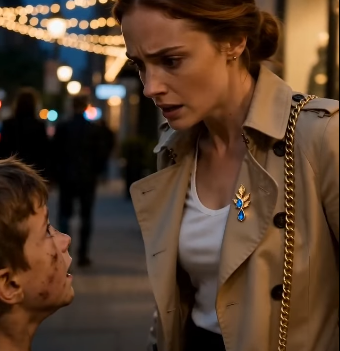
Then a small hand reached out from the crowd.
A boy. Young enough to still have baby softness in his cheeks, old enough to carry something heavy in his eyes. He held up a photograph without a single word of introduction, the way children do when they’ve been rehearsed, when someone they love has coached them through every detail of this exact moment.
She almost walked past him.
She almost didn’t look.
For one long second, the entire street stopped feeling real. Not the lights. Not the pedestrians moving around her like water around a stone. Not the warm golden reflections bending in the shop windows. Nothing registered except the photograph trembling in that small, shaking hand.
Because the woman in that photograph was her sister.
Not frozen in memory the way grief preserves people. Not the runaway her father had described with barely disguised contempt. Not the quiet tragedy the family had buried under years of silence and locked doors. The woman in the photograph was older. Worn down by time and whatever storms had found her. But unmistakably, undeniably alive.
The woman’s breath left her body in a way that had nothing to do with the cold.
“Where is she?” she asked. The words came out softer than she intended, less like a question and more like something she had been holding in her chest for years, finally cracking open on a sidewalk in the middle of an ordinary evening.
The little boy clutched the photograph tighter against his chest.
“She couldn’t come,” he said carefully, like he had practiced this too. “She said they’d watch you.”
That single sentence did something to her spine. She looked over her shoulder instinctively, scanning the crowd, measuring the distance between herself and every dark window, every passing stranger who lingered a half-second too long. Because the old fear had never truly left her. It had only been waiting politely, curled up in a corner of her memory like something that knew it would eventually be needed again.
Her father had not simply been a man who hated scandal. He had been something far more calculated than that. A man who moved people the way others move pieces on a board. Who erased inconveniences quietly and completely. When her younger sister had fallen deeply in love with a man the family disapproved of, when a pregnancy made that love impossible to ignore any longer, the family had not called it rebellion. They had called it something worse. Something that required a permanent solution.
Her sister vanished within days.
No funeral. No explanation offered to anyone outside the inner circle. No body, no grave, no space in the family story where a daughter used to stand. Just a subject that closed like a door slamming shut, and the unspoken understanding that no one would knock on it again.
She had spent years building a version of herself that believed the story they told. The one about shame and running away and a girl who chose to disappear rather than face consequences. She had almost convinced herself it was true.
But she had never taken off the pin.
A small, unremarkable thing. Something her sister had pressed into her palm years ago as a private promise between them. A symbol that required no explanation because it was never meant for anyone else to understand. She still wore it every single day, through marriages and moves and all the seasons of a life she had tried to live honestly despite what it was built on.
The boy’s voice was barely above a whisper now.
“She said you’d still be wearing yours if you still loved her.”
That line arrived in her chest like something irreversible.
She looked at the child more carefully. Really looked this time. At the shape of his cheeks. The set of his mouth. The particular way he held himself, braced against the possibility that this stranger on the sidewalk might turn away. She asked him how old he was. He answered. And the number landed with the quiet force of something that had always been true, waiting for the exact right moment to be spoken aloud.
Her lips parted again. Not from shock this time. From grief that had finally found its address.
“She’s sick,” the boy said.
There it was. The reason for all of it. Not a reunion born from sentiment or the slow forgiveness of old wounds. Urgency. Real, pressing, unmistakable urgency that had sent a child alone through a city to find a woman he had only ever known from a photograph and a name spoken in quiet rooms.
“She said if I found you,” he whispered, “you’d know where to hide us.”
And in that moment, every piece of the past rearranged itself into something she could finally see clearly. Her father was gone now, but powerful men leave systems behind them. Lawyers. Loyal shadows. Structures designed to protect old secrets long after the man himself has gone quiet. Her sister had not surfaced after all this time because of longing alone. She had surfaced because the danger was still breathing, still close enough to make running necessary again.
She knelt down right there on the glowing sidewalk, coat pooling around her, the city rushing past on all sides, and she asked him the only question that mattered now.
“Did she tell you my name?”
He nodded. One slow, certain movement. A tear traced its way down his cheek and he didn’t bother wiping it away.
“She said if I got scared, I should say it once. And you’d come.”
The beautiful, indifferent city street transformed into something else entirely in that moment. It became the place where her sister had found her again, across all those lost years, through a child and a pin and a love that had refused to stay buried no matter how many people had tried to bury it.
She took his hand.
She stood up.
And for the first time in longer than she could honestly remember, she knew exactly where she was going.