The laughter was still hanging in the air when the windows began to shake.
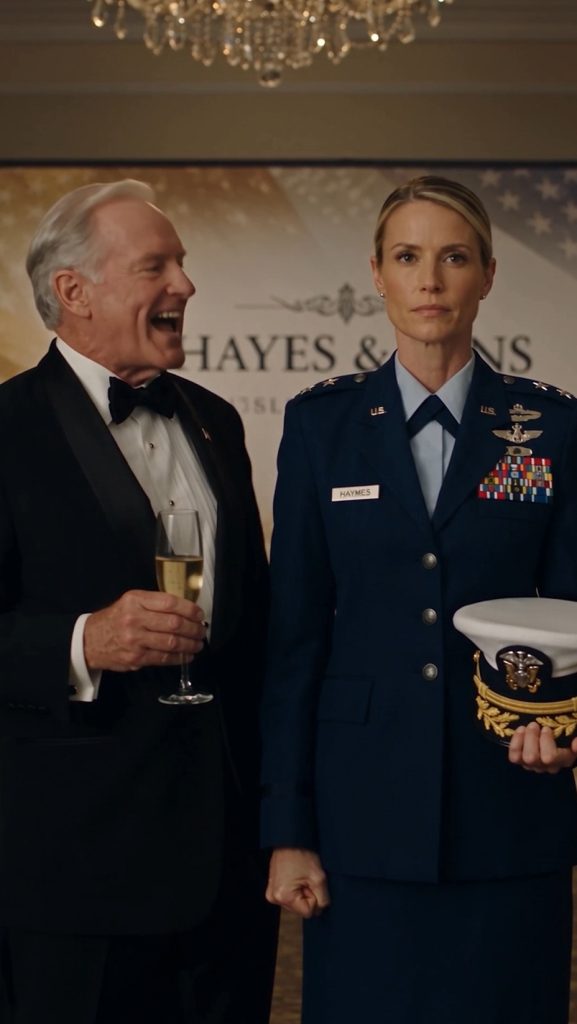
Seconds earlier, an entire room had watched a father reduce his daughter’s twenty-two years of service to a joke. Now something enormous was descending outside—and for the first time that evening, he had nothing to say.
The banquet hall had been decorated for my parents’ fiftieth anniversary, every table dressed in white linen beneath a gold banner that read:
HALF A CENTURY OF HAYES & SONS.
My mother had chosen the first half.
My father had insisted on “& Sons.”
He had one son.
Grant stood beside him in an expensive navy suit, smiling for photographs with one hand resting comfortably on Dad’s shoulder. He had never worn a uniform. Never delivered devastating news to a sailor’s family. Never stood on a ship’s bridge while black water slammed against the windows.
But in my father’s eyes, Grant was the serious child.
The heir.
I was Amelia Hayes—the daughter who had “gone Navy” and apparently forgotten to come home.
My aunt Ruth found me near the drinks table.
“Amelia, honey, are you still doing that military job?”
“Yes.”
Her expression softened into something dangerously close to pity. “And you’re almost forty now?”
“Thirty-nine.”
“Still no husband?”
Around us, several relatives suddenly became deeply interested in their glasses.
“My work keeps me busy.”
Dad heard that.
Of course he did.
“Work?” His voice carried across the room. “Come on, Amelia. Tell everybody about your boats.”
A few people chuckled.
Then the crowd shifted, opening around me as Dad approached. He slipped an arm over my shoulders and squeezed just a little harder than affection required.
“This is my daughter,” he announced proudly enough to make the humiliation worse. “She’s been in the Navy for what—fifteen years?”
“Twenty-two.”
He gave a theatrical whistle.
“Twenty-two years playing sailor.”
The laughter came easily.
That was the part that hurt.
Most of them weren’t cruel people. They weren’t trying to cut me open in public.
They were simply following his lead.
“Dad,” I said quietly.
He barely looked at me.
“I told her when she joined, didn’t I, Claire? I said, ‘Sweetheart, the military will chew you up and spit you out.’”
My mother stood beside the anniversary cake in her pale blue dress.
Our eyes met.
Her face carried the same silent plea I had known since I was seventeen.
Please don’t make this difficult.
Dad raised his glass.
“Still waiting to see if I was right.”
The room erupted again.
Something inside me became very still.
I could have told them about the strike groups I had commanded. About briefing Cabinet officials. About carrying responsibility for thousands of sailors whose families trusted people like me to bring them home.
I could have explained what it cost to earn the stars on my shoulders.
But I had spent too many years trying to make my father understand a life he had never bothered to ask about.
So I smiled.
And then the glass doors rattled.
The chandelier trembled overhead.
One by one, conversations stopped as a deep mechanical thunder rolled across the lawn.
People turned toward the windows.
A Black Hawk helicopter was dropping toward the grass.
Wind exploded through the grounds, whipping tablecloths sideways and sending flower arrangements tumbling.
My father lowered his glass.
For once, he looked genuinely uncertain.
The helicopter settled.
A side door opened.
A uniformed Marine stepped onto the lawn and moved toward the banquet hall with unmistakable purpose.
Inside, no one spoke.
He entered.
Walked past my aunt.
Past Grant.
Past my father.
Then he stopped directly in front of me.
His heels came together.
His hand rose sharply in salute.
“Admiral Hayes,” he said, his voice carrying through the silent room. “The President is waiting.”
Nobody laughed.
I slowly turned toward my father.
The color had vanished from his face, and for the first time in twenty-two years, he was looking at me as though he had never known his own daughter at all.
What happened after that salute changed everything between us. 👇
The Marine lowered his hand, but nobody in the room seemed to remember how to move.
My father’s glass trembled slightly between his fingers.
“Admiral?” he whispered.
It was almost lost beneath the thump of the helicopter blades outside.
The Marine glanced at him, then back at me.
“Yes, sir.”
Dad opened his mouth.
Grant stepped between us.
“Don’t.”
One word.
Quiet. Sharp.
Dad stared at him. “Excuse me?”
Grant’s jaw tightened.
“I said don’t. Don’t make another joke. Don’t tell her they’re exaggerating. Don’t pretend you don’t understand what you’re looking at.”
Something changed in my father’s face.
Not confusion.
Fear.
My mother saw it too.
“Richard?”
Dad looked away.
And suddenly Grant’s expression hardened.
“Oh, God,” he said.
The room remained painfully silent.
“You knew.”
My mother took one step forward. “Knew what?”
Grant turned toward her, but his eyes stayed on Dad.
“He knew Amelia was an admiral.”
The words seemed to strike harder than the helicopter landing had.
Dad’s fingers closed around his glass.
“That’s enough.”
“No.” Grant’s voice broke slightly. “It’s been enough for years.”
I didn’t move.
I could hear the helicopter outside. The clink of a spoon rolling slowly across a table. Someone breathing too loudly near the windows.
My mother looked between them.
“Richard, what is he talking about?”
Grant swallowed.
“The promotion invitation came to the office eight months ago. The ceremony. Her photograph. Everything.”
My mother’s face emptied.
“I asked you about that envelope.”
Dad said nothing.
“You told me it was Navy paperwork.”
“It was.”
“It was an invitation to our daughter’s promotion?”
Dad’s silence answered her.
My stomach tightened.
For years, I had told myself he didn’t understand.
That he simply didn’t know.
That ignorance was easier to survive than contempt.
Grant looked at me then, and shame passed across his face.
“He made me promise not to tell you I’d seen it.”
“Why?”
My voice barely sounded like mine.
Dad finally looked at me.
His eyes were wet, but his expression was still fighting desperately to remain hard.
“Because every damn thing in this family became about you leaving.”
The Marine beside me shifted almost imperceptibly.
Dad continued.
“You left at seventeen with one goal after another. Academy. Ships. Commands. Washington. Every year you came home less. Every year people asked me what my daughter was doing, and I barely knew how to answer.”
“You could have asked me.”
“You never needed us.”
The words landed quietly.
That was the wound beneath all of it.
Not disappointment.
Resentment.
I looked at him for a long moment.
“No, Dad. I needed you.”
His face changed.
“I just stopped begging you to notice.”
My mother covered her mouth.
Dad stared at the floor.
I stepped closer.
“You didn’t fail to understand my life.”
He looked up.
“You chose not to.”
The Marine spoke softly beside me.
“Admiral, we need to move.”
Duty.
Even now.
Especially now.
I nodded.
Dad suddenly reached toward me.
“Amelia—”
I stepped back.
Not cruelly.
Just enough.
His hand remained suspended between us.
“I have to go.”
“Can we talk when you come back?”
For twenty-two years, I had waited to hear something like that.
I thought it would feel like victory.
It didn’t.
It felt like grief arriving late.
“I don’t know,” I said.
Then I turned and walked toward the doors.
No one laughed.
No one whispered.
And when the helicopter lifted from the lawn, I looked down through the window and saw my father standing alone beneath that ridiculous gold banner while the rest of my family slowly moved away from him.
By the time I returned that night, the banquet hall was almost dark.
Workers had cleared the tables. Half the lights were off. The cake had been cut but barely eaten.
The banner still hung above the empty room.
Grant sat beneath it with his tie loosened and his jacket folded beside him.
Mom sat across from him.
Dad stood near the windows.
Nobody asked what the President wanted.
They understood I couldn’t tell them.
Mom rose when she saw me.
She walked toward me, then stopped an arm’s length away.
For once, she didn’t ask me to make anything easier.
“I owe you an apology,” she said.
Her voice shook.
“I spent your whole life asking you to absorb the damage so everyone else could stay comfortable.”
I felt my throat tighten.
“Mom.”
“No. Let me finish.”
Her hands twisted together.
“Every time he mocked you, I gave you that look. You know the one.”
I did.
Please don’t make this difficult.
Her eyes filled.
“I thought I was keeping this family together.”
A tear slipped down her cheek.
“I was teaching you that keeping the peace mattered more than protecting yourself.”
I reached for her hand.
She gripped mine with both of hers.
“I am so sorry.”
Behind her, Grant stood.
“I am too.”
He walked toward me.
“I let him make me the good child because it was easier than asking what that made you.”
“You were a kid too.”
“Not for the last twenty years.”
That stopped me.
Grant gave a small, broken laugh.
“I’ve spent half my life standing where he put me. Beside him. In photographs. At the company. At dinners. Always the son who stayed.”
He glanced at Dad.
“I’m done being used to prove she was wrong for leaving.”
Dad’s shoulders dropped.
Grant reached into his pocket and placed a set of office keys on the table.
The metal sounded unnaturally loud.
“I resigned tonight.”
Dad turned.
“What?”
“I’m not taking over Hayes & Sons.”
Everything my father had built his identity around seemed to vanish from his face at once.
“The company is your future.”
“No,” Grant said. “It was yours.”
Dad stared at the keys.
“You’re throwing away thirty years because of one bad speech?”
Grant’s chair scraped backward.
“No, Dad. I’m refusing to spend the next thirty becoming you.”
Silence.
Complete.
Irreversible.
My father slowly sat down.
For the first time in my life, he looked small.
Not weak.
Human.
There was a difference.
Mom picked up her purse.
“I’m staying with Ruth for a while.”
Dad closed his eyes.
“Claire.”
“I have spent fifty years smoothing over every sharp edge in this family.”
Her voice was quiet.
“I need to find out who I am when I stop doing that.”
Then she kissed his forehead.
Not forgiveness.
Not yet.
A goodbye to the way things had been.
The next few weeks changed the shape of our family.
Grant did not return to the company.
Mom did not return home.
And Dad, faced with a business named for a son who no longer wanted it and a family that had stopped arranging itself around his temper, stepped down from daily control.
There was no dramatic announcement.
No applause.
He simply signed the papers and left the office he had occupied for thirty-six years.
The power went out of him quietly.
That mattered more.
He called me twice.
I didn’t answer.
The third time, I did.
For several seconds, neither of us spoke.
Then he said, “I’m not calling to ask you to forgive me.”
I sat at my kitchen table, looking through the dark window.
“Good.”
“I’m calling because I need to say something without making you responsible for what happens afterward.”
I waited.
“I was proud of you.”
My eyes closed.
He took a ragged breath.
“And I hated that I was proud.”
That hurt more than I expected.
“Why?”
“Because every promotion proved you could build a life without me.”
His voice cracked.
“And instead of being grateful that my daughter became strong, I punished you for not needing my permission.”
I pressed my fingers against my forehead.
“You made me feel ashamed of the best parts of myself.”
“I know.”
“No. You know now.”
A pause.
“You’re right.”
That was the first time I could remember my father saying those words to me without qualification.
Months passed.
Mom eventually went home, but on different terms.
Dad never returned to running the company.
Grant took a position somewhere else and discovered, to his surprise, that he liked being introduced without our father’s name attached to him.
Aunt Ruth stopped asking whether I was “still doing that military job.”
She started every conversation with, “What are you allowed to tell me?”
It made me laugh the first time.
Then one Sunday, Grant arrived at my house carrying a battered cardboard box.
“I found this while clearing Dad’s office.”
Inside were old tax papers, photographs, yellowed newspaper clippings.
Then I saw a folded sheet of construction paper.
My hands stopped.
A ship had been drawn across it in purple crayon, impossibly large against blue waves.
Three crooked stars floated above the deck.
Across the top, in the uncertain handwriting of an eight-year-old, were the words:
ADMIRAL AMELIA.
I stared at it.
“I forgot this existed.”
Grant said nothing.
I turned the page over.
There was handwriting on the back.
Dad’s.
She’ll command one someday.
Don’t tell her I said that. She’s stubborn enough already.
For several seconds, I couldn’t breathe.
Grant sat beside me.
“He kept it in the top drawer of his desk.”
I ran my thumb over the faded pencil marks.
All those years.
All those jokes.
All that contempt.
And underneath it, buried so deeply he had almost destroyed us trying to hide it, had once been belief.
It did not erase what he had done.
But it changed the question I had carried my whole life.
Maybe my father had never believed I would fail.
Maybe he had been terrified I wouldn’t.
That evening, I drove to my parents’ house.
Dad opened the door.
He looked older.
Softer around the edges.
I held up the drawing.
His eyes immediately filled.
“You found that.”
“Grant did.”
He nodded.
Neither of us moved.
Finally, I asked, “Did you really think I could do it?”
His mouth trembled.
“When you were eight?”
He looked at the picture.
“I thought you could do anything.”
“And when did that change?”
He looked at me.
“It didn’t.”
The answer broke something open inside me.
He wiped his face.
“I changed.”
For once, there was no excuse behind it.
No defense.
Just truth.
I stepped through the doorway.
Dad moved aside.
It wasn’t forgiveness.
Not completely.
Forgiveness, I learned, wasn’t a door you walked through once.
It was a hallway.
Some days you moved forward.
Some days you stopped.
But at least we were finally walking in the same direction.
By spring, Sunday dinners had become ordinary again.
Not the old ordinary.
Something better.
Mom spoke when she disagreed now.
Grant came without a suit.
Dad asked about my work and accepted “I can’t discuss that” without turning it into a joke.
One evening, I caught him studying the stars on my uniform.
He noticed me watching.
“I know what those mean now,” he said.
I smiled.
“Do you?”
He nodded.
“I looked it up.”
That made me laugh harder than it should have.
Mom called everyone to the table.
Grant stole a piece of bread before she sat down.
Dad complained.
Mom told him to mind his own plate.
And for once, nobody rearranged themselves around his mood.
We simply ate.
The old childhood drawing had been framed.
Mom hung it near the dining-room doorway, not beside Dad’s business awards or Grant’s graduation photographs, but beside one new family picture.
All four of us.
No one standing in front.
No heir.
No disappointment.
No favorite child.
Just a family that had finally learned how expensive silence could become.
As evening settled outside, Dad reached across the table and filled my coffee cup without asking.
His hand shook slightly.
Mine didn’t.
And beneath the warm kitchen light, with the ridiculous purple ship hanging crookedly on the wall behind us, I realized home had finally become a place where none of us had to become smaller just to belong.