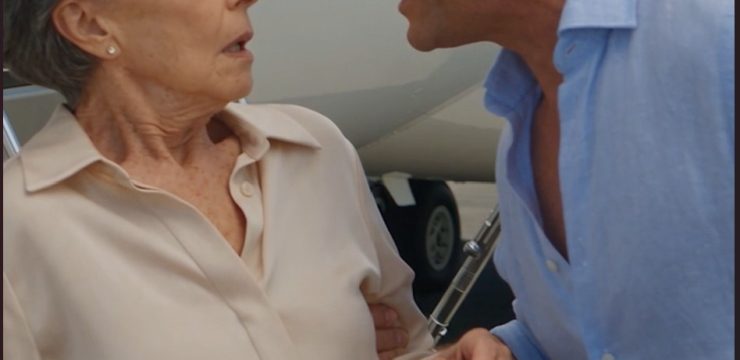
The invitation tore in half before Evelyn could stop him.
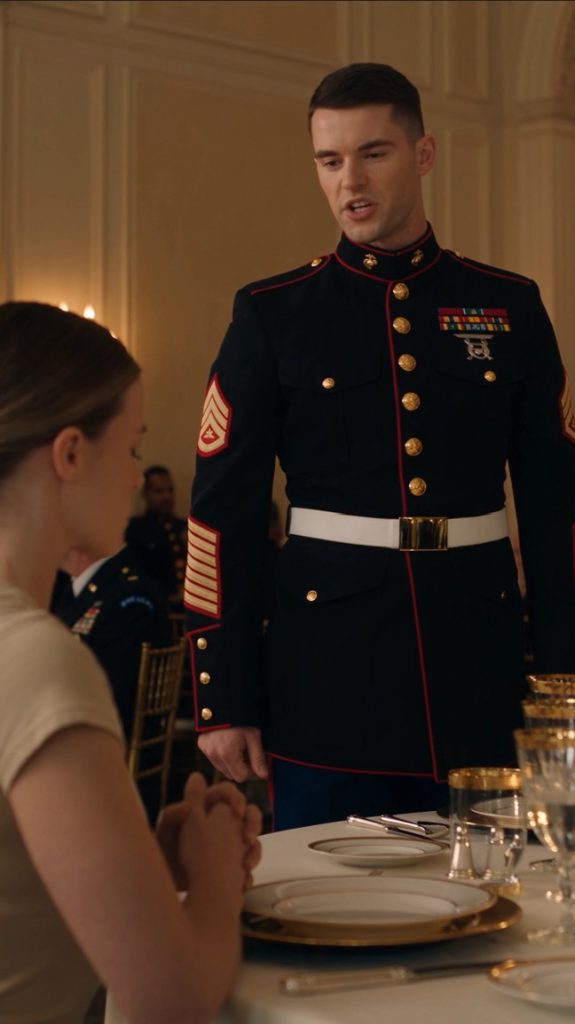
For one stunned second, nobody in the dining hall moved. Then Lieutenant Mason Cole let one piece fall beside her plate and watched the other drift beneath the empty chair next to her.
“You need to move, ma’am.”
His polished shoe struck the chair leg as he stepped closer. Evelyn slowly rose, one hand braced against the table while every nearby conversation faded into silence.
“That invitation has my name on it.”
Mason looked her over instead.
The faded navy dress she had pressed that morning. The worn black shoes polished carefully enough to shine, though nothing could hide the years creased into the leather.
“This section is for honored families,” he said. “Not people looking for a free meal.”
A young petty officer stared down at his plate. Another sailor shifted in his chair, uncomfortable, but neither spoke.
Evelyn pointed toward the gold seal on the torn card.
“Read the line under the crest.”
Mason barely glanced at it.
“Anyone with a printer can make this.”
Then he reached for the water glass at the empty place setting and poured it across the chair.
Water soaked the cushion, splashed onto the floor, and darkened the edge of Evelyn’s skirt.
“Leave before the honored guest walks in and sees this mess.”
Evelyn watched the water gather beneath the chair. Slowly, she bent down and retrieved the fallen half of her invitation.
“The honored guest will not take that seat without me.”
Several heads turned.
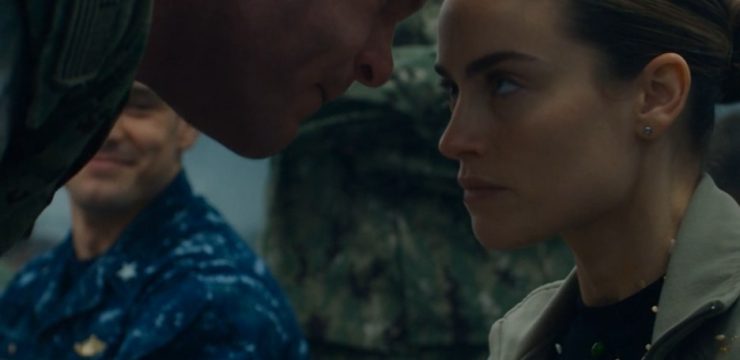
Something flickered across Mason’s face, but it vanished beneath a mocking smile.
He grabbed Evelyn above the elbow.
“You honestly believe you matter that much?”
Her chair scraped violently across the polished floor as he pulled her halfway upright.
Evelyn never cried out.
She only looked past him.
Toward the closed double doors.
Then a drum sounded in the corridor.
The deep beat rolled through the hall, heavy enough to seem to settle inside every chest.
Mason’s fingers tightened.
“Last chance, ma’am.”
A second drumbeat came.
The doors opened.
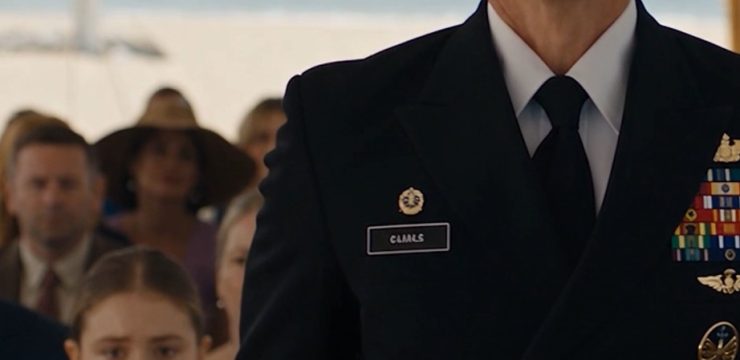
Every uniformed guest rose almost at once as a rear admiral entered beside an entire returning SEAL team, their boots striking the floor in measured rhythm.
Mason loosened his grip slightly, already turning toward the stage.
But the admiral never approached the podium.
He walked past it.
Past the commanding officers.
Straight toward Evelyn.
Then, before the entire room, the rear admiral lowered himself onto one knee.
The silence became so complete that droplets falling from the soaked chair sounded like the ticking of a clock.
“Mrs. Ross,” he said softly, “we brought your son home.”
Two sailors stepped forward carrying a walnut memorial case beneath a precisely folded American flag.
They placed it on the table with both hands and stood at attention.
Mason released Evelyn immediately.
The woman he had accused of stealing a seat stared at the flag without speaking.
For eleven months, officials had told her that her youngest son was missing overseas. Recovery operations were continuing. Information was limited. She would be contacted when something was confirmed.
Evelyn already knew the language of military grief.
Her oldest son, Daniel, had been killed during a rescue mission nineteen years earlier.
Seven years later, Michael, her second son, had died protecting two teammates.
Six days ago, a certified envelope had arrived at her small home near Chula Vista.
She had read it beside the kitchen sink.
The letter asked her to attend a ceremony at Naval Amphibious Base Coronado honoring personnel from a recently completed overseas operation.
One instruction had stood out.
A specific seat had been reserved for her beside the guest of honor.
She had understood what the letter could not bring itself to say.
Now Evelyn carefully picked up the two torn pieces of that invitation.
Her fingers trembled.
Her voice did not.
“I didn’t come here for anyone’s pity.”
She placed the pieces beside the folded flag.
“I came to take the last soldier in my family home.”
Outside the windows, afternoon sunlight flashed across San Diego Bay and distant aircraft.
Inside, Mason stood frozen beside the water he had spilled.
The rear admiral slowly turned toward him.
His jaw hardened.
And when Mason saw the expression on his commanding officer’s face, he finally understood that this ceremony was no longer going to end the way he expected.
What happened in that room next was something none of them would forget. 👇
The admiral did not raise his voice.
“Lieutenant Cole, step away from Mrs. Ross.”
Mason’s mouth opened, but nothing came out. He looked down at the torn invitation, then at the dark water spreading beneath the chair, as if the evidence might somehow rearrange itself into something less damning.
“Sir, I believed there was a security issue.”
The young petty officer at the next table stood so quickly his chair rocked backward.
“No, sir. He never called security. He tore her invitation. He poured the water. He grabbed her arm.”
Another sailor rose.
“I saw it too, Admiral.”
Then another.
The sound that followed was not shouting. It was worse for Mason. Chairs moved. Uniforms straightened. People who had been silent a minute earlier began standing one by one.
The admiral looked at Evelyn.
“Mrs. Ross, do you want to make a formal statement?”
Her fingers tightened around the torn halves of the invitation.
She looked at the walnut case beneath the folded flag. For eleven months, she had waited for someone to tell her where her son was. Now he was finally within reach, and every part of her wanted to take him home and close the door on the world.
Mason saw the hesitation.
“Ma’am,” he said quickly, “I made a mistake.”
Evelyn lifted her eyes.
“No.”
The word stopped him.
“A mistake is sitting at the wrong table. You looked at my dress. You looked at my shoes. You decided you knew who I was before you ever read my name.”
“I was trying to protect the ceremony.”
“From me?”
The silence that followed seemed to hollow out the room.
A senior chief from the returning team stepped forward carrying a thin blue folder.
“Sir, there’s something you need to see.”
Mason went still.
The chief opened the folder and removed the ceremony’s guest-access sheet. Evelyn’s name appeared near the top, marked with the same gold designation printed on her invitation.
Beside it was a signature.
Mason Cole.
The admiral looked up.
“You signed the guest briefing this morning.”
Mason’s jaw tightened.
“Sir, I signed several pages. I didn’t memorize every name.”
“You were specifically briefed on Mrs. Ross,” the chief said. “Her arrival instructions were repeated because she was coming alone. You acknowledged them.”
Something changed in every face around him.
Until then, Mason could still pretend cruelty had grown from confusion.
Now even that shelter was gone.
Evelyn stared at his signature.
“You knew my name.”
“I didn’t know it was you.”
Her eyes dropped briefly to her worn shoes.
“That’s exactly the problem.”
The admiral closed the folder.
“Lieutenant Cole, you are relieved of duty effective immediately. Report to the command duty office and remain available for investigation. You will have no contact with Mrs. Ross.”
Mason swallowed.
“Admiral, my career—”
“You should have thought about your career before you put your hands on a guest.”
Two chiefs moved to either side of him.
Before leaving, Mason turned toward Evelyn.
“I’m sorry.”
She studied him for a long moment.
“I hope one day you understand what you’re sorry for.”
Then she turned back to her son.
The investigation later confirmed the witness statements, the security footage, the destroyed invitation, and Mason’s signed briefing sheet. Formal proceedings ended his naval career.
Evelyn never attended them.
She had already given him the only thing she owed him.
The truth.
When the hall emptied, the young petty officer approached her.
“Mrs. Ross?”
His eyes were wet.
“I should have stood up sooner.”
“Yes,” she said.
He flinched.
Then Evelyn touched his sleeve.
“So next time, do.”
He nodded once and walked away straighter than he had approached.
The returning SEALs remained.
A broad-shouldered chief with a healing cut near his temple stepped toward her.
“Your son saved my life.”
Evelyn closed her eyes.
“He saved all of us long enough to get out.”
Her fingertips pressed against the edge of the flag.
“Was he alone?”
“No, ma’am.”
Her breath caught.
“We were with him.”
For eleven months, that question had lived inside her like a blade.
The chief reached inside his jacket and removed a small envelope, worn soft at the corners.
“He gave me this before the operation. Told me I was only allowed to hand it to you if he couldn’t.”
One word was written across the front.
Mom.
Evelyn did not open it until she reached her small house near Chula Vista.
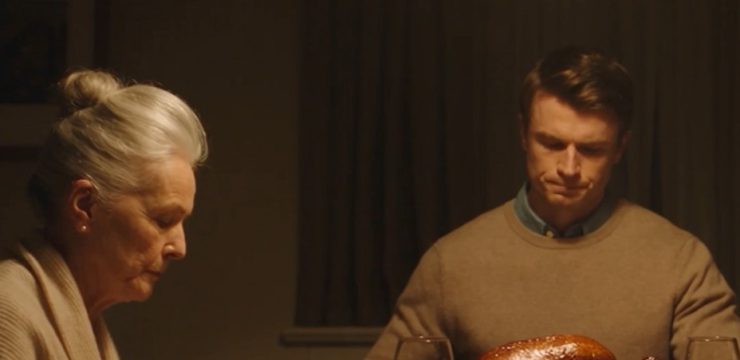
She placed the memorial case on the dining table beneath three framed photographs: Daniel grinning beneath a crooked cap, Michael with an arm around his younger brother, and her youngest son laughing at something outside the frame.
Two members of the team waited near the doorway while she opened the letter.
Halfway through, Evelyn covered her mouth.
Then she laughed.
It was small, broken, and soaked with tears, but unmistakably a laugh.
“What did he say?” the chief asked.
She handed him the final page.
If I don’t make it back, don’t let Mom eat alone after you bring me home. She’ll pretend she wants the house quiet. She’s lying. Bring food. Sit in every chair. Tell her the stories I was smart enough not to tell her myself.
The chief wiped his face.
“There’s more,” Evelyn whispered.
On the back was a list of names.
Every man from the returning team.
Beside each was a small detail: who hated onions, who drank coffee too strong, who had a daughter learning piano, who always called his wife before boarding a plane.
At the bottom, her son had written:
They’re going to think they’re bringing me home to you. Truth is, Mom, I’ve been trying to bring them home to you for years.
Evelyn stared until the ink blurred.
Suddenly she remembered the packages of extra plates that had appeared on her porch the previous spring. The strange questions about whether her old dining table could hold twelve.
They had never been random.
Three Saturdays later, trucks began pulling into her cracked driveway.
The men arrived carrying grocery bags, foil trays, flowers, bread, and one enormous pie.
The broad-shouldered chief stood in her kitchen exactly as predicted and insisted he was not hungry.
Evelyn pointed at a chair.
“Sit.”
He sat.
The young petty officer from the ceremony came too. He brought a newly printed copy of her invitation.
“I thought you might want one that wasn’t torn.”
Evelyn looked at it.
“I kept the other one.”
She had framed the two damaged halves beneath glass beside her sons’ photographs.
Not because she wanted to remember Mason.
Because she wanted to remember the moment people finally stopped being silent.
By winter, her little garden was alive again.
Daniel’s photograph stayed on the shelf. Michael’s stayed beside it. Her youngest son’s folded flag rested below them.
Nothing replaced any of them.
Nothing was supposed to.
But grief, Evelyn discovered, could share a room with laughter without betraying the dead.
On the first anniversary of the ceremony, the team returned for dinner.
Every chair was filled.
Someone burned the rolls. Someone else told a story about her son involving a flooded barracks hallway and a stolen traffic cone, then laughed too hard to finish.
Evelyn laughed with them until tears ran down her face.
Later, as the evening softened into low voices, the chief placed something small beside her hand.
An old brass key.
“What is this?”
“Your son gave it to me before deployment.”
A metal tag on the ring carried Evelyn’s address.
The chief smiled.
“He said if anything happened, one of us was supposed to make sure nobody let you lock us out.”
Evelyn looked around the table.
At the men her son had trusted.
At the young sailor who had learned to stand.
At the empty serving dishes and fingerprints shining on glasses beneath the warm kitchen light.
Then she closed her fingers around the key.
“No one needs a key anymore.”
She walked to the front door and turned the deadbolt open.
Cool night air drifted into the house.
Behind her, someone started another story.
Someone laughed.
A chair scraped closer to the table to make room.
Evelyn left the door open and returned to them, passing beneath the photographs of her three sons as the house filled with voices.
For the first time in nineteen years, there was no empty place waiting for someone to come home.