My forty-three-year-old son shoved me away from the private jet stairs and said, “Try to board this plane and I’ll have security remove you.”
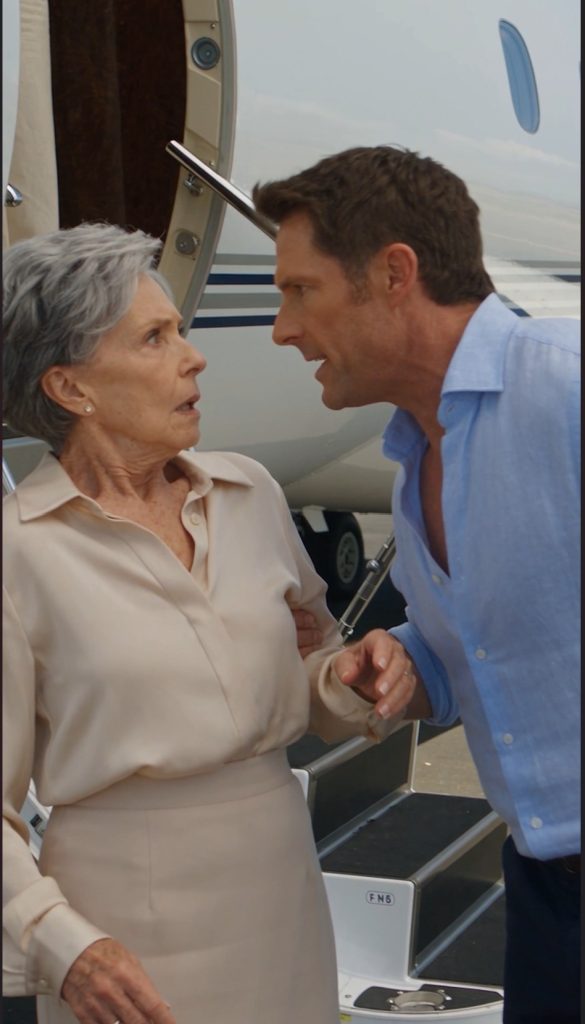
His wife laughed as she climbed aboard with my grandchildren, even though Michael had personally invited me on the Hilton Head trip four days earlier. I stepped aside without arguing, because there was one thing neither of them seemed to remember about the aircraft waiting behind them.
I’m Eleanor Harrison, sixty-eight years old, and I had spent most of my life believing that keeping peace in a family sometimes meant swallowing small hurts. Michael was my only son, and after his father, David, died, I told myself that his growing distance was grief, stress, marriage, work, or simply the natural separation between a mother and her grown child. I had forgiven forgotten invitations, changed dinner plans, holidays shortened at the last minute, and dozens of little moments when his wife, Lauren, made it clear she preferred me useful but not too present. But standing on that hot Charlotte tarmac, watching my son physically block me from a trip I had helped arrange, something inside me finally stopped making excuses.
My granddaughter Emma was already halfway up the stairs when she turned around. “Grandma?” she asked, and the confusion on her eleven-year-old face hurt more than Michael’s hands on my shoulders. Her eight-year-old brother, Noah, leaned around Lauren and said, “But Grandma’s coming to the beach with us.” Lauren’s smile vanished as she ordered both children inside, while Michael told me their plans had changed and Lauren wanted “family time.”
“I’m your family,” I said quietly. Michael barely looked uncomfortable before answering, “You know what I mean.” Five words were enough to tell me exactly where I stood, because I had spent years helping this family while pretending not to notice that my presence had gradually become less welcome than the things I provided. I had helped Michael through college, supported him after his first business failed, helped him and Lauren buy their first home, cared for Emma after Lauren’s difficult recovery, and spent countless afternoons with the grandchildren so their parents could work or rest. Yet somehow I was now expected to understand that “family time” meant my son, his wife, their children—and not me.
What made the humiliation worse was that Michael had called me only four days earlier asking about the flight. “Mom, do you still have access to that charter program?” he had asked, explaining that commercial travel with two children would be exhausting. I checked availability through the Harrison Family Office, the company David and I had built over thirty-seven years, and found an aircraft for Saturday morning. Then Michael himself said, “Why don’t you come with us?”
I had hesitated because Lauren and I had not been close for some time, but Emma and Noah were excited when they heard I might join them. So I agreed, packed two books, a linen dress, sunscreen, and the sour candies Noah loved, and arrived at the terminal believing I was spending a weekend with my family. Apparently, sometime between getting access to the plane and reaching the airport, Lauren had decided she wanted the vacation without me. Michael had chosen the easiest solution: use what I arranged, then tell me to go home.
He picked up my suitcase and set it several yards away from the aircraft. “I’ll have someone arrange a car for you,” he said, as though sending his mother away after shoving her on a runway was simply another travel detail to solve. When I asked where the car would take me, he said, “Home.” Lauren looked down from the aircraft doorway and added, “You can spend the weekend resting, Eleanor. Maybe that’s better anyway.”
That was the moment I understood this was no misunderstanding. Michael wasn’t trapped between his wife and his mother, and Lauren wasn’t accidentally insensitive. They expected me to accept being excluded because they were confident I would never make a scene, especially with Emma and Noah watching. They were right about one thing: I wasn’t going to scream, beg, or embarrass my grandchildren.
I looked at Michael and asked one simple question. “Whose aircraft do you believe you’re boarding?” He frowned and said it obviously belonged to the charter company, then insisted Lauren’s assistant had arranged everything through his office. I knew that wasn’t true, but I didn’t correct him, because suddenly I wanted to understand exactly how much he believed belonged to him simply because I had allowed him to use it.
Lauren called impatiently from inside the cabin, asking whether they were finally leaving. Michael turned back to me and whispered, “Mom, please don’t turn this into something embarrassing.” I reminded him that he had just put both hands on me in front of airport employees and his own children, but he dismissed it by saying he had “barely touched” me. Then he said something even more revealing: “You always make everything about respect.”
I looked at the son I had raised and realized he believed asking not to be humiliated was somehow demanding too much. So I stopped arguing. I picked up my handbag, stepped completely away from the stairs, and said, “All right.”
Michael visibly relaxed. “Thank you,” he said, as if I had finally become reasonable again. Then he turned toward the plane without apologizing, and I watched him place one foot on the first stair.
Before he could climb any higher, the pilot appeared in the doorway and came down toward us. Captain Robert Hayes looked at the tablet in his hand, then directly at my son. “Mr. Harrison?” he said calmly.
Michael stopped. “Yes?”
The captain glanced past him toward me before speaking again. “Sir, I can’t depart without Mrs. Harrison’s authorization.”
Michael frowned. Lauren appeared behind him in the open doorway, suddenly no longer smiling. And for the first time that morning, my son slowly turned toward me as if he were finally asking himself one question he should have asked before putting his hands on me:
Why did the pilot need my permission?
A hot gust moved across the runway, lifting the edge of Lauren’s white cover-up. Michael’s face emptied of color.
“What authorization?” he asked.
Captain Hayes kept his voice calm. “This aircraft is operated for Harrison Aviation Holdings. Dispatch authority for personal use remains with Mrs. Harrison. Her approval is required before we close the door.”
Michael looked from the pilot to me, then back at the polished fuselage.
Lauren came down two steps. “That can’t be right. My assistant booked this.”
“She submitted the passenger details,” Captain Hayes said. “She didn’t authorize the aircraft.”
Then he glanced at his tablet. “There’s also a discrepancy. Mrs. Harrison was on the original manifest. She was removed yesterday afternoon with a note stating she had voluntarily withdrawn and approved the revised list.”
I turned to Michael.
“I never sent that,” he said.
Lauren’s hand froze on the railing.
From inside the cabin, Emma’s voice came softly. “Mom said Grandma changed her mind.”
No one moved.
Michael looked up at his wife. “Did you tell them that?”
Lauren lowered her voice. “I handled it because you wouldn’t. We talked about needing boundaries.”
“We talked about one weekend to ourselves. We did not talk about lying to my mother.”
Her mouth hardened. “She arranged the plane. She was going to make the whole trip about how generous she is.”
For years I had found explanations for Lauren. She was protective of her marriage. She needed space. Michael needed his own family.
But explanations become excuses if you repeat them long enough.
I looked at Captain Hayes. “Please cancel the flight.”
Lauren stared at me. “You cannot be serious.”
“I am.”
Michael rubbed a hand over his face. “Mom—”
“No. Not here. Not in front of the children. Take Emma and Noah home.”
For once, he did not argue.
The children came down slowly. Emma kept her eyes on me with the terrible alertness children develop when adults are pretending everything is fine.
I opened my arms.
They both came to me.
“I thought you didn’t want to come,” Emma whispered.
“I wanted to come very much.”
Behind her, Michael closed his eyes.
That Monday, he arrived at the Harrison Family Office ten minutes early and sat across from me in David’s old conference room.
A folder waited between us.
Our controller had reviewed the travel requests connected to Michael’s office. Lauren’s assistant had used credentials Michael had authorized for scheduling and expenses. Several family-office services had been requested over the previous year without being brought to me directly.
The amounts were not the point.
The assumption was.
Michael turned the pages until he reached Friday’s email.
REMOVE E. HARRISON FROM MANIFEST. MRS. HARRISON HAS APPROVED THE CHANGE. DO NOT CONTACT HER DIRECTLY.
Below it was the forwarded instruction from Lauren.
“I gave her assistant access,” he said quietly.
“Yes.”
“So this is on me too.”
“Yes.”
The conference-room door opened.
Lauren walked in.
Michael stood. “I told you not to come here.”
“You stopped answering me.”
Her eyes went to the folder.
“This is insane. You’re investigating us because of a family argument?”
“I’m reviewing access to a company you do not own,” I said.
“It’s his family company.”
“It is also a legal entity with employees and controls.”
Lauren gave a short laugh. “There it is. The money. That’s always how you win.”
For years, I would have defended myself.
This time I didn’t.
“Money is how I avoided conflict,” I said. “I kept giving because it was easier than admitting every favor was becoming an expectation. That was my mistake.”
Michael lifted the printed email.
“Did you write this?”
Lauren stared at him.
“Lauren.”
“I told my assistant what needed to happen.”
“You said my mother approved it.”
“She would have made a scene if anyone called her.”
Michael looked at her for a long moment.
Then he said, “She didn’t make a scene when I put my hands on her.”
Lauren went still.
“So now I’m the villain because you can’t stand up to your mother?”
“No.” His voice shook. “I’m responsible for what I did. I’m asking whether you’re responsible for what you did.”
She did not answer.
That was the moment her power broke. Not because I defeated her, but because Michael finally stopped letting her turn every question into someone else’s guilt.
I slid one page across the table.
Effective immediately, Michael’s discretionary family-office privileges were suspended. Lauren and her assistant would have no access at all. Any improper personal expenses would be repaid.
Lauren looked at Michael, waiting for him to explode on her behalf.
Instead, he removed the family-office card from his wallet and placed it beside the folder.
“I’ll repay whatever I owe.”
Her face changed.
She picked up her handbag. At the door, she turned to him.
“If I leave now, don’t expect me to come crawling back.”
Michael’s eyes were wet.
“I’m not asking you to crawl. I’m asking you to tell the truth.”
She left.
The latch clicked softly behind her.
He and Lauren separated that month. I did not celebrate it. There was nothing joyful about two children learning their parents would live in different homes.
But there was relief in the end of pretending.
Lauren remained Emma and Noah’s mother, and I never spoke against her to them. The financial access was closed permanently, the questionable expenses were repaid, and the children were never asked to choose sides.
Three weeks later, Michael came to my house alone.
Rain tapped softly against the kitchen windows.
“I keep hearing myself say it,” he told me.
I knew which words he meant.
I barely touched you.
His throat moved.
“I put my hands on you. Then I told you it barely counted because I didn’t want to look at what I’d done.”
I did not rescue him from the silence.
“I’m sorry, Mom. Not for the plane. Not because I lost access to anything. I’m sorry I learned to treat your kindness like it had no cost.”
My throat tightened.
“I love you,” I said. “But loving you does not mean trusting you immediately.”
He nodded. “I know.”
That answer mattered more than any promise.
Before he left, I opened the bottom drawer of David’s desk and brought out an envelope.
Michael recognized his father’s handwriting.
His name was written across the front.
“What is this?”
“Your father wrote it six months before he died.”
“Why didn’t you give it to me?”
“Because he asked me not to.”
David had left instructions that the letter was to be given to Michael only when I believed he was ready to understand what stewardship meant.
Michael opened it carefully.
He read in silence until his shoulders began to shake.
He gave me only one line.
“Your mother will know when you understand that what we built was never meant to make you important. It was meant to make you responsible.”
Michael pressed the paper to his mouth.
For years, I had wondered whether keeping control of the family office meant I had failed to trust my son.
David’s letter gave both of us a different answer.
It had never been about withholding something from Michael. It had been about waiting until he could carry responsibility without believing it made everyone else smaller.
Trust returned slowly.
Michael began counseling. He rebuilt his finances without family-office shortcuts. He showed up when he said he would. I watched without rushing to reward him.
Nearly a year after the morning on the tarmac, Emma called me.
“Grandma, are you busy next weekend?”
“That depends.”
“We want to go to Hilton Head.”
There was a pause.
Then Michael’s voice came through in the background.
“Tell her we’re driving.”
I laughed before I could stop myself.
We rented a small house two blocks from the beach.
No jet. No assistants. No special arrangements.
Noah found the bag of sour candies I had packed a year earlier, still sealed in the side pocket of my old suitcase.
“You saved them?”
“I suppose I did.”
That evening, we walked toward the water as the sun lowered over the dunes.
Michael fell into step beside me.
He glanced at my bag. “Want me to carry that?”
I handed it to him.
Ahead of us, Emma and Noah ran toward the surf, their shoes in their hands.
Michael looked at me.
“Mom?”
“Yes?”
“You coming?”
This time, he waited for my answer.
I slipped my arm through his.
“Yes,” I said.
And together we walked toward the children, the evening light warm on our faces, with no one being pushed away and no one left behind.