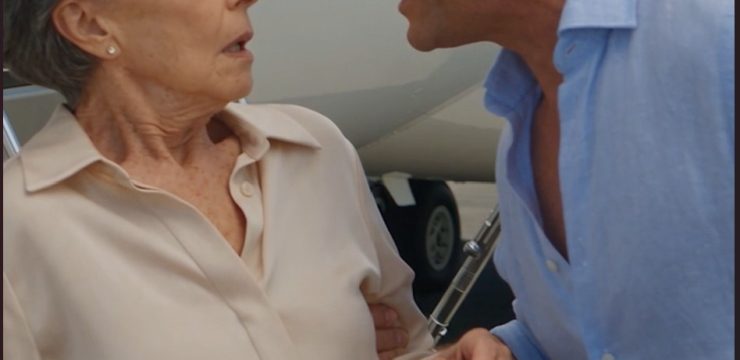
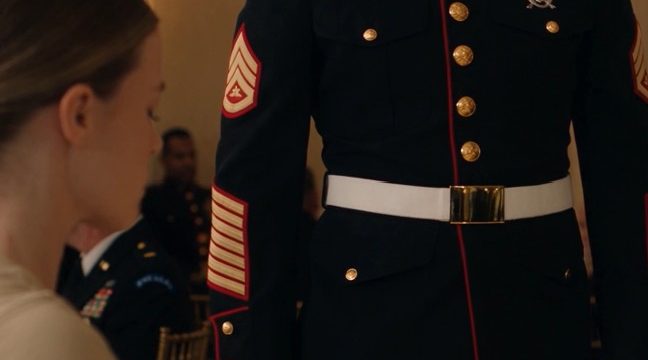
The chair screamed across the cafeteria floor before she could even touch it.
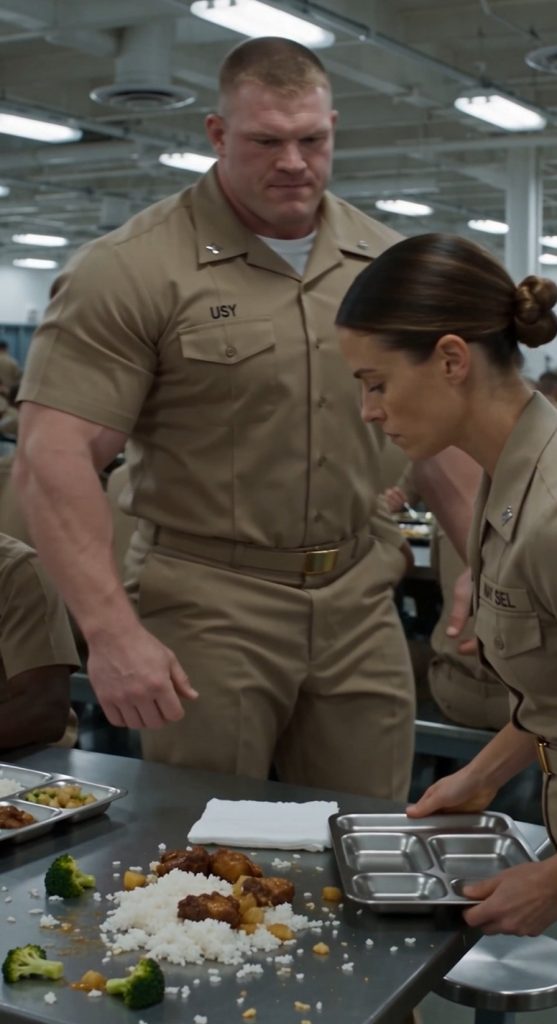
Metal scraped against tile, conversations died mid-sentence, and suddenly an entire room was watching one woman stand beside a table where she had already been told—without anyone saying it plainly—that she did not belong.
Captain Mason Drake rested his hand on the chair he had dragged away.
“This table is reserved for people who survived real training.”
Emma Hayes said nothing.
She stood with a stainless steel tray balanced between both hands, her dark hair secured in a low ponytail, her uniform clean and completely unmarked. No qualification badge. No combat patch. Nothing that explained why she was there.
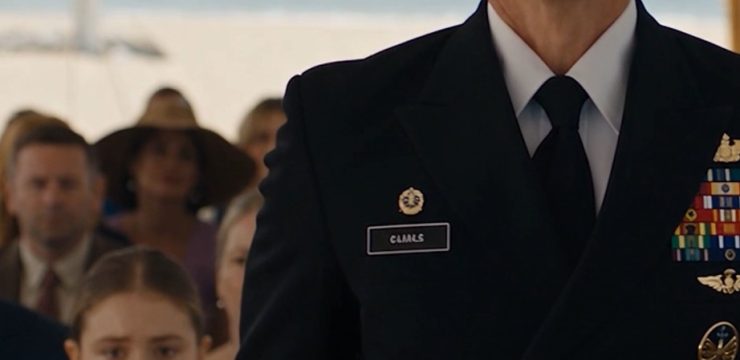
Across from her, Mason’s decorated chest filled the front of his perfectly pressed jacket.
“Did nobody explain how seating works here?”
Emma looked around the table.
Every man sitting there wore something that announced experience, rank, or sacrifice.
“I understand perfectly,” she said.
Mason smiled.
“Good. Then find somewhere appropriate.”
Several soldiers dropped their eyes. Others kept staring.
Emma simply moved to the neighboring table and set down her tray.
No protest. No embarrassment.
That seemed to bother Mason more.
“You seem lost, recruit.”
Emma unfolded a paper napkin.
“I’m exactly where I was told to be.”
Lieutenant Cole Barrett raised his eyebrows, amused.
Mason’s smile thinned.
“Who told you to be here?”
Emma glanced toward the rear cafeteria doors.
“They’ll arrive soon.”
A few quiet laughs circled the table.
Mason stood.
His chair struck the floor behind him.
“People usually introduce themselves before making mysterious claims.”
Emma lifted her fork.
“You didn’t ask my name.”
Cole laughed loudly.
“She thinks we need an introduction.”
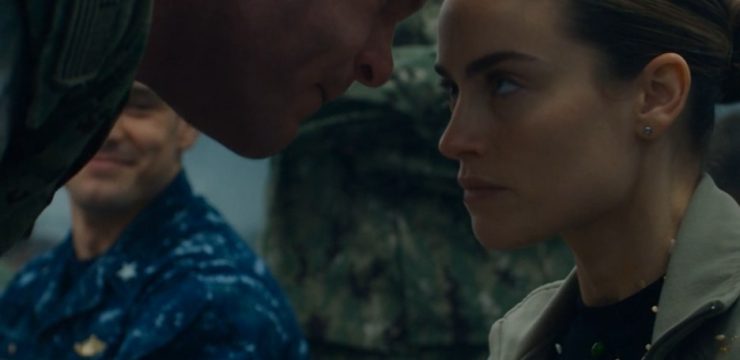
Mason walked over until his shadow covered Emma’s tray.
“I asked whether you belonged here.”
Emma looked directly at him.
“Those are different questions.”
Silence spread outward.
Mason’s expression tightened.
He had expected discomfort. Maybe an apology. Maybe anger.
Not correction.
And now his men were watching.
His boot pressed against the table leg.
Then he kicked.
The table jumped sideways.
Emma moved back just before the edge caught her hip.
Her tray slid violently across the surface.
The soup went first, spilling over the table and splashing onto the floor. Vegetables scattered beneath chairs. The metal tray hit the tile with a crack that silenced every remaining voice in the cafeteria.
Then Mason’s table exploded with laughter.
Cole slapped the tabletop.
“Those reflexes will get someone killed,” Mason said.
Emma stared at what remained of her meal.
A piece of bread floated in the spilled soup near her boot.
Nobody helped.
Near the drink station, a young sailor stepped forward.
His friend immediately caught his sleeve.
Emma crouched.
Slowly, she picked up the tray.
Mason watched her carefully.
He wanted anger.
A raised voice.
An accusation.
Something he could use.
Instead, Emma set the tray upright and reached for another napkin.
“Nothing to say?” Mason asked.
She wiped the table.
“What would you like me to say?”
He leaned closer.
“Maybe thank me for the lesson.”
Emma folded the soaked napkin.
“What lesson was that?”
Mason gestured toward the mess.
“That appearances matter.”
Her eyes moved briefly to his medals.
“So does conduct.”
Several men shifted in their seats.
Cole stopped laughing.
Mason lowered his voice.
“You should be careful speaking to senior officers.”
Emma placed the recovered fork onto the tray.
“You should be careful speaking for the Navy.”
Something changed in the room.
Men who had been watching Emma now looked at Mason.
Others studied her uniform again, as though the absence of insignia suddenly meant something different.
Mason stepped closer.
His polished boot stopped beside the spilled food.
“Maybe they brought you here to serve coffee.”
Emma rose and held the tray at her side.
“Would that make your behavior acceptable?”
His nostrils flared.
“This is a military cafeteria, not a therapy session.”
Emma placed the tray back onto the table.
Her voice remained quiet.
“No, Captain.”
She looked him directly in the eyes.
“It’s a place where character becomes visible.”
For the first time, Mason didn’t answer immediately.
And as Emma’s gaze drifted once more toward the rear cafeteria doors, the laughter was gone.
Nobody in that room understood yet why she was waiting for them to open. 👇
The doors opened before Mason could find another insult.
Rear Admiral Evelyn Shaw entered first, followed by Master Chief Lena Ortiz and two officers carrying slim black folders. They had taken only three steps into the cafeteria when Shaw saw the spilled soup, the overturned bowl, and the tray in Emma’s hand.
Mason’s posture changed so fast it was almost painful to watch.
“Admiral.”
The men at his table stood. Chairs scraped backward in uneven bursts.
Emma did not move.
Shaw’s eyes went from Mason to Emma, then to the wet napkin folded beside the ruined meal.
“Commander Hayes,” she said quietly. “I see you’ve met Captain Drake.”
The title landed harder than the tray had.
Cole’s face drained of color.
Mason stared at Emma as if a different person had stepped into her uniform. His gaze moved automatically to her bare chest, searching for the insignia that should have warned him.
Shaw crossed the room and stopped beside the spilled food.
“My office authorized Commander Hayes to wear a generic training uniform this morning. No ribbons. No qualification badges. No visible assignment identifiers. She is leading the command-climate review you were notified about three weeks ago.”
Mason swallowed.
“You said the review started Monday.”
“It did.”
“This is Friday.”
“Yes.”
The answer left nowhere to hide.
Mason recovered just enough to straighten his shoulders.
“Admiral, there’s context here.”
Emma looked at the soup on the floor.
Mason pointed toward her, but his hand fell before the gesture was complete.
“She was insubordinate. Deliberately provocative. She refused to identify herself.”
“I answered every question you asked,” Emma said.
“And you kicked the table,” Shaw added.
“That was—”
“A joke?” came a voice from near the drink station.
The young sailor who had almost stepped forward was standing alone now.
His face was pale, but his hands were no longer at his sides. They were clenched hard enough to whiten his knuckles.
“Seaman Price,” Mason said. “Think carefully.”
Noah Price took one breath, then another.
“He’s done this before.”
Mason’s face went still.
Price looked at Emma instead of him.
“Not the tray. Other things. Making people stand through meals. Calling them weak in front of the division. Threatening evaluations if they complained.”
“Stop,” Mason said.
Price flinched.
That single involuntary movement seemed to break something open.
A petty officer near the wall raised her hand halfway, then let it fall.
“He changed my qualification recommendation after I reported an injury.”
Another voice came from behind Mason’s table.
“He made me redo a watch after I went to medical.”
A third sailor spoke without standing.
“He told us nobody would believe junior sailors over a captain.”
The cafeteria filled with the strangest sound Emma had ever heard.
People telling the truth.
Mason looked from face to face as his authority abandoned him in real time.
“These are accusations,” he said. “Nothing more.”
Emma’s hand moved to the small seam beneath her jacket.
For the first time that morning, she hesitated.
Shaw saw it.
“Commander?”
Emma removed a thin black recorder no larger than two fingers.
“The climate-review team authorized continuous audio during my observation period,” Emma said. “I can submit this as evidence.”
If she turned it over, the morning would no longer be an ugly encounter everyone could pretend to forget. It would become a record. Statements. Interviews. Careers examined under fluorescent lights.
Some of the people who had spoken would be frightened tomorrow.
Emma closed her fingers around the recorder.
Mason saw the hesitation and mistook it for weakness.
“You know exactly what this looks like,” he said. “A staged trap.”
Emma’s eyes lifted.
“It looks like you behaved this way because you thought nobody important was watching.”
Her thumb pressed the evidence-lock button.
She placed the recorder in Shaw’s hand.
Then Cole stood.
“I need to make a statement too.”
Mason turned on him.
“Cole.”
Cole’s jaw trembled once.
“I laughed.”
Nobody interrupted him.
“I encouraged him. Not just today.” His voice roughened. “I kept telling myself I was surviving him. That if I stayed useful, he’d aim at somebody else.”
He looked toward Price.
“That meant I helped him aim.”
Mason gave a humorless laugh.
“So now everyone gets to save themselves by blaming me?”
“No,” Cole said. “I’m not saving myself.”
He reached into his jacket and removed a folded sheet of paper.
“I kept copies of the evaluation changes.”
For one second, Mason’s expression broke.
Cole handed the paper to Shaw.
By noon, Captain Mason Drake had been relieved of command pending investigation.
He left the cafeteria between two senior officers, not in handcuffs, not dragged, not shouting. Somehow the quietness was harsher. The men who had laughed with him moved aside without being asked.
Mason paused once near Emma.
“You destroyed my career.”
Emma’s face did not change.
“No, Captain. I witnessed what you did with it.”
The doors closed behind him.
For several seconds, nobody moved.
Then Noah Price bent down and picked up the piece of bread still floating in the soup.
Emma crouched beside him.
“You were going to help earlier,” she said.
His mouth tightened.
“I wanted to.”
“You stopped.”
“My friend stopped me.”
Price glanced toward the sailor by the drink station.
“Because I asked him to.”
Emma frowned.
“I was the anonymous complaint.”
The words were barely audible.
“I wrote that the only way anyone would see what was happening was if they came in without stars, stripes, ribbons, anything he respected.” His eyes dropped to her plain uniform. “I didn’t know they’d actually do it.”
For the first time all morning, Emma had no immediate answer.
Price’s letter had brought her into that cafeteria exactly as she had appeared: someone Mason believed did not matter.
“You were afraid,” Emma said.
“Yes, ma’am.”
“And you still wrote it.”
Emma held out her hand.
After a moment, he took it.
The investigation lasted eleven weeks.
The recording from the cafeteria was only one piece. Cole’s copies led investigators to altered evaluations. Medical records matched complaints about retaliation. Sailors who had transferred away agreed to speak once they learned others already had.
Mason denied some allegations and minimized others, but the pattern survived every attempt to explain it away.
He was permanently removed from command. A formal board substantiated abuse of authority and retaliation, and he retired at a reduced grade with his leadership career ended.
Cole received a formal reprimand for his participation.
He accepted it without appeal.
Months later, he found Price outside the same cafeteria.
“I’m not asking you to forgive me,” Cole said.
Price studied him for a long moment.
“Good.”
Cole nodded.
Then Price glanced at the bench beside him.
“But you can sit down.”
Cole did.
It was not forgiveness.
Not yet.
But neither man pretended it was.
By winter, the cafeteria had changed in ways nobody had ordered on paper.
There was a table near the windows where junior sailors could sit with senior leaders without appointments or ceremony. No reserved signs. No rank-based seating. No invisible rules.
Someone had nicknamed it the Open Table.
Emma learned that on a gray morning when she returned for the final climate-review follow-up.
Noah was already there.
His corrected evaluation had restored the qualification opportunity Mason had threatened to take from him. The petty officer whose injury had been used against her was back on a supported recovery plan. Cole had been reassigned from supervisory duties and was completing leadership remediation before anyone would consider putting people under him again.
Nothing had been magically repaired.
But people had stopped whispering.
That mattered.
Emma carried her tray toward the window table.
Noah saw her and smiled.
He reached beside him, took the final empty chair, and pulled it out for her.
The sound of its legs crossing the tile made Emma stop.
For one heartbeat, she was back in that first morning—the metallic shriek, Mason’s hand on the chair, the laughter waiting for her to react.
Noah noticed her stillness.
“You okay, ma’am?”
Emma looked at the chair.
Then at the people around the table.
Cole was there too, quieter now, listening more than he spoke. Master Chief Ortiz sat with coffee between her hands. The petty officer from the wall was laughing at something a recruit had said.
Emma set down her tray.
“I’m exactly where I was told to be.”
Noah blinked.
Then he understood.
A soft laugh moved around the table, nothing cruel in it.
Emma sat.
Outside the windows, winter light spread across the base, pale and clean. Inside, someone passed her the bread basket before she had to ask.
The chair that had once been dragged away to tell her she did not belong was now held open by a sailor who had finally learned that courage did not always look like standing up in the moment.
Sometimes it looked like writing one frightened letter and trusting that somewhere, someone would come.
Emma rested one hand on the edge of the table as the conversation carried on around her.
No one moved the chair.
No one asked whether she belonged.
And for the first time, the empty place beside them meant only one thing: there was always room for someone else.