The armed military police officer was only a few steps away when the black SUV rolled through the gate.
A moment earlier, my father-in-law had ordered me removed from the base in front of hundreds of soldiers. Then a four-star general climbed out, looked across the parade field, saw me—and went completely pale.
The national anthem had barely ended.
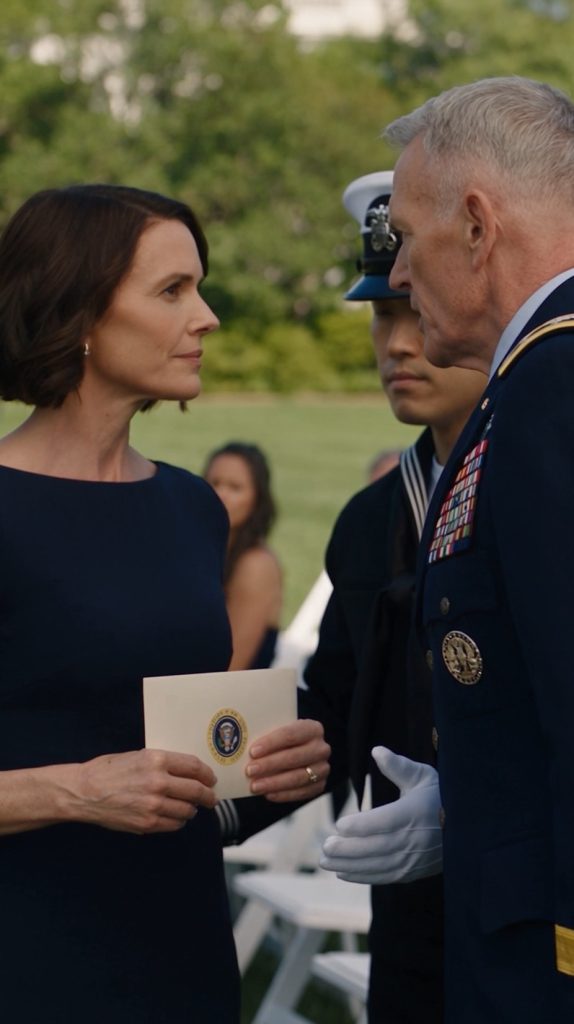
I stood beneath the brutal July sun at Fort Bellamy, Georgia, wearing a simple navy dress with a sealed envelope pressed tightly between my fingers.
Three hundred soldiers filled the parade field. Families crowded the sidelines. Senior officers occupied the reviewing area, local reporters waited with cameras raised, and nearly everyone from my husband’s command had come to honor Brigadier General Harold Wade’s retirement.
Harold had spent decades building a reputation for discipline, authority, and a temper few people dared challenge.
Then he pointed directly at me.
“Get this woman off my base before she brings any more disgrace to my bloodline.”
The words carried across the field.
For several seconds, no one moved.
My husband, Captain Michael Wade, stood ten feet away in full dress blues. His jaw tightened, but he said nothing.
His mother stared at the ground.
His sister hid a smile behind her champagne glass.
Six years of marriage disappeared in three sentences.
Harold’s face remained hard.
“She doesn’t have clearance.”
A pause.
“She isn’t wanted here.”
Then, with hundreds of people watching, he delivered the blow he had clearly been saving.
“She is not family.”
One of the military police officers began walking toward me.
I didn’t cry.
I didn’t argue.
And I didn’t look at Michael and beg him to defend the woman he’d married six years earlier.
Instead, I looked beyond Harold’s shoulder.
A black SUV had just passed through security.
A small flag fluttered from its front fender.
Four stars.
My heartbeat suddenly slowed.
I knew exactly who was inside.
The ceremony had been planned down to the smallest detail—the speeches, decorations, press photographs, retirement tribute, even the arrangement of chairs beneath the Georgia heat.
Harold had controlled everything.
Everything except me.
To him, I had always been an embarrassment.
Emma Wade. Mechanic’s daughter. Former waitress. The woman he believed had somehow convinced his son to marry beneath the family name.
The young MP stopped in front of me.
His nametag read RODRIGUEZ.
He looked nervous enough to know the situation was ugly, but disciplined enough to follow the order anyway.
“Ma’am, I’m going to have to ask you to leave.”
I gave him a small smile.
“Sergeant, if you ask me, I’ll step back.”
Relief flickered across his face.
Then I added quietly, “But I wouldn’t put your hands on me today.”
Something changed in his eyes.
Not fear.
Recognition.
Anyone who has spent enough time around uniforms eventually learns the difference between arrogance and certainty. One is performed.
The other has been earned.
Harold saw Rodriguez hesitate.
Then he laughed.
“Listen to her,” he called loudly. “This is what I’ve dealt with for years. Delusions of importance.”
A few uncomfortable laughs moved through the crowd.
Harold gestured toward me like I was evidence in a trial.
“A waitress with a military spouse ID thinks she’s important because she married my son.”
His humiliation was deliberate.
Public.
Cold.
Exactly as he intended.
Then the black SUV stopped.
The driver’s door opened.
A four-star general stepped onto the parade field.
Conversation died instantly.
Officers snapped to attention. Even Harold’s expression changed, his smug confidence returning as though the arrival of someone powerful had restored the natural order of things.
The general started toward the ceremony.
Then he saw me.
He stopped.
Completely.
The color drained from his face.
For one long, unbearable moment, nobody moved.
He turned slightly toward the officer beside him, but his eyes never left me.
“What is she doing here?”
Confusion rippled across the field.
Harold stepped forward, almost eager to explain.
“Sir, she’s being escorted out.”
The general looked at me again.
Then at the sealed envelope in my hand.
Then back at Harold.
His eyes widened.
Around him, several senior officers suddenly went rigid.
The silence became so absolute I could hear one of the flags snapping in the wind.
When the general finally spoke, his voice was barely above a whisper.
“That’s Reaper Two.”
And judging by the faces around me, those two words had just changed everything. 👇
Rodriguez took one step backward before anyone told him to.
The four-star general crossed the last few yards slowly, his polished shoes striking the pavement with sharp, measured taps. Harold’s mouth opened, but no sound came out. For the first time that afternoon, he looked like a man who had realized the ground beneath him no longer belonged to him.
The general stopped three feet from me. “Ms. Wade.”
Not Emma. Not ma’am.
Ms. Wade.
Then he looked at Rodriguez. “Sergeant, you will not touch her.”
“Yes, sir.”
Harold forced out a laugh. “Sir, there’s clearly been a misunderstanding.”
“There has,” the general said.
He nodded toward the envelope in my hand. “Is that the authorization?”
“Yes, General Mercer.”
Harold’s eyes narrowed. “Authorization for what?”
Mercer ignored him. “You can still deliver it privately.”
The envelope contained fourteen pages cleared for limited release that morning. I looked at Harold, then at Michael.
Michael finally met my eyes.
There was fear in his face, but not for me.
He was afraid of what the truth would do to his father.
“Emma,” he said softly.
One word. A plea.
Six years of marriage, and somehow that hurt worse than Harold’s insults.
I broke the seal.
Harold stepped forward. “You have no authority to—”
General Mercer turned. “She has more authority to speak about what is in that envelope than anyone standing on this field.”
I removed the first page.
“Operation Night Lantern.”
Michael went still.
Harold did too.
Seven years earlier, an Army advisory convoy had been trapped beyond its extraction corridor after enemy movement closed the southern route. The field commander received three warnings to reposition before dark.
He ignored them.
That commander was Harold Wade.
When the convoy was hit, he filed an after-action report saying the team on the ground had failed to follow movement instructions. The report protected his decisions and buried the radio traffic proving he had ordered them to hold position.
For years, that version stood.
Then investigators recovered the original traffic from a compartmented archive.
Harold stared at the pages.
“No.”
General Mercer’s voice hardened. “The Inspector General authenticated the recordings.”
Eleanor lifted her head. Her champagne glass trembled against her fingers.
“You told us the logs were destroyed.”
Harold looked at her.
Michael whispered, “Dad?”
I read the next line.
“Following the strike, an unauthorized recovery element entered the corridor and extracted eleven surviving personnel under fire.”
General Mercer looked at me.
“Call sign Reaper Two.”
The field went silent.
Michael took a step toward me. “You were there?”
“Yes.”
He had always known there were years of my government service I could not discuss.
Three months earlier, he saw his father’s name on a restricted routing notice and asked me to let someone else deliver the findings.
I refused.
Today, when Harold tried to throw me off the base, Michael chose silence.
“I thought you were trying to destroy him,” he said.
“I was trying to tell the truth.”
Harold snapped, “This is classified theater. A disgruntled woman using an old operation to embarrass this family.”
General Mercer reached inside his jacket and removed a folded document.
“No, Harold. This is the order suspending your retirement processing effective today.”
Nobody moved.
The band stood frozen beside their instruments. Reporters lowered their voices.
“The findings substantiate false official statements, obstruction, and abuse of command authority,” Mercer continued. “Your retirement award is withdrawn pending final action.”
Harold’s face went gray.
“This ceremony is over.”
That sentence broke him.
Not loudly.
His shoulders simply lowered, and the certainty that everyone around him existed beneath his rank vanished.
Eleanor set her glass on a chair.
“You let me blame those soldiers,” she said. “You let me write condolence letters believing their sons disobeyed you.”
“Eleanor—”
“Don’t.”
It was the first time I had ever heard her interrupt him.
Michael faced his father.
“Were the orders yours?”
Harold hesitated.
That was enough.
Michael removed his cap and held it against his chest.
“I defended you my whole life,” he said. “Even today.”
Then he turned to me.
“I defended him today.”
“Yes.”
His throat worked.
“I’m sorry.”
I had wanted those words while Rodriguez was walking toward me.
But hearing them did not repair anything.
“Not here,” I said.
Two officers approached Harold with quiet formality. He looked around the field one last time.
Hundreds of people who had come to applaud him watched him leave.
Nobody clapped.
Three months later, the final military review sustained the findings. Harold’s retirement honors were withdrawn, his misconduct entered permanently into the record, and he retired at a reduced grade after investigators concluded he had corrupted the official account of Night Lantern.
Michael and Eleanor testified.
Two former staff officers admitted Harold had pressured them to alter timelines in the original report.
The truth had not needed revenge.
Only daylight.
Michael moved into the guest room.
For six weeks, we spoke carefully around each other, like people carrying cracked glass between them.
He never asked me to forgive him.
Instead, he went to counseling, apologized to Rodriguez, and called his mother every Sunday. One rainy evening, he sat across from me at the kitchen table with both hands around a forgotten mug.
“I kept thinking loyalty meant keeping the family from breaking,” he said.
Rain ticked against the windows.
“But I was protecting the person who kept breaking it.”
I looked at him.
“I needed you to choose me before you knew I was Reaper Two.”
“I know.”
“Not because a four-star knew my name.”
“I know.”
“Because I was your wife.”
His eyes filled, but he did not look away.
“And because what he did was wrong,” he said, “even if you had been exactly who he said you were.”
That was the first apology that reached the wound.
Eleanor changed too.
She bought a smaller house with a porch and stopped lowering her eyes when she spoke. Claire came to see me there one afternoon.
“I smiled,” she said.
I knew what she meant.
“At the ceremony.”
“Yes.”
She rubbed her thumb against her phone. “I thought if Dad was humiliating someone else, he wasn’t looking at me.”
It was not an excuse.
I stepped aside and let her in.
The last truth came six months after the parade field.
General Mercer invited Michael and me to a quiet room at Fort Bellamy after the final declassification review.
“There is something your husband has never been cleared to hear,” Mercer told me.
He pressed play.
Static filled the room.
Then a younger voice came through the speaker.
“Reaper Two, this is Viper Six. We have wounded. We cannot hold.”
Michael stopped breathing.
I knew the voice immediately.
He did not.
Then his hand rose slowly toward his mouth.
My younger voice answered through gunfire.
“Viper Six, mark your position. We are coming to you.”
Michael stared at me.
On the recording, someone shouted coordinates. Rotor noise swallowed half the words. Then the voice returned, weaker.
“Reaper Two, be advised, one officer is critical.”
Mercer stopped the tape.
“That officer,” he said, “was First Lieutenant Michael Wade.”
Michael looked at me as if the room had tilted.
I had known his name before our first date, recognizing it years later in a Tacoma coffee shop when he introduced himself and wondered why I stared half a second too long.
I had never been allowed to tell him.
“You saved me,” he whispered.
“My team saved eleven people.”
“You came back for us.”
“That was the job.”
His face folded quietly.
He reached across the table.
Six months earlier, on the parade field, I had needed that hand and he had kept it at his side.
Now he waited.
I placed my hand in his.
A year later, Michael and I stood on Eleanor’s porch while summer rain darkened the steps.
Claire argued with her mother about cinnamon in an apple pie. Rodriguez, newly promoted, had sent a photograph from his new assignment.
General Mercer had retired too.
Quietly.
By choice.
He sent me a card with four words inside.
You can come home now.
For years, I thought home was the place where nobody asked questions about the locked rooms inside me.
I had been wrong.
Home was where those doors could open and nobody used what they found as a weapon.
Michael came outside carrying two mugs and leaned against the porch rail beside me.
He did not ask whether I had forgiven everything.
Some things healed too slowly for ceremonies.
Instead, his shoulder touched mine.
Inside, Eleanor laughed. Claire shouted that she had not burned anything. Rain whispered through the trees.
Michael reached for my hand.
This time there was no audience, no uniform, no rank, no one watching to see what he would choose.
He chose me anyway.
And with the warm kitchen light spilling across the porch behind us, I finally let myself believe we were home.