The laughter was quiet enough to pretend it wasn’t cruelty.
But everyone in the veterans’ hall heard it.
And when a young lieutenant deliberately stretched his boots across the aisle in front of a wounded Army captain, the room seemed to realize—too late—that something ugly had already begun.
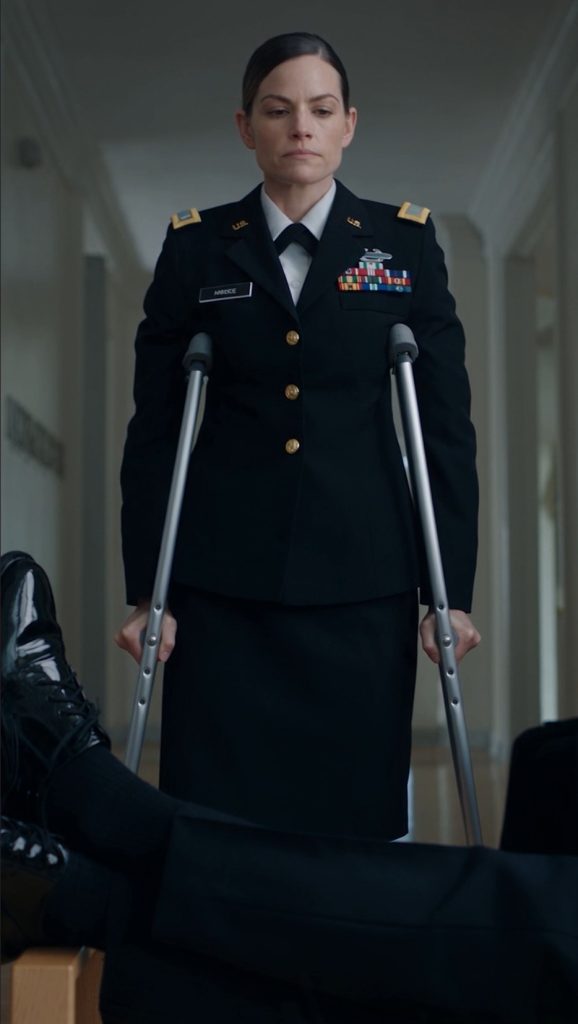
Captain Shannon Davis stopped beside him.
One hand rested on the polished metal crutch supporting her left side. Her dress uniform was immaculate, her dark hair pulled into a severe bun, every ribbon placed with exact precision.
Beneath her trouser leg, the prosthetic was almost invisible.
Almost.
“Move your feet.”
Lieutenant Mercer leaned farther back in his chair.
Young. Handsome. Smug.
The trident on his chest seemed to give him all the confidence he needed.
“And if I don’t?”
His three friends laughed under their breath.
Mercer glanced around, making sure people were watching.
“I thought this hall was for veterans,” he said. “Not injured mascots.”
Silence swallowed the room.
Someone near the back muttered, “Jesus Christ.”
No one moved.
Shannon’s fingers tightened around the crutch, but her face stayed calm.
“Move your feet.”
Mercer smiled at his friends.
“Ranger Barbie wants the road cleared.”
A few nervous laughs followed.
Shannon slowly studied his ribbons.
His nameplate.
Then the trident.
Finally, she looked into his eyes.
Mercer mistook discipline for weakness.
“What are you going to do, Captain?” he asked. “Hit me with that crutch?”
This time, nobody laughed.
Then a voice cut through the hall.
“Lieutenant Mercer.”
Mercer’s smile vanished.
Major General Robert Hale rose from the second row.
Even in a civilian suit, he carried the quiet authority of a man accustomed to sending soldiers into battle—and writing letters to families when they did not return.
Mercer pulled his boots away immediately.
“Sir, we were just joking.”
Hale stared at him.
“Did she look like she was laughing?”
Mercer said nothing.
“Stand up.”
He obeyed.
So did his friends.
Hale approached slowly.
“Tell everyone where you were twelve months ago.”
Mercer swallowed.
“Deployed, sir.”
“Where?”
A pause.
“Outside Khost.”
Something changed in the room.
Hale’s expression hardened.
“When your team became trapped in that ravine, your radios failed, your medic was shot through the throat, and the extraction helicopter couldn’t land because the zone was too hot…”
He took one step closer.
“…who walked into that kill zone?”
The color drained from Mercer’s face.
Shannon looked away.
For the first time, pain cracked through her composure.
Hale continued.
“Who carried your medic through sustained gunfire?”
Mercer stared at the floor.
“Who dragged you behind her while you were bleeding out?”
His jaw trembled.
“Who kept pressure on your artery for eleven minutes after her own leg had nearly been severed?”
Every face turned toward Shannon.
Mercer whispered, “Captain Davis, sir.”
“Louder.”
“Captain Davis, sir.”
Shock moved through the room.
Hale pointed toward the prosthetic Mercer had mocked minutes earlier.
“She survived six surgeries. A bone infection. Months of rehabilitation. She learned to walk again while your discharge paperwork was still being processed.”
Mercer could no longer look at her.
“You see damaged metal,” Hale said. “I see the reason you’re alive.”
One of Mercer’s friends shifted uneasily.
“Sir… we didn’t know.”
Hale turned sharply.
“That is precisely the point.”
The words landed harder than shouting.
“You didn’t know—and you opened your mouth anyway.”
Then Hale faced Mercer again.
“Tell everyone what Captain Davis lost saving you.”
Mercer swallowed.
“Her leg, sir.”
Hale remained still.
“That wasn’t everything.”
Shannon closed her eyes.
Then Hale spoke three names.
“Sergeant Hollis.”
A pause.
“Staff Sergeant Rainer.”
Another.
“Chief Alvarez.”
When Shannon opened her eyes, something inside them had changed.
Hale looked directly at Mercer.
“Now tell everyone in this room why those three soldiers never came home…”
Mercer’s entire body stiffened.
Hale’s voice dropped.
“…and tell them what you did after Captain Davis carried you out.”
Nobody moved.
Nobody breathed.
Because that was the part of the story no one in that hall had ever heard—and what came next would change everything. 👇
Mercer’s lips parted, but no sound came out.
Hale waited. He did not rescue him from the silence.
Finally, Mercer whispered, “They stayed behind to cover the withdrawal.”
Shannon’s head snapped toward him.
Hale’s eyes narrowed. “That is what you wrote in your statement. It is not what happened.”
The room seemed to contract. Mercer’s breathing turned shallow, and one of his friends slowly stepped away from him.
Hale reached inside his jacket and placed a small black recorder on the nearest table.
Mercer stared at it as if it were a weapon.
“The recovery team found Chief Alvarez’s field recorder three weeks after the engagement,” Hale said. “The audio was damaged. It took months to restore.”
Shannon stopped breathing.
Mercer shook his head. “Sir, I was wounded. I don’t remember everything clearly.”
“You remembered enough to sign an after-action report.”
Hale pressed a button.
Static filled the hall.
Then Shannon heard her own voice from a year earlier—strained, breathless, unmistakable.
“Do not transmit. They’re triangulating us. Hold this position until I get Mercer and Doc across.”
Gunfire crackled through the speaker.
Then Mercer’s voice.
“I’m not dying in this ravine. I’m calling the bird.”
Shannon’s face went white.
“No,” she whispered.
Her recorded voice came again, farther away now.
“Mercer, stay off that radio!”
A transmission followed.
Coordinates.
A desperate request for immediate extraction.
Then the sound of incoming fire.
Someone in the hall covered his mouth.
Hale stopped the recording.
“You transmitted from a compromised position after Captain Davis ordered radio silence,” he said. “The enemy adjusted fire onto your location. Hollis, Rainer, and Alvarez were cut off from the withdrawal route.”
Mercer’s voice cracked. “I was bleeding out.”
“So was she.”
Mercer looked at Shannon.
For a year, she had carried those three deaths differently than the loss of her leg. The prosthetic hurt in ways she could describe. Hollis, Rainer, and Alvarez did not.
“I thought I gave the wrong order,” she said.
Mercer looked down.
That was answer enough.
Shannon’s crutch struck the floor once as she stepped toward him.
“You let me believe that.”
“I was scared.”
“I was scared too.”
Her voice never rose.
“I was carrying you with one leg coming apart inside my boot, and I was scared too.”
Mercer flinched.
“Did you tell the investigators I ordered the transmission?”
Hale answered.
“Yes.”
Something inside Shannon’s face went still.
Not empty.
Finished.
Hale faced the room. “Captain Davis was under sedation when the first statements were collected. By the time she could give a full account, Mercer’s version had already shaped the official timeline.”
Mercer glanced toward the door.
“Don’t,” Hale said.
He froze.
“Your command was notified this morning. The investigation has been reopened.”
Mercer reached unconsciously toward the trident on his chest.
Hale noticed.
“Leave it alone. A board will decide whether you ever wear it again.”
Mercer’s hand fell.
Shannon stared at the recorder.
“There’s more,” Hale said.
She looked at him.
For the first time, the general hesitated.
“Play it.”
Gunfire returned.
Then Chief Alvarez’s voice emerged beneath the static.
“Davis has the wounded moving. We hold here.”
Rainer answered.
“She ordered us back.”
“I know.”
Then Hollis.
“If we move now, they reach her.”
A pause. Breathing. Distant shouting.
Alvarez spoke again.
“Tell Davis this was our call.”
Shannon’s knees nearly gave way.
The recording hissed.
“Get her home.”
Hale stopped it.
No one moved.
For twelve months, Shannon had replayed a version of that ravine in which three men died obeying her. She had learned to walk again while believing every step had been purchased with their lives.
Now she knew.
They had disobeyed her.
They had chosen.
Shannon covered her mouth with one trembling hand.
Mercer stepped toward her. “Captain—”
“Don’t.”
He stopped.
“You don’t get to use me to make yourself feel forgiven.”
His face folded.
“I’m sorry.”
“I believe you.”
He looked up.
“But being sorry is not the same as being absolved.”
The silence that followed was clean and terrible.
Two officers appeared near the rear doors. Mercer saw them and seemed to shrink inside his uniform.
Months later, the findings became official.
Mercer’s false statement was substantiated. The unauthorized transmission and his attempt to shift responsibility onto Shannon were entered into the corrected record. His qualification was revoked, and the proceedings that followed ended his military career.
There was no triumph in it.
Justice sounded quieter than Shannon had expected.
It sounded like three families finally receiving a report that did not lie about how their loved ones had died.
She met them on a cold morning beneath a pale winter sky.
Mrs. Hollis held Shannon’s hands without speaking.
Rainer’s older brother hugged her carefully.
Chief Alvarez’s wife, Elena, stood before her with a small wooden box pressed to her chest.
“I hated you for six months,” Elena said.
Shannon did not look away.
“I know.”
“No. You don’t.” Elena’s mouth trembled. “The report said he stayed on your order. Then I hated myself because he wrote about you like you were family.”
She opened the box.
Inside lay three worn challenge coins.
One from Hollis.
One from Rainer.
One from Alvarez.
“They made a promise before that deployment,” Elena said. “If one of them didn’t come back, the others would bring his coin home.”
Shannon touched Alvarez’s coin.
Elena gave a broken little smile.
“None of them came back to do it.”
Shannon shut her eyes.
“So we decided you should.”
Elena placed the box in her hands.
“You were the one they got home.”
Shannon could not speak.
Mrs. Hollis stepped closer.
“You thought surviving meant you owed them your suffering,” she said. “You don’t.”
Shannon stared at the coins.
“What do I owe them?”
Rainer’s brother answered.
“A life.”
The word went through her like light.
Not punishment.
Not repayment.
A life.
Spring came slowly.
Shannon returned to rehabilitation without treating every successful step like an apology. She began helping new amputees on mornings when the phantom pain allowed it. On harder days, she let other people help her.
Hale visited one afternoon carrying two coffees.
“I should have asked before playing that recording in front of everyone.”
Shannon took the cup.
“Yes.”
He blinked.
Then she almost smiled.
“But if you had asked, I would have said no.”
“I know.”
“And you would have done it anyway?”
Hale considered that.
“I’d like to say no.”
A small laugh escaped her.
It sounded rusty.
It also sounded real.
He handed her an envelope.
“There’s one more thing.”
Shannon groaned. “You generals need a new phrase.”
Inside was the restored transcript. The final page contained a section she had never heard.
A fourth voice.
Hers.
Faint beneath the static.
“I’m coming back for you.”
Below it was Alvarez’s answer.
“No, Captain. You already did.”
Shannon read the words twice.
That was the final truth the ravine had kept from her.
They had not died waiting for her to save them.
They died knowing she would try.
And they had chosen to stop her from turning back.
A year after the night in the veterans’ hall, Shannon stood in the memorial garden with Elena, the Hollises, Rainer’s brother, Hale, and several members of the old team.
No speeches.
No cameras.
The three challenge coins had been set into a simple wooden frame beside the names of the fallen.
Shannon rested her hand against it.
Her prosthetic stood steady beneath her.
No crutch.
A breeze moved through the trees. Behind her, coffee was being poured, someone was laughing too loudly, and Hale was losing an argument about barbecue to Mrs. Hollis.
Elena came to her side.
“You ready?”
Shannon looked once more at the names.
For the first time, memory did not drag her backward.
It stood beside her.
“Yes,” she said.
Halfway to the others, Shannon stopped.
She turned back, touched two fingers to her lips, then pressed them gently against the wooden frame.
Three coins caught the afternoon light.
Then she went home with the living.