The water hit her like a public execution of dignity. Thirty soldiers watched their captain stand drenched and motionless while the general responsible waited for her to break. But what none of them knew was that she had been expecting this moment—and someone far more powerful was waiting for it too.
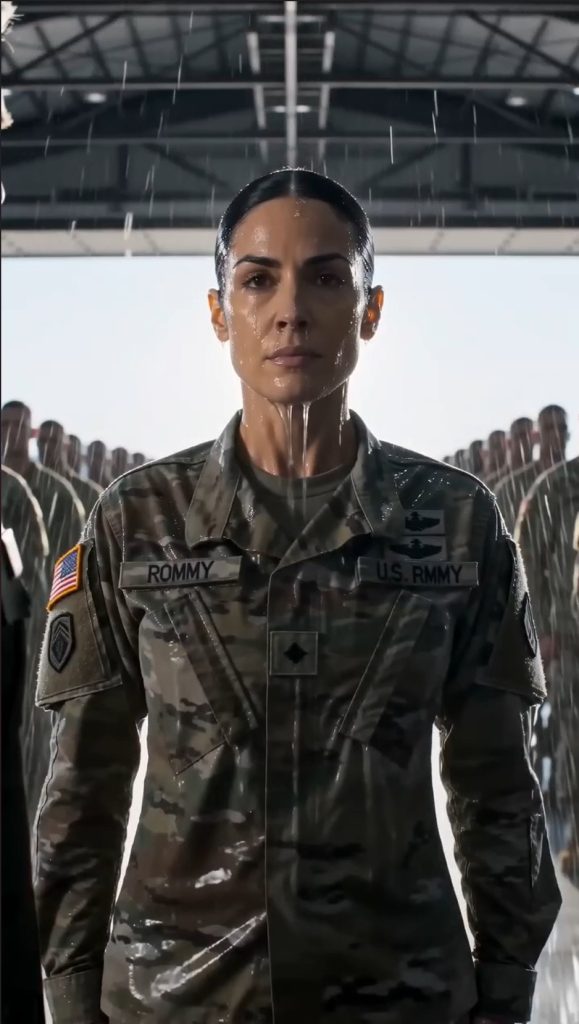
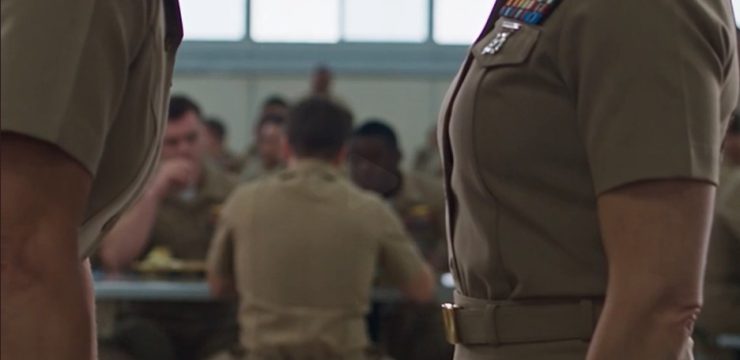
The hangar was so quiet that water dripping from Captain Ramirez’s uniform could be heard striking the concrete.
General Hale stood before her, an empty metal bucket dangling from his hand. His expression carried the unmistakable satisfaction of a man who believed he had just reminded everyone who held the power.
“Too hot for you, Captain?”
Ramirez didn’t answer.
Water slid through her hair, down her cheeks, and beneath the collar of her uniform. Her boots stood in a widening puddle, but her shoulders remained square, her hands resting perfectly still at her sides.
Hale glanced toward the thirty soldiers standing in formation.
“Look at your captain,” he announced. “This is what happens when someone mistakes a uniform for the ability to command.”
No one moved.
Some soldiers kept their eyes forward. Others struggled not to look at Ramirez, knowing that even the smallest reaction might draw the general’s attention.
She could feel their discomfort more sharply than the cold water against her skin.
“Maybe command isn’t meant for people who fall apart this easily,” Hale continued.
Ramirez slowly lifted her chin.
She had endured the humiliation without protest, but there was something unsettling about her silence. It wasn’t surrender. It was the kind of patience that came from knowing something the other person didn’t.
Hale noticed it too.
“Thirty soldiers are standing here watching you embarrass yourself,” he said, stepping closer. “Doesn’t that bother you?”
Her fingers remained relaxed.
“Say something, Captain.”
Nothing.
His jaw tightened.
“Or did that bucket wash away your courage?”
For the first time, Ramirez looked directly into his eyes.
“Are you finished, General?”
The question was quiet enough that the soldiers nearest them almost missed it.
Hale’s expression hardened.
“You don’t get to question me.”
“I wasn’t questioning you, sir.”
She paused, watching his face.
“I was giving you one last chance.”
Something shifted in the hangar.
Hale let out a short, disbelieving laugh, but his smile no longer reached his eyes.
“One last chance?” he repeated. “What exactly do you think you’re going to do?”
Ramirez said nothing.
“Call someone? File a complaint? Tell them a general hurt your feelings?”
A few soldiers lowered their gaze. The humiliation had gone far beyond discipline, and everyone standing there knew it.
Ramirez reached into her pocket.
Slowly, deliberately, she removed her phone.
Her hands weren’t trembling.
Hale watched her with open contempt.
“Go ahead,” he said. “Make your little phone call.”
She raised the phone to her ear.
“I’m not calling to complain.”
“Then what are you doing?”
Her eyes never left his face.
“I’m telling them you’re ready.”
Hale’s smile disappeared.
For several seconds, nothing happened.
Then Ramirez spoke.
“Sir. It happened exactly the way you predicted.”
The general stared at her.
“Who are you talking to?”
Before she could answer, an engine echoed beyond the hangar doors.
A black SUV appeared at the entrance, moving slowly into the sunlight. Its dark windows reflected the rows of soldiers, the abandoned bucket, and the captain standing soaked in the center of the floor.
Hale turned toward the vehicle.
Then back toward Ramirez.
His face had begun to lose its color.
She lowered the phone just enough for him to hear her.
“You should have asked who sent me.”
The words seemed to strike harder than the water ever had.
On the other end of the call, someone began speaking.
Ramirez listened.
Hale stood frozen as the SUV came to a stop.
And just as the next order was about to be given, the general realized something terrifying.
For the first time that morning, he wasn’t the one in control.
What waited behind that vehicle’s dark windows was about to change everything. 👇
The rear door of the SUV opened.
A silver-haired officer stepped onto the concrete, followed by two military investigators carrying sealed folders.
General Hale recognized the officer immediately.
“Admiral Whitmore?”
The older man’s expression remained unreadable.
“General Hale. Step away from Captain Ramirez.”
Hale straightened instinctively, struggling to recover the authority that had slipped from his grasp.
“Admiral, whatever you’ve been told, this is a command matter. I was conducting a disciplinary exercise.”
Whitmore looked at the puddle beneath Ramirez’s boots.
Then at the empty bucket.
“An exercise?”
His voice was quiet.
“Is that what you call this?”
Hale opened his mouth, but Whitmore raised one hand.
“Before you answer, General, understand that this conversation is being recorded.”
A faint mechanical hum drifted through the hangar.
The soldiers remained motionless.
Whitmore approached Ramirez and stopped an arm’s length away.
“Captain, are you injured?”
“No, sir.”
“Do you require medical attention?”
“No, sir.”
He studied her wet uniform, and something softened briefly behind his eyes.
“You can stand at ease.”
Ramirez hesitated.
For nearly three weeks, she had lived under Hale’s relentless scrutiny. Every report questioned. Every decision challenged. Every attempt to protect her soldiers treated as insubordination.
Even now, permission to relax felt unfamiliar.
She finally shifted her weight.
Whitmore turned toward the formation.
“The rest of you may stand at ease as well.”
Thirty pairs of shoulders loosened almost simultaneously.
Hale watched, visibly disturbed.
“Admiral, I demand to know what’s happening.”
Whitmore nodded toward one of the investigators.
The woman opened a folder.
“General Marcus Hale, you are under formal investigation for abuse of command authority, retaliation against personnel, obstruction of military investigations, and falsification of operational records.”
The words spread through the hangar like a shock wave.
Hale’s face tightened.
“This is ridiculous.”
The investigator continued.
“Effective immediately, you are relieved of command pending further proceedings.”
For a moment, nobody moved.
Then Hale laughed.
It was a brittle, desperate sound.
“You cannot remove me based on the accusations of a captain who couldn’t handle discipline.”
Whitmore took one step closer.
“Captain Ramirez isn’t the reason you’re standing here.”
Hale’s eyes flickered.
“She’s the reason your soldiers finally have a chance to tell the truth.”
Ramirez felt her chest tighten.
For weeks, she had prepared herself for this confrontation. She had imagined anger, satisfaction, perhaps relief.
Instead, she felt the cold water soaking through her undershirt.
And she remembered a young sergeant sitting across from her in an empty office, struggling to explain why he had signed a report he knew was false.
Hale’s voice broke through the silence.
“Those soldiers were following lawful orders.”
“Then you should have no objection to their testimony,” Whitmore replied.
Hale turned toward the formation.
His gaze moved from face to face.
No one met his eyes.
“Sergeant Collins!”
A young soldier in the front rank stiffened.
“Tell the admiral what you told me last month.”
Collins swallowed.
His hands curled at his sides.
Hale’s voice sharpened.
“That’s an order.”
“General Hale,” Whitmore interrupted, “you no longer have command authority over that soldier.”
The words landed heavily.
Collins looked toward Ramirez.
She gave him the smallest nod.
He stepped forward.
“Sir,” he began, his voice rough, “the report I signed wasn’t true.”
Hale went still.
Collins forced himself to continue.
“During the field exercise, the communications failure wasn’t caused by Captain Ramirez’s team. We were ordered to proceed after the equipment had already been reported unsafe.”
A low murmur passed through the formation.
Hale snapped his head toward him.
“You signed that report voluntarily.”
“No, sir.”
Collins’s voice trembled.
“You told me that if I didn’t sign it, you’d make sure I never saw another promotion.”
Silence.
“And you said you’d transfer me before my wife finished her medical treatment.”
Ramirez closed her eyes for one brief second.
There it was.
The truth Collins had been too frightened to speak aloud.
Whitmore turned to Hale.
“Do you deny threatening Sergeant Collins?”
“Absolutely.”
One investigator removed a small recording device from her case.
“We have the original audio, General.”
Hale looked toward Ramirez.
His expression changed.
Not anger this time.
Recognition.
“You recorded me.”
Ramirez met his stare.
“I documented what happened.”
Hale stepped forward.
“You planned this. You came into my command intending to destroy my career.”
She didn’t retreat.
“I came here because three soldiers requested help, and every complaint they filed disappeared.”
Whitmore’s expression darkened.
Ramirez continued.
“One was threatened with reassignment. Another was accused of misconduct. The third withdrew his complaint after being told his family would suffer the consequences.”
Hale’s breathing grew shallow.
“And when I asked for the records,” Ramirez said, “you tried to destroy my credibility before I could obtain them.”
The hangar seemed smaller now.
Every soldier was listening.
Hale looked from Whitmore to the investigators.
“You have no idea what it takes to maintain discipline in a unit like this.”
Whitmore’s answer was immediate.
“I know exactly what it takes.”
He glanced toward Collins.
“And I know the difference between discipline and fear.”
One of the investigators stepped beside Hale.
“General, we need your identification and access credentials.”
Hale stared at her outstretched hand.
For years, those credentials had opened doors, summoned soldiers, and protected him from questions.
Now he was being asked to surrender them in front of the very people he had tried to intimidate.
His fingers moved slowly toward his pocket.
But before he handed anything over, he turned toward Ramirez.
“Do you understand what you’ve done?”
Her throat tightened.
He spoke through clenched teeth.
“You’ve made every officer in this command look weak.”
Ramirez looked past him at the soldiers.
At Collins, whose hands were still shaking.
At the youngest private, who had watched the entire morning without once raising his head.
Then she answered.
“No, General.”
Her voice was steady.
“I’ve shown them that rank doesn’t excuse cruelty.”
Hale’s face hardened one last time.
“You’ll regret this.”
Whitmore moved between them.
“That’s enough.”
The investigators escorted Hale toward the SUV.
No one saluted.
No one spoke.
The only sound was the measured rhythm of footsteps against concrete.
At the hangar entrance, Hale glanced backward.
Thirty soldiers remained standing beneath the harsh lights.
For the first time, none of them looked afraid of him.
The vehicle door closed.
And the man who had commanded the entire installation was driven away without another word.
Ramirez watched until the SUV disappeared.
Then her knees nearly gave way.
She caught herself before anyone noticed.
Almost.
“Captain?”
Collins had approached quietly.
He held a clean towel in both hands.
“I found this in the equipment room.”
Ramirez looked at it.
Something about the simple gesture nearly undid her.
She had stood motionless while a general humiliated her before thirty soldiers.
But a young sergeant offering her a towel made her eyes burn.
“Thank you, Collins.”
He hesitated.
“Ma’am, I should’ve spoken sooner.”
She shook her head.
“You spoke when it counted.”
“No,” he whispered. “You stood there and took all of that because we were afraid.”
Ramirez lowered the towel.
“Fear doesn’t make you a coward, Sergeant.”
His eyes filled.
“Neither does asking for help.”
Behind him, several soldiers had begun approaching.
One apologized for remaining silent.
Another admitted that he had witnessed Hale threaten a corporal months earlier.
A third quietly asked whether the investigation meant they could finally speak without losing their careers.
Ramirez answered each one carefully.
“Yes. And we’ll make sure your statements are heard.”
Whitmore watched from a distance.
When the last soldier stepped away, he approached her.
“You handled yourself well.”
Ramirez gave a tired smile.
“I nearly answered him when he picked up the bucket.”
“I know.”
She looked at him.
“You knew he would do something like that?”
Whitmore’s face grew solemn.
“We knew he might try to humiliate you. We didn’t know how far he’d go.”
Ramirez stared at the floor.
“Then why did you let me stand there?”
The question surprised even her.
Whitmore didn’t immediately answer.
“Because you asked us not to intervene before he showed his own soldiers who he was.”
She remembered the conversation.
She remembered insisting that Hale’s conduct had to be witnessed and independently documented.
But understanding the decision didn’t make the experience painless.
“I thought I was prepared,” she admitted.
Whitmore nodded.
“Knowing what someone might do doesn’t stop it from hurting.”
Her lips pressed together.
For the first time that morning, she allowed herself to breathe without measuring every movement.
The investigation continued for months.
Hale initially denied every allegation.
Then the communications records were recovered.
The falsified reports were traced.
More soldiers came forward.
The recordings, documents, and sworn testimony established a pattern of retaliation that had followed Hale through multiple assignments.
At the conclusion of military proceedings, Hale was dismissed from service following conviction on charges arising from his misconduct.
His rank could no longer shield him.
His influence could no longer silence anyone.
When the official findings reached Ramirez, she read them alone at her desk.
She expected satisfaction.
Instead, she sat quietly, remembering every soldier who had once believed nobody would listen.
A knock came at the door.
Collins entered, holding a small envelope.
“Ma’am, the unit wanted you to have this.”
Inside was a photograph.
Thirty soldiers stood together in front of the hangar.
On the back, each had signed his or her name.
Beneath the signatures were five words.
Thank you for standing there.
Ramirez held the photograph for a long time.
Then she noticed a folded letter tucked behind it.
The handwriting was familiar.
It belonged to Private Ellis, the youngest soldier in the formation.
She unfolded the paper.
Captain, my father served for twenty-two years. Before he died, he told me that good leaders don’t need to make people feel small.
When General Hale poured that water over you, I thought you were going to fight back.
But you didn’t.
You waited until the truth could protect all of us.
I wanted you to know something.
That morning, when everyone was afraid to move, I remembered what my father said.
And for the first time since joining this unit, I understood what he meant.
Ramirez’s vision blurred.
At the bottom of the letter was one final sentence.
My father was Sergeant Daniel Ellis. You served under him years ago.
She stopped breathing for a moment.
Daniel Ellis.
The name carried her backward to her first deployment, when she had been a frightened young lieutenant trying desperately not to make mistakes.
Ellis had been the senior sergeant who quietly corrected her reports, checked on exhausted soldiers, and reminded her that leadership was never about being the loudest person in the room.
Once, after she had been publicly criticized by a superior officer, he had found her sitting alone outside the barracks.
He’d handed her a cup of coffee.
And said something she’d carried ever since.
“One day, somebody’s going to need you to be the officer you wish you’d had today.”
Ramirez covered her mouth.
She had known Private Ellis’s surname.
She had never known whose son he was.
The following afternoon, she found him cleaning equipment near the hangar.
“Ellis?”
He turned.
“Ma’am?”
She held up the letter.
“Why didn’t you tell me?”
He looked down.
“My dad always said I should earn my own place.”
Ramirez smiled through sudden tears.
“He was a remarkable man.”
Ellis nodded.
“He talked about you.”
She stared at him.
“Your father talked about me?”
“All the time.”
He gave a shy smile.
“He said you were going to become the kind of commander people could trust.”
Ramirez could no longer speak.
Ellis reached into his pocket and handed her an old military challenge coin.
“My dad wanted me to give you this if I ever served with you.”
She turned it over.
Scratched into the metal were four simple words.
Lead With Courage And Kindness.
That evening, the soldiers gathered outside the hangar for a small meal.
There were no speeches.
No cameras.
Just tired people sharing food, laughing quietly, and speaking more freely than they had in months.
Collins called his wife and told her his transfer had been canceled.
Ellis sat beside Ramirez, listening as she told him stories about his father.
And Whitmore, passing through on his way out, paused to watch the unit together.
“Looks different here,” he said.
Ramirez followed his gaze.
“It feels different.”
The admiral smiled.
“Good.”
As the sun lowered beyond the airfield, Ramirez walked back toward the hangar.
The concrete had been cleaned.
The bucket was gone.
Nothing remained of the humiliation except the memory.
But this time, she didn’t see thirty frightened soldiers watching their captain suffer.
She saw thirty people learning that courage could belong to them too.
Ellis appeared beside her and quietly offered a fresh cup of coffee.
She accepted it.
For a moment, neither spoke.
Then Ramirez looked down at the challenge coin resting in her palm.
Years earlier, a good sergeant had taught a frightened young officer how to stand tall without making anyone else feel small.
Now his son stood beside her, beneath the fading light, no longer afraid of the command he served.
Ramirez smiled and took a sip of coffee.
And for the first time in a very long while, the hangar felt like somewhere they all belonged.