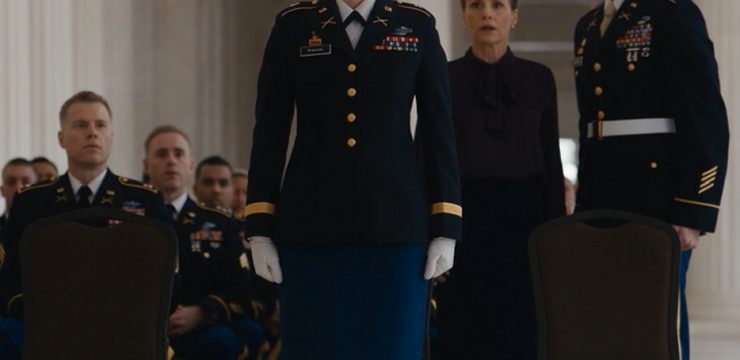
The entire dining hall fell silent when the admiral slammed her fist against the steel counter. She had just given a mysterious woman five seconds to explain herself, unaware that the stranger standing before her carried the authority to turn her entire world upside down.
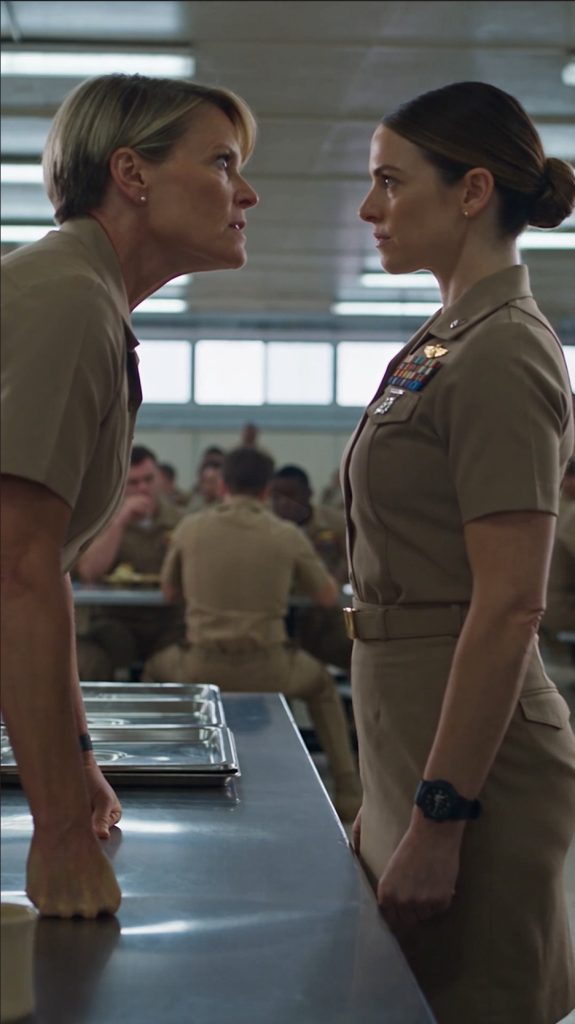
And somewhere across the room, one officer already knew the truth.
“Five seconds,” Admiral Reeves said, her voice cutting through the silence. “That’s how long you have to explain what you’re doing here.”
The woman in black didn’t move.
She stood behind the serving counter, on the wrong side of the line, wearing a fitted black tactical jacket that looked painfully out of place among the Navy uniforms.
Her dark hair was pulled tightly back. Her hands rested calmly at her sides.
There was no identification visible. No nervous explanation. Not even the slightest hint of intimidation.
Instead, she studied the admiral’s face.
“You really don’t recognize me?”
Reeves narrowed her eyes.
The silver stars on her collar caught the harsh fluorescent lighting as she leaned closer.
“I recognize someone who has no business standing in my dining hall.”
At a nearby table, three young sailors exchanged uneasy glances.
One slowly lowered his fork.
“She’s finished,” he whispered to the sailor beside him. “They’re going to escort her straight off the base.”
The admiral heard him.
For a moment, the corner of her mouth lifted.
She had spent years commanding rooms filled with officers who knew better than to question her authority.
And now this stranger, dressed in black, was standing inside her own dining facility as though the rules didn’t apply.
Reeves reached for a white ceramic mug resting near the serving trays.
She pushed it across the stainless-steel counter.
“Take this to my table,” she ordered. “Then get yourself out of here.”
The mug scraped softly against the metal.
The woman looked down at it.
Then back at the admiral.
“I don’t take orders from you.”
A heavy silence settled over the room.
Someone near the entrance shifted uneasily in his chair.
Reeves’s expression hardened.
Across the dining hall, Lieutenant Commander Hale stood holding a coffee pot, her hand frozen halfway toward an empty cup.
She had been watching the exchange from the beginning.
But something about the woman’s face had finally registered.
Her eyes widened.
The color disappeared from her cheeks.
“Oh God,” she whispered.
Reeves didn’t notice the words.
She was too focused on the person who had just refused a direct order in front of her personnel.
“What’s your name?” the admiral demanded.
The woman didn’t raise her voice.
She didn’t reach into her jacket or offer an identification card.
She simply held Reeves’s gaze.
“You should already know.”
Hale carefully lowered the coffee pot.
Her fingers were trembling.
She had seen enough official briefings to understand that certain visitors never announced themselves through ordinary channels.
And she understood something else.
The admiral was dangerously close to making a mistake she couldn’t take back.
Before Hale could cross the room, a burst of static crackled from the wall-mounted radio.
The sound seemed unnaturally loud.
Then a voice came through.
“Command center to Special Inspector Carter.”
Every sailor turned toward the speaker.
Reeves went still.
The woman in black remained exactly where she was.
Hale stepped forward, her voice barely steady.
“Ma’am…”
The admiral kept staring at the stranger.
Hale swallowed.
“She’s from Washington.”
For the first time, Reeves’s confidence seemed to falter.
Only slightly.
A tightening around her mouth. A flicker in her eyes.
The woman across the counter had not moved an inch.
The white mug still sat between them, untouched.
Reeves slowly straightened her shoulders.
The room waited.
Then her voice dropped to something colder than anger.
“Now,” she said, looking directly at the woman in black, “let’s talk about what you’ve been hiding.”
And in that terrible silence, nobody knew which woman was about to be exposed. 👇
Carter reached into her jacket.
Reeves instinctively stepped back.
But the inspector withdrew only a folded document, its edges worn from being handled too many times.
“Before we discuss what I’ve been hiding, Admiral, perhaps you’d like to explain why three safety reports disappeared from your command records.”
The silence deepened.
Reeves stared at the paper.
“I have no idea what you’re talking about.”
“That’s interesting,” Carter replied. “Because your signature appears on every one of them.”
Hale gripped the back of an empty chair.
Reeves noticed.
Her eyes moved toward the lieutenant commander, and something dangerous passed across her face.
“Hale. My office. Immediately.”
“She’s staying,” Carter said.
“You don’t command my officers.”
“No,” Carter answered. “But I have written authorization to interview them without interference.”
She unfolded the document and placed it beside the untouched mug.
An official seal gleamed beneath the fluorescent lights.
Reeves looked down.
For several seconds, she said nothing.
Then she laughed softly.
“You’ve come all the way from Washington over paperwork?”
Carter’s expression didn’t change.
“Three months ago, a sailor reported that emergency suppression equipment aboard one of your vessels had failed two separate inspections.”
Reeves crossed her arms.
“The equipment was repaired.”
“The repair authorization was dated eleven days before the replacement parts arrived.”
A low murmur moved through the room.
Carter continued.
“The sailor who reported the problem was removed from operational duty. His evaluation was rewritten. Two others were warned that speaking about the incident would damage their careers.”
Hale closed her eyes.
She remembered those warnings.
She remembered the young faces across her desk, the way frightened sailors tried to sound professional while asking whether telling the truth could cost them everything.
Reeves tapped the document.
“You’re accepting accusations from disgruntled personnel.”
“I’m comparing their statements with procurement records, inspection photographs, and the original maintenance logs.”
Carter paused.
“Records someone inside this command tried very hard to destroy.”
Reeves’s attention snapped toward Hale.
“You.”
Hale looked up.
The admiral’s voice sharpened.
“You’ve been communicating with Washington behind my back.”
Hale’s lips parted, but no words came.
For years, she’d admired Reeves.
The admiral had once encouraged her career, praised her judgment, and made her believe that loyalty meant protecting the people beneath her.
Then the inspections failed.
And loyalty became something else.
A demand for silence.
“Hale,” Reeves said, “think very carefully about what you say next.”
Carter turned toward the lieutenant commander.
“You don’t have to answer her.”
But Hale shook her head.
“Yes,” she whispered. “I do.”
She stepped away from the chair.
“I submitted the first report.”
Reeves went motionless.
“I brought you the photographs,” Hale continued. “I showed you the inspection results. You told me the problem had already been addressed.”
“It had.”
“You told me to sign the corrected report.”
“And you did.”
Hale’s eyes filled.
“Yes.”
The admission seemed to take something out of her.
“I signed it because I trusted you.”
For a moment, only the ventilation system could be heard.
Then Reeves leaned forward.
“Thank you, Commander. You’ve just admitted your own involvement.”
Hale’s face crumpled.
Carter watched the admiral carefully.
There it was.
The instinct that had protected Reeves for years: whenever accountability came close, she found someone with less power to carry it.
“You’re correct about one thing,” Carter said. “Commander Hale signed that document.”
Reeves smiled.
“But you haven’t heard what happened afterward.”
The inspector opened a slim folder.
Inside was another page.
A handwritten statement, dated two days after the falsified inspection.
Hale recognized her own writing.
She brought a trembling hand to her mouth.
“I filed that with the inspector general,” she whispered.
“Yes,” Carter said.
Reeves’s smile disappeared.
The statement described the failed equipment, the altered documentation, and the pressure Hale had received to approve the changes.
It also contained one sentence Carter had underlined.
I am submitting this because the sailors under my supervision deserve equipment they can trust, even if making this report ends my career.
Reeves stared at the handwriting.
Then she reached for the paper.
Carter moved it out of reach.
“That’s not all.”
She placed a small digital recorder on the counter.
Reeves’s breathing changed.
Barely.
But Hale noticed.
Carter pressed a button.
The admiral’s own voice filled the dining hall.
“Those inspection figures are not leaving this office.”
A pause.
Then Hale’s voice.
“Ma’am, if the equipment fails at sea—”
“It won’t.”
“But if it does?”
Another pause.
“Commander, you have a career worth protecting. Don’t make me regret putting you in that position.”
The recording ended.
No one moved.
Reeves stared at the device as though she could force the words back inside it.
“You recorded a private conversation?” she demanded.
Hale wiped her cheek.
“I thought nobody would believe me.”
Reeves’s face reddened.
“You violated my trust.”
Hale looked at her for a long moment.
Then, quietly, she answered.
“No, ma’am. You used it.”
Something in the room shifted.
Not loudly.
Not dramatically.
But every sailor who had lowered his eyes when Reeves entered now seemed to be looking directly at her.
The admiral turned toward Carter.
“I want your superior on the phone.”
“They’ve already reviewed the evidence.”
“This is an outrageous attack on my command.”
“This is an investigation into what happened under your command.”
Reeves stepped closer.
“Do you have any idea what I’ve sacrificed for this Navy?”
For the first time, Carter’s voice carried an unmistakable edge.
“I know exactly what service costs, Admiral. That’s why we don’t ask junior sailors to pay for mistakes their commanders refuse to acknowledge.”
Reeves opened her mouth.
Nothing came out.
The radio crackled again.
“Inspector Carter, the command representatives have arrived.”
Through the glass doors, two senior officers appeared alongside a legal representative.
Carter gathered her papers.
“Admiral Reeves, you’ve been directed to relinquish command pending formal proceedings. You’ll receive the written order and an opportunity to respond through the appropriate channels.”
Reeves looked past her at the waiting officers.
For one brief second, she seemed smaller.
Then she turned toward Hale.
“You’ve destroyed everything I’ve built.”
Hale struggled to hold her gaze.
“No,” she said. “I stopped helping you hide what was broken.”
Reeves had no answer.
When she walked toward the doors, the sailors moved aside.
Not out of admiration.
Simply to let her pass.
The sound of her footsteps faded down the corridor.
Nobody applauded.
Nobody celebrated.
Hale sat heavily in the nearest chair and covered her face.
Carter gave her a moment before pulling out the chair opposite.
“Commander.”
Hale shook her head.
“I should have refused to sign.”
“Yes,” Carter said gently. “You should have.”
Hale looked up, startled by the answer.
Carter didn’t soften it.
“But you came forward. You preserved evidence. And when you were threatened, you told the truth again. Those things matter, too.”
Hale stared at the white mug.
“I thought I’d ruined those sailors’ lives.”
“You hurt their trust,” Carter replied. “Rebuilding that will take more than one statement.”
Hale nodded slowly.
“Then I’ll do the work.”
In the months that followed, the investigation expanded beyond the dining hall.
The original inspection records were restored. The sailors who had been punished for reporting the failures received corrected evaluations and formal acknowledgment of the retaliation.
The vessel’s equipment was repaired and independently tested before being cleared for further service.
Hale accepted responsibility for signing the false report. Her cooperation did not erase that decision, but it helped establish exactly how the pressure had been applied.
Reeves’s actions were examined in formal proceedings.
The evidence proved that she had knowingly approved false records and retaliated against personnel who challenged them.
She was permanently removed from command and eventually separated from naval service following the disciplinary process.
Her career did not end because an inspector embarrassed her in public.
It ended because the people she had tried to silence finally had the evidence to be heard.
Yet the most unexpected moment came much later, when Carter returned to the same dining hall.
Hale was waiting beside the serving counter.
“You never answered her question,” Hale said.
Carter looked puzzled.
“Which one?”
“Why she should have recognized you.”
Carter smiled faintly.
“Years ago, I was a junior sailor assigned here temporarily. I worked this serving line during an inspection.”
Hale stared at her.
“Here?”
Carter nodded.
“I tried to report a maintenance problem. Admiral Reeves told me to stop wasting her time and bring coffee to the visiting officers.”
Her eyes moved toward the counter.
“She never asked my name.”
Hale’s expression softened.
“So that’s why you stood there.”
“Partly.”
Carter reached into her folder and removed a small envelope.
“There’s something else.”
Inside was a photocopy of an old handwritten complaint.
Hale recognized the handwriting immediately.
It belonged to one of the young sailors whose career had nearly been destroyed.
But beneath his signature were several more.
She read them slowly.
The sailors from the dining hall.
The same men who had sat quietly while Reeves threatened Carter had privately helped preserve inspection photographs and records.
“They knew?” Hale whispered.
“They knew an investigator was coming. They didn’t know when.”
Hale pressed the paper against her chest.
For months, she’d believed those young men hated her for failing to protect them.
“They could have left me to face this alone.”
Carter glanced toward the tables.
“They said you were the first officer who ever listened when they told you something was wrong.”
Hale’s eyes filled again.
This time, she didn’t hide them.
A young sailor approached from the serving line, carrying two fresh mugs of coffee.
He was the same one who had predicted Carter would be escorted off the base.
“Commander,” he said awkwardly, placing a mug before her.
Hale looked up.
“I owe you an apology.”
He shifted his weight.
“You already gave us one, ma’am.”
“That doesn’t make everything right.”
“No,” he answered.
Then he pulled out a chair.
“But it makes it easier to start.”
Hale nodded, unable to speak.
Carter watched them quietly, then reached for her own coffee.
Outside, the afternoon sunlight stretched across the windows, turning the steel counters warm and gold.
The dining hall was noisy again.
Sailors laughed over unfinished meals. Chairs scraped the floor. Someone called for another cup of coffee.
Nothing about the room looked extraordinary.
But the people inside it understood what had changed.
No one would have to choose between protecting their career and reporting a danger without knowing there were others prepared to stand beside them.
Hale lifted her mug with both hands.
Across the table, Carter finally took a sip.
And in the very place where a white mug had once been used to humiliate a stranger, two women sat among the sailors they had fought to protect, sharing coffee without fear, while the ordinary, beautiful sound of a safe room carried on around them.