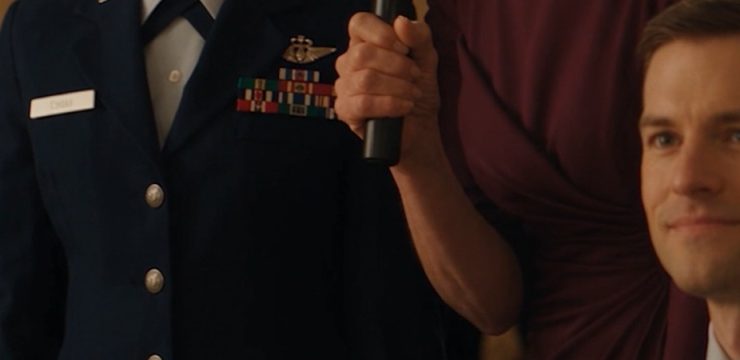
The moment her mother leaned close and whispered, “Don’t embarrass your brother today,” Major Emily Carter felt something inside her go painfully still.
She had spent years learning to survive those words without reacting. But this morning, surrounded by hundreds of decorated officers, her mother had no idea how close she was to discovering the truth.
And Emily wasn’t going to warn her.
The grand military hall glittered beneath towering lights. Rows of officers stood in immaculate dress uniforms, their medals catching the light whenever they moved. The air carried the quiet weight of ceremony, tradition, and carefully guarded pride.
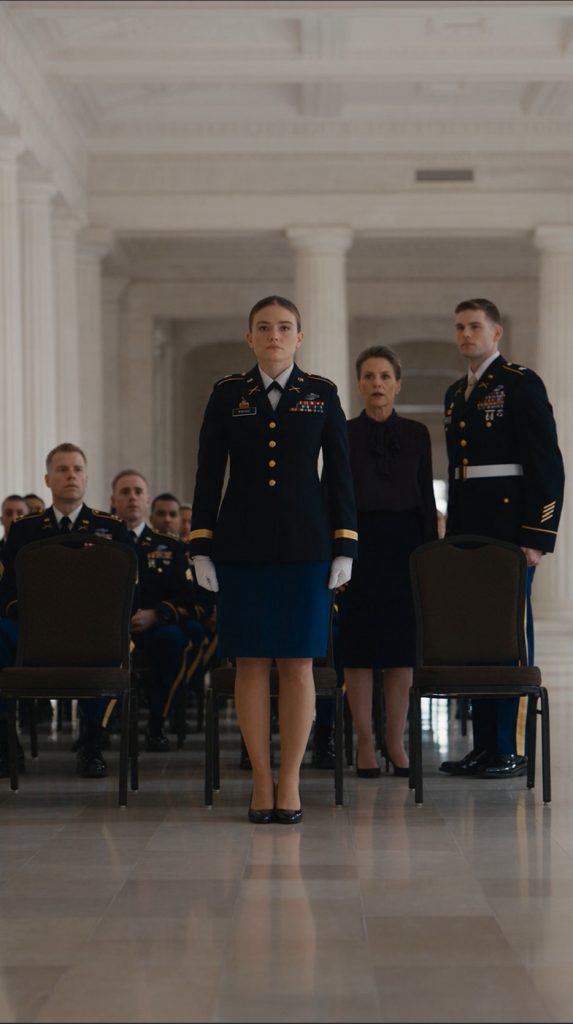
Emily stood in the center aisle, her back straight, her expression unreadable.
Behind her, her mother adjusted her elegant jacket, watching the stage with unmistakable excitement. Every trace of warmth in her face seemed reserved for the son standing near the podium.
Emily had learned long ago not to expect any of it for herself.
Her brother stepped forward as another ribbon was presented. Applause rolled through the hall, and their mother immediately approached him, smiling with a tenderness Emily could barely remember receiving.
With practiced care, she pinned the ribbon onto his uniform.
“Now that,” she said proudly, loud enough for the nearby officers to hear, “is what an officer should look like.”
A few people smiled. Others nodded approvingly.
Emily remained silent.
She had worn her own uniform through years of service, sacrifice, and responsibilities she was never permitted to discuss. Yet somehow, standing only a few feet from her family, she still felt like the daughter who could never quite measure up.
Her brother turned toward her when the applause faded.
He approached with a confidence that had followed him since childhood, then lowered his voice.
“Mom says you’re being transferred.”
Emily watched his expression carefully.
There was curiosity in his eyes, but something else, too. The familiar certainty that whatever happened to Emily could never matter as much as his own achievements.
“She doesn’t know why I’m here,” Emily replied.
Her brother frowned.
Before he could ask another question, a sharp click echoed from the podium.
The microphone had been switched on.
An officer stepped forward, holding a document. His expression was solemn, and when he began speaking, even the faintest whispers disappeared.
“There is one officer whose identity has been withheld until this morning.”
A strange stillness settled over the room.
Emily’s mother glanced toward the stage, visibly intrigued. Her brother straightened his shoulders, as though preparing for another announcement.
Then the officer spoke again.
“Major Emily Carter.”
For a moment, nothing moved.
Her mother’s smile vanished so completely that she seemed almost unfamiliar. One hand remained suspended near her son’s freshly pinned ribbon.
Emily’s brother slowly turned his head.
He looked at her as though he had heard the wrong name.
Emily, now seated among the officers, kept her white-gloved hands folded neatly in her lap. Her eyes remained lifted, calm and distant, while the silence around her grew almost unbearable.
She had imagined this moment before.
Not with satisfaction. Not with revenge.
Only with the quiet understanding that some truths could not remain hidden forever.
The officer returned to the microphone.
“Please stand.”
Chairs scraped across the polished floor.
Hundreds of officers rose together, a single movement sweeping through the enormous hall.
Emily remained seated for one breath longer.
Then she stood.
Her mother’s lips parted, but no words came. Her brother’s confidence disappeared as he whispered, “Emily?”
For the first time, both seemed to understand that this ceremony had never been only about him.
Emily did not turn.
She faced the flag, her shoulders squared, while the officer at the podium lowered his eyes to the next line of the document.
Her mother took an uncertain step forward.
Then the officer raised his head, preparing to reveal why Major Emily Carter had been summoned.
And the words he was about to speak would change everything that family believed. 👇
“Major Carter, please come forward.”
Emily stepped into the aisle. The sharp sound of her shoes against the polished floor seemed impossibly loud.
At the podium, the officer waited until she reached the stage.
“By direction of the Secretary of the Army, Major Emily Carter is awarded the Distinguished Service Medal for exceptionally meritorious service in a position of extraordinary responsibility.”
Her mother’s hand flew toward her mouth.
The officer continued, describing an operation whose classified details had only recently been cleared for public acknowledgment. Emily had coordinated the evacuation of military personnel and civilians during a rapidly deteriorating overseas crisis, refusing to abandon the command post until the last evacuation convoy had reached safety.
Three nights without proper sleep. Communications failing. Injured personnel arriving faster than transportation could carry them.
And one major who had accepted responsibility when every available option carried a terrible risk.
Emily stared straight ahead as the citation was read.
She remembered the faces more clearly than the danger. A young medic who had cried quietly after loading his final patient. An exhausted driver whose hands shook so badly he could barely hold his canteen.
Those were the people she wished were standing beside her.
When the medal was placed around her neck, the hall erupted into applause.
Her brother joined slowly, his hands moving almost mechanically.
Their mother did not clap.
She was staring at the stage, trying to reconcile the daughter she had belittled that morning with the officer now receiving the room’s highest recognition.
Then the commanding general stepped forward.
“Major Carter,” he said, extending his hand, “your team speaks of you with extraordinary respect. You should be proud of what you accomplished together.”
“Thank you, sir.”
His voice softened.
“And for clarity, your upcoming transfer is an assignment to a senior operational planning position. Your command recommended you personally.”
In the front row, Emily’s mother lowered her eyes.
Her brother looked sharply toward her.
“Mom,” he whispered, “you said she was being removed.”
“Not here,” she answered.
But Emily heard them.
And something in her chest tightened.
Because she knew exactly where that story had come from.
Following the ceremony, officers surrounded Emily with congratulations. Several shook her hand. Others spoke quietly about colleagues who had served alongside her.
Her brother waited until the crowd thinned.
“Emily, can we talk?”
She studied him for a moment.
“Outside.”
They found an empty corridor beyond the reception hall, where afternoon sunlight cut across the marble floor.
Their mother followed.
“Emily,” she began, forcing a trembling smile, “why didn’t you tell us?”
Emily removed her gloves slowly.
“Tell you what?”
“That you were receiving something so important.”
“You knew I was serving.”
“That isn’t what I mean.”
“I know.”
The words settled between them.
Her brother folded his arms.
“Mom told me your transfer was disciplinary. She said she’d heard it from someone at headquarters.”
Emily looked toward her mother.
“Did she tell you who?”
Their mother stiffened.
“I was only concerned about you.”
Emily held her gaze.
“Did you contact my commanding officer?”
No answer.
Her brother’s expression changed.
“Mom?”
Finally, their mother looked away.
“I sent a letter. I thought someone needed to know that you weren’t being honest with your family.”
Emily closed her eyes briefly.
She had learned about the letter weeks earlier. Her commander had shown it to her privately, explaining that its unsupported accusations had been reviewed and dismissed.
She had chosen not to confront her mother before the ceremony.
Until that moment, she had hoped the accusations came from misunderstanding rather than deliberate cruelty.
“You told my command I was unstable,” Emily said quietly. “That I exaggerated my responsibilities. That I couldn’t be trusted.”
Her brother stared at their mother.
“You actually wrote that?”
“I was trying to protect her career.”
Emily gave a small, disbelieving breath.
“By questioning whether I deserved to have one?”
Her mother straightened, reaching for the authority she had always used to end uncomfortable conversations.
“I am still your mother.”
“And I’m still your daughter.”
Emily’s voice barely rose.
“But you wrote things about me you knew weren’t true.”
A door opened at the far end of the corridor.
The commanding general appeared with a senior officer, paused when he noticed the family, and approached Emily.
“Major Carter, your commander asked me to confirm that the correspondence issue is closed. The allegations were found without merit and had no bearing on your assignment.”
Emily nodded.
“Thank you, sir.”
The general’s gaze moved briefly toward her mother.
“Professional evaluations are based on verified evidence, ma’am. Not family opinions.”
He offered Emily a respectful nod and continued down the corridor.
No one spoke until his footsteps faded.
Her mother stared at the floor.
For years, she had controlled how Emily was described within their family. She decided which achievements mattered, which disappointments were remembered, and whose approval everyone should seek.
Now her words had reached beyond their home.
And they had failed.
Her brother stepped away from her.
“I repeated what you told me,” he said. “To people I work with.”
His mother reached for his sleeve.
“Please, don’t make this into something—”
He pulled his arm back.
“You made me believe my sister was disgracing our family.”
Emily watched his face.
For the first time, he seemed to be examining his own part in what had happened.
He turned toward her.
“I should have asked you.”
“Yes,” Emily answered.
He swallowed.
“I liked believing I was the successful one.”
That admission hurt more than she expected.
“Why?”
He looked toward the hall where his ribbon had been presented.
“Because Mom always made it seem like there was only room for one of us.”
Their mother began crying.
“I did everything for this family.”
Emily’s expression softened, but she did not move closer.
“You did a lot for us, Mom. I won’t pretend otherwise.”
Her mother looked up hopefully.
“But you also taught me that loving you meant making myself smaller.”
The tears continued, but Emily no longer felt compelled to stop them.
“I spent years waiting for you to be proud of me,” she said. “Today, I finally understood I don’t need to keep waiting.”
Her mother reached toward her.
Emily gently stepped back.
“I need some distance. And I need you to respect it.”
The finality of that request seemed to frighten her mother more than the medal, the general, or the ruined accusations.
This time, she had no argument that could restore her authority.
Her son stood beside Emily.
Not against their mother.
Simply no longer willing to stand between her and the consequences of her choices.
That evening, Emily returned to the nearly empty hall to retrieve a folder she had left with the ceremony staff.
Only a few lights remained illuminated.
Near the podium, an elderly sergeant major was carefully placing unused programs into a cardboard box.
He recognized her immediately.
“Major Carter.”
“Sergeant Major.”
He smiled.
“Thought you might want this.”
He handed her a small envelope.
Inside was a photograph taken during the evacuation operation. A group of exhausted service members stood beside a transport aircraft, covered in dust, their faces lined with fatigue.
Emily was near the edge of the frame, helping another officer support an injured man.
On the back, several people had written their names.
Beneath them was a message.
You kept telling us nobody gets left behind. You kept your word.
Emily pressed her thumb against the corner of the photograph.
The sergeant major watched her quietly.
“Your team asked us to make sure you received that after the ceremony.”
She smiled, though her eyes had filled.
“Thank you.”
Then he hesitated.
“There’s something else you ought to know.”
Emily looked up.
“The ceremony staff asked whether your family would help arrange a private presentation before the official event. Your mother said your brother’s award was the family’s priority.”
Emily stared at him.
He continued gently.
“So your people made a different request. They wanted you recognized publicly, in front of the officers you helped bring home.”
For several seconds, Emily could not answer.
All morning, she had believed the secrecy surrounding her recognition was simply a matter of military procedure.
Now she understood something else.
The people who had served beside her had quietly made sure she would not be overlooked again.
The sergeant major placed the last programs into the box.
“They wanted you to see how many people knew what you did.”
Emily looked at the photograph again.
She had spent so much of her life trying to earn a place in her own family that she had almost missed the family she had built through service.
“Please tell them,” she whispered, “that I remember every one of them.”
Over the following months, her relationship with her mother changed.
Emily stopped accepting the Sunday calls that began with criticism disguised as concern. She answered letters when she felt ready, and refused invitations that came with conditions.
Her mother eventually sent a written apology.
It did not erase the years.
But for the first time, it contained no excuses.
Her brother began visiting her without their mother. Sometimes they talked about childhood. Sometimes they sat over coffee, struggling with the things neither had known how to say.
At one visit, he brought his ceremonial ribbon.
“I used to think this meant I had finally beaten you at something,” he admitted.
Emily shook her head.
“We were never supposed to be competing.”
“I know that now.”
He placed the ribbon back inside its case.
“I’m proud of you, Em. I should have said that years ago.”
She reached across the table and squeezed his hand.
“I wanted to hear it.”
He nodded, unable to meet her eyes.
And that was enough for the moment.
By the following spring, Emily had settled into her new assignment.
One quiet weekend, her brother visited with their mother. Emily had agreed to a short meeting, with no promises beyond a conversation.
They sat together in her small garden while sunlight warmed the stone path.
Her mother looked older than Emily remembered.
“I don’t expect you to trust me because I’ve apologized,” she said.
Emily listened.
“I know.”
“I’d like to earn a place in your life again. Whatever that looks like.”
Emily glanced toward her brother, who sat quietly beside them.
“Then we start with honesty,” she said. “And we take our time.”
Her mother nodded.
No grand embrace followed.
No perfect words repaired the past.
But when Emily brought out three cups of tea, her mother stood and helped carry them without offering a single criticism.
Later, after they had gone, Emily returned to the garden.
Inside the house, her medal rested in its case beside the photograph of her team.
She sat beneath the fading evening light, holding the handwritten message one last time before placing it beside the medal.
For most of her life, she had believed recognition meant finally becoming someone her mother could admire.
Now she understood.
She had already become someone worth respecting, long before anyone stepped up to a microphone.
And as the last warmth of the sun settled across her hands, Major Emily Carter smiled—not because she had finally been seen by everyone, but because she no longer needed anyone’s permission to see herself.