The little girl’s hand was inches from a slice of cake when a woman’s furious voice cut through the glittering charity gala.
“Don’t touch that! That food isn’t for children like you.”
Three hundred wealthy guests stood frozen beneath the chandeliers. And across the garden, a young billionaire named Damon Cross had just witnessed something he would never be able to ignore.
The string quartet fell silent. A waiter slowly lowered his tray of champagne glasses. Beneath the golden lanterns hanging between magnolia trees, every conversation stopped as attention turned toward the marble dessert table.
There stood a barefoot little girl, no older than five.
Her brown curls were tangled, her blouse torn along the hem. Dirt marked her knees, and her small toes pressed nervously into the damp grass.
She was painfully thin.
Damon noticed her wrists first, fragile beneath the sleeves of her worn blouse. She looked as though she had gone without proper meals for far too long.
Yet somehow, in a garden filled with people gathered to fight childhood poverty, she was the one being treated as though she didn’t belong.
Towering over her was Elisa Rochefort, a prominent donor dressed in red satin, diamonds sparkling at her throat and wrist.
“How did you get inside?” Elisa demanded, her expression tightening with disgust. “Where is security?”
The little girl flinched.
Her eyes wandered toward the enormous banner stretched across the entrance.
Annual Gala: Helping Children in Need.
She couldn’t read every word. But the pictures displayed around the garden were simple enough to understand: smiling children, baskets of bread, books, and promises of a better future.
Perhaps those pictures had given her courage to walk inside.
Perhaps, for one brief moment, she had believed this was a place where someone like her could ask for food without being afraid.
“Please, ma’am,” she whispered, barely lifting her eyes. “I only wanted one piece.”
Elisa drew back as though the child had attempted to steal something precious.
“I said that food is not for you.”
The girl’s hand fell immediately.
Damon felt something tighten inside his chest.
He looked around at the guests, their tailored suits, exquisite jewelry, and champagne glasses. Some avoided his gaze. Others stared at the child with uncomfortable curiosity.
No one moved to help her.
The irony was unbearable.
Only moments earlier, those same people had been applauding speeches about compassion. They had pledged enormous donations beneath a banner promising hope to vulnerable children.
But when a hungry child appeared directly before them, compassion had disappeared.
Damon started walking.
He passed silent board members, wealthy donors, and photographers who hesitated with their cameras. His polished shoes sank slightly into the damp lawn.
The air smelled of roses, expensive perfume, and the approaching rain.
When the little girl noticed him coming, she stiffened.
Her eyes followed every step.
Damon recognized that expression. It was the instinctive fear of a child who had learned that approaching adults might mean trouble.
He slowed immediately.
Elisa turned toward him, seemingly prepared to explain herself.
But Damon didn’t acknowledge her.
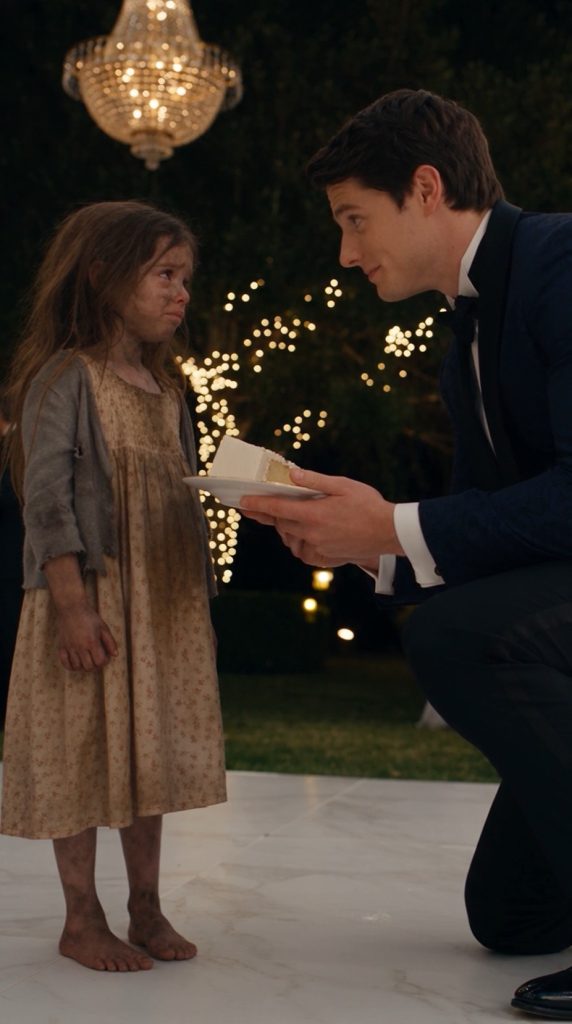
Instead, he reached for a clean porcelain plate.
Beside them stood an elaborate five-tier cake decorated with delicate golden sugar flowers. Elisa herself had insisted on the extravagant centerpiece, claiming its beauty would inspire greater generosity.
Without asking permission, Damon carefully cut a generous slice.
He placed it on the plate and added a fresh strawberry.
The guests watched in absolute silence.
Then the young billionaire did something nobody expected.
He lowered himself onto one knee, bringing his eyes level with the frightened little girl’s.
For the first time that evening, someone was looking at her without judgment.
His voice softened.
“What’s your name, sweetheart?”
The girl’s lips trembled. She looked at the cake, then at Elisa, before turning her frightened eyes back toward Damon.
For several seconds, she couldn’t speak.
And when she finally opened her mouth, Damon leaned closer to hear the words that were about to change the entire evening. 👇
“My name is Lily,” she whispered. “Do you know where my mommy went?”
Damon kept the plate steady, although something in her question made his chest tighten.
“What’s your mommy’s name?”
“Anna.” Lily swallowed. “She said she’d come back before it got dark. But the people at our house told us we couldn’t stay anymore.”
Behind Damon, Elisa shifted.
“Mr. Cross, this is becoming rather inappropriate. Security can handle the situation.”
Damon raised one hand without looking at her.
“Lily, what house?”
“The one with all the beds. Mommy says it’s where people go when they don’t have homes.”
A faint murmur passed through the crowd.
Damon knew the place. Haven House was a family shelter his charitable foundation had been funding for three years. At the previous board meeting, Elisa had personally presented a glowing report about its expansion.
“Was it Haven House?” he asked.
Lily nodded.
“They locked the doors this morning. Mommy cried, but she told me everything would be okay.”
Damon looked toward Elisa.
For the first time that night, the woman in red seemed to struggle for an answer.
“Haven House is undergoing temporary restructuring,” she said. “These things happen in nonprofit operations.”
“Your report said they had enough funding for another eighteen months.”
“And they do, technically. There are administrative complications.”
Damon turned back to Lily.
“Did your mommy come here with you?”
Lily shook her head.
“She went to find the lady who took our money.”
The words were quiet enough that Damon nearly missed them.
“What lady?”
Lily’s eyes moved past his shoulder.
And stopped on Elisa.
The air seemed to leave the garden.
Elisa gave a sharp, humorless laugh.
“This is ridiculous. You’re seriously going to entertain accusations from a child who wandered in off the street?”
Damon stood slowly.
“I’m going to find her mother.”
He asked the nearest waiter to bring Lily water and something more substantial than cake. Then he turned to the security director, who had appeared beside the dessert table.
“Please find Anna from Haven House. And nobody is to remove this child.”
Before the man could answer, a woman’s voice broke through the gathering.
“Lily!”
A woman in a faded blue cardigan pushed past two security guards near the garden entrance.
Her hair was damp with sweat. One sleeve had been torn at the elbow. She was breathing so hard that she nearly stumbled when she saw her daughter.
“Mommy!”
Lily ran.
Anna dropped to her knees and caught her, holding the little girl against her chest with both arms.
“Where were you?” she whispered, pressing kisses into Lily’s tangled curls. “I looked everywhere. I thought—”
She couldn’t finish.
Lily clung to her.
“I was hungry, Mommy. I’m sorry.”
Anna pulled back just enough to see her daughter’s face.
“You never have to apologize for being hungry.”
Damon looked away for a moment.
He had spent years attending fundraising dinners, approving grants, signing enormous checks. Yet he couldn’t remember the last time he had stood close enough to the people receiving that money to hear a sentence like that.
Anna noticed him.
Her expression changed when she recognized his face.
“Mr. Cross?”
“You know me?”
“I’ve written to your foundation eleven times.”
Elisa stepped forward immediately.
“Anna, this is neither the place nor the time.”
Anna’s hands tightened around Lily.
“No,” she said, trembling. “You told me that last month. And the month before.”
Damon’s voice became very still.
“What happened to Haven House?”
Anna reached into her cardigan and removed a folded envelope. Its edges were softened from being carried and handled repeatedly.
“We were supposed to receive the winter funding in July. We never did. The pantry emptied first. Then the electricity was shut off in one wing.”
She took a shaky breath.
“Last week, we were told the shelter could no longer afford to remain open.”
Elisa folded her arms.
“That is a gross oversimplification.”
Anna didn’t look at her.
“I asked for the financial records. They told me the grants had already been paid.”
Damon took the envelope.
Inside were copies of unanswered letters, overdue utility notices, and a statement from the shelter’s bank showing that the promised funding had never arrived.
He knew the amount immediately.
Two million dollars.
He had approved it himself.
“Where is that money?” he asked Elisa.
Her expression hardened.
“I will not be interrogated in front of guests.”
“Then answer one question. Did Haven House receive the grant?”
Elisa glanced around the garden.
“Funds are allocated through several administrative channels.”
“That wasn’t my question.”
Silence.
Damon turned toward the foundation’s treasurer, Martin Hale, standing near the front of the crowd.
“Martin, what do the records show?”
Martin hesitated.
His gaze moved from Elisa to Anna, then to the barefoot girl holding her mother’s hand.
“The accounts show that Haven House received the full amount.”
Anna shook her head.
“We didn’t.”
Martin’s face drained.
For several seconds, the only sound was the distant rumble of thunder.
Then he reached into his jacket and removed his phone.
“There were discrepancies in the quarterly reports,” he admitted. “I requested supporting invoices last week.”
“From whom?” Damon asked.
Martin looked at Elisa.
“She told me the paperwork had already been reviewed.”
Elisa’s voice rose.
“Because it had!”
Martin shook his head.
“Not by me.”
Damon had known Martin for years. The man’s hands were visibly shaking as he opened an email.
“The payments weren’t sent to the shelter’s account,” Martin said. “They were transferred to a management company listed as an outside contractor.”
He turned the screen toward Damon.
The company name was Rochefort Advisory Services.
For a moment, Damon simply stared.
Elisa’s family name.
Anna looked between the men, struggling to understand the significance of what she was hearing.
“Does that mean the money was never coming?” she asked.
Nobody answered immediately.
Lily pressed closer to her mother.
Elisa straightened.
“My company provided legitimate administrative services. Every payment was authorized.”
“By you,” Martin said quietly.
She turned on him.
“You signed the financial statements.”
“Yes,” he replied. “And I’ll have to answer for that.”
The admission seemed to take something out of him.
Damon looked toward the lanterns, the flowers, the extravagant cake.
Then back at Anna.
“How many families lost their rooms?”
“Thirty-two,” she whispered. “Some have children younger than Lily.”
Damon closed his eyes briefly.
Thirty-two families.
While he had been preparing his speech about generosity, thirty-two families had been packing whatever they could carry.
He turned toward Elisa.
“You knew.”
She didn’t answer.
“You knew the shelter was closing, and you stood here tonight talking about how much we’d accomplished.”
Elisa’s composure finally cracked.
“Do you have any idea how much work I’ve done for this foundation? How much money I’ve brought into this room? You think wealthy people attend these events because they enjoy hearing about poverty?”
Damon stared at her.
Elisa gestured toward the decorations.
“They come because of the experience. The elegance. The connections. That’s how fundraising works.”
Anna spoke before Damon could answer.
“My daughter slept outside a locked shelter today.”
Elisa fell silent.
Anna’s voice trembled, but she continued.
“You were talking about which flowers would impress your guests. I was trying to explain to a little girl why her bed was gone.”
Nobody moved.
Damon handed Martin the envelope.
“Preserve every record. The bank statements, payment approvals, contracts, emails. Everything.”
He turned to the foundation’s board members.
“I am requesting an immediate emergency vote to remove Elisa from every position of authority and refer these transactions for independent forensic investigation.”
Elisa laughed bitterly.
“You can’t destroy my reputation over this.”
“No,” Damon replied. “Your decisions have done that.”
The board members withdrew into the adjoining reception room with Martin and the foundation’s legal counsel. Elisa followed them, still arguing, while Anna and Lily remained beneath the lanterns.
Damon stayed behind.
For the first time, the glittering gala seemed unbearably cold.
He brought Anna a chair and sat across from her while Lily ate a warm meal the kitchen staff had prepared.
“I owe you an apology,” he said.
Anna stared down at her hands.
“You didn’t close the shelter.”
“I signed the checks. I attended the meetings. I believed the reports because they looked impressive.”
He paused.
“I never went to see whether the doors were still open.”
Anna looked at him then.
“People like us don’t need impressive reports, Mr. Cross.”
Her voice softened.
“We need somebody to answer when we knock.”
Damon nodded, unable to defend himself.
Inside the reception room, voices rose and fell.
The board voted that night to remove Elisa from her leadership position and suspend her access to every foundation account. Martin surrendered his signing authority pending the investigation.
When Elisa emerged, two security officers were waiting to escort her from the grounds.
She stopped beside Damon.
“You’ve ruined everything I’ve built.”
He looked at Lily, who had fallen asleep against Anna’s shoulder.
“No,” he said. “You forgot what you were supposed to be building.”
Elisa walked away without another word.
The investigation that followed would take months. Auditors eventually confirmed that funds meant for Haven House and other children’s programs had been diverted through contracts benefiting Elisa’s company.
The evidence was referred to prosecutors. Elisa later pleaded guilty to fraud-related charges, received a prison sentence, and was ordered to pay restitution. Her foundation role, professional standing, and influence over charitable funds were permanently lost.
But Damon didn’t ask Anna and Lily to wait for the courts.
That same night, he arranged emergency accommodation for every displaced Haven House family and personally guaranteed the costs while the foundation established properly controlled funding.
He insisted the new accounts be independently audited, with payments verified directly by the organizations receiving them.
And he made one more decision.
He asked Anna to help redesign the foundation’s family assistance program.
She looked at him as though she’d misunderstood.
“Me?”
“You know what happens when the system fails,” he said. “I need someone who will tell me when we’re getting it wrong.”
Anna’s eyes filled.
“I don’t have a fancy degree.”
“You kept thirty-two families together longer than our entire board managed to keep one promise.”
She took a moment before answering.
“I’ll do it. But I’m not going to tell you what you want to hear.”
For the first time that night, Damon smiled.
“Good.”
Three months later, Haven House reopened.
The peeling walls had been repainted. The broken heating system was replaced. The kitchen shelves were full, and every family had a secure room.
More importantly, the shelter now had a resident advisory committee, a confidential complaints process, and a direct line to the trustees.
Anna helped create each one.
Martin, after cooperating fully with investigators, resigned as treasurer. He later volunteered his accounting skills to a separate community food program, without access to its funds.
He never asked anyone to excuse his failure to question the earlier reports.
One afternoon, Damon visited Haven House without photographers or announcements.
He found Anna organizing supplies in the kitchen while Lily sat at a small table drawing pictures with colored pencils.
“Mr. Damon!” Lily shouted.
She ran toward him.
This time, she didn’t stop to measure his footsteps.
She threw her arms around his waist.
He knelt and hugged her.
“Have you been eating properly?” he asked.
Lily nodded enthusiastically.
“We had pancakes today. And Mommy says we can have them again next Sunday.”
Damon laughed.
“That sounds like an excellent plan.”
Anna approached with a folder.
“I found something while we were sorting the old shelter records,” she said.
Her expression was unusually tender.
Inside the folder was a photograph from years earlier.
A much younger Anna stood beside an elderly woman serving soup in a crowded community kitchen.
Damon recognized the woman instantly.
His grandmother.
He hadn’t seen that photograph before.
Anna watched him carefully.
“She volunteered at the original Haven House every Thursday,” Anna explained. “When I was sixteen, I lived there for almost a year.”
Damon’s fingers tightened around the photograph.
His grandmother had died when he was twenty. She had been the person who taught him that wealth meant little unless it could ease somebody else’s suffering.
Anna smiled faintly.
“She always said people shouldn’t have to prove they deserve kindness.”
Damon lowered his eyes.
He could almost hear her saying it.
Then Anna reached into the folder again.
“She also helped me finish school. Before she died, she made me promise that if I ever had the chance, I’d help another family the way she’d helped mine.”
Damon looked across the room at Lily.
The little girl had returned to her drawing, entirely unaware of the history unfolding beside her.
Suddenly, he understood something that had been invisible beneath the lights of the gala.
His grandmother’s kindness had reached Anna years before he ever met her.
And Anna had spent much of her life passing it forward.
Damon sat down heavily.
For years, he had tried to honor his grandmother by donating money in her name.
But the truest part of her legacy had been living quietly in the same city, raising a daughter and helping families survive.
Anna placed the photograph in his hands.
“I think she would have been glad you met Lily.”
Damon couldn’t speak for a moment.
Then he nodded.
That spring, Haven House held a small celebration in its garden.
There were no photographers, champagne towers, or expensive invitations.
Just families, volunteers, folding chairs, homemade food, and children running through the grass.
Damon arrived carrying a simple strawberry cake.
Lily spotted it immediately.
“Is that for everybody?”
He set it on the table.
“Everybody.”
She considered his answer seriously.
“Even if they don’t have nice shoes?”
Damon crouched beside her.
“Especially if they need a place to feel welcome.”
Lily grinned and reached for his hand.
Anna stood nearby, smiling through tears she no longer tried to hide.
As evening settled over the garden, Damon cut the first slice and handed the plate to Lily.
She accepted it without flinching.
Then she broke off a small piece, placed it on another plate, and offered it to him.
“You can have some too,” she said.
Damon sat beside her on the grass.
Around them, children laughed, dishes clinked, and warm light spilled from the shelter’s windows.
And for the first time in a very long while, Damon wasn’t thinking about how much money he had given away.
He was thinking about the small hand resting confidently in his, the photograph of his grandmother waiting safely at home, and the simple fact that nobody in that garden needed permission to belong.
Lily leaned against his shoulder and took another bite of cake.
This time, no one told her to stop.