The champagne glass shattered just as two little boys ran into the baby shower. My ex-husband had invited me there to remind everyone that I couldn’t give him children. But when his mother saw the twins’ faces, she went pale—and suddenly, the man who had spent seven years blaming me couldn’t speak.
Four years earlier, Mark had ended our marriage with a sentence I never forgot.
“I can’t spend the rest of my life waiting for your body to cooperate.”
We had spent seven years trying to become parents. There were fertility specialists, painful treatments, negative pregnancy tests, and nights when I cried quietly beside a husband who no longer reached for me.
The doctors called it unexplained infertility. My ovarian reserve was slightly low, and Mark’s results weren’t perfect either. But he never acknowledged that we might both be struggling.
At Thanksgiving, he raised his glass before his family.
“To people who actually know how to build a family.”
Nobody laughed. His mother, Diane, only looked at me with pity.
Three months later, we divorced.
Three weeks after the divorce became final, Mark returned to my apartment in Westerville, Ohio, for some forgotten boxes. We argued about our marriage, the treatments, and everything we’d lost.
Then, in a moment of grief and familiar loneliness, we spent one final night together.
By morning, he was buttoning his shirt at the door.
“Last night doesn’t change anything.”
“I know,” I whispered.
Several weeks later, I discovered I was pregnant.
At my first ultrasound, the technician turned the monitor toward me.
“Claire, there are two heartbeats.”
Twins.
I cried harder than I had in years. Nine months later, Luke and Owen were born, and the life I’d thought was over began again.
For three years, I built a peaceful home around my sons, away from Mark’s daily presence.
Then a pale pink envelope arrived.
Inside was an invitation to his new wife Emily’s baby shower, held in Dublin, Ohio. Beneath the elegant lettering, Mark had handwritten eight words.
“Come see what you could never give me.”
I read them twice.
The cruelty wasn’t surprising anymore. What unsettled me was how easily he still believed his version of our marriage.
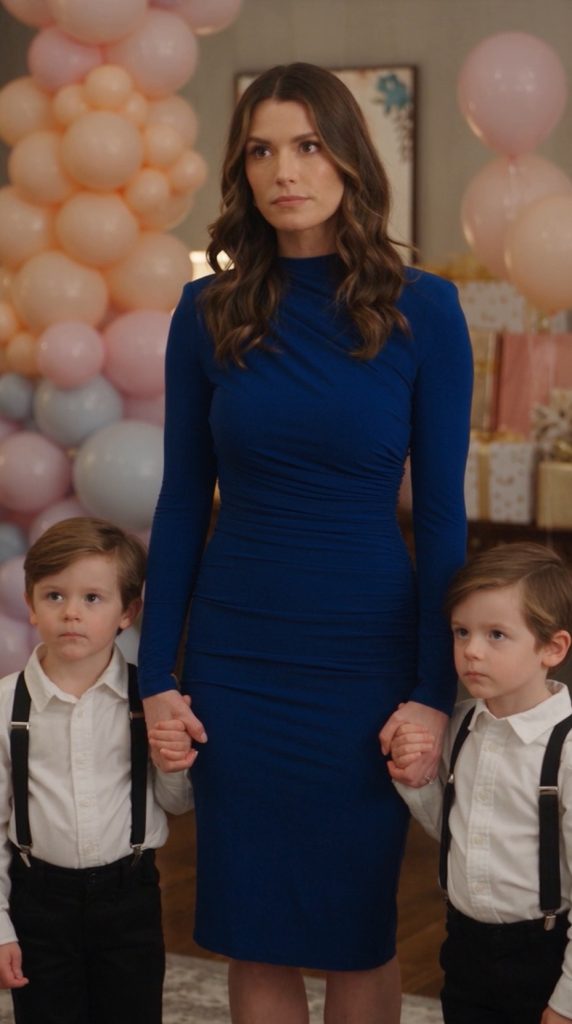
That Saturday, I wore a navy dress and walked into a room filled with pastel balloons, flowers, and smiling guests.
Emily sat among unopened presents, one hand resting on her pregnant belly.
Mark spotted me immediately.
“Claire! You actually came!”
Before I could answer, he lifted his champagne glass.
“Becoming a father has always been my biggest dream,” he announced. “I wasted seven years waiting for someone who couldn’t make that happen.”
The room grew uncomfortable.
“Sometimes you have to leave the wrong woman to find the right one.”
My face burned. Diane watched silently from beside the gift table.
I placed my untouched drink down and turned toward the exit.
Then footsteps echoed down the hallway.
“MOMMY!”
Two familiar voices.
Luke and Owen rushed through the doorway, their sneakers squeaking across the polished floor. I dropped to my knees as they threw themselves into my arms.
A sharp crash broke the silence.
Diane’s champagne glass lay shattered beneath her chair.
She stared at Luke, then Owen, her trembling hand gripping the table.
Their dark eyes. Their dimples. Those expressions she’d known on her own son’s face decades earlier.
Mark slowly lowered his glass.
Diane looked at him, then back at my boys.
“Claire…” Her voice barely carried across the room. “Those little boys…”
I held my sons closer as she rose unsteadily, her eyes filling with recognition.
Then she turned toward Mark, opened her mouth, and the entire room waited for the words he had never imagined hearing. 👇
“They’re yours, aren’t they?”
Diane’s question came out barely above a whisper, but it traveled through the silent room.
Mark stared at his mother.
“What?”
She stepped around the broken glass, her eyes never leaving Luke and Owen.
“Look at them, Mark. Look at their faces.”
Luke buried his cheek against my shoulder. Owen watched the strangers with the solemn curiosity of a child who sensed something was wrong but couldn’t understand why.
Mark’s gaze moved between them.
His mouth opened, then closed.
“Claire,” he said slowly. “What is this?”
I stood, keeping one hand on each boy’s shoulder.
“These are my sons.”
His expression hardened.
“That’s not what I asked.”
“No,” I replied. “It isn’t.”
Emily shifted in her chair.
“Mark, what’s going on?”
He didn’t answer her.
Instead, he took two steps toward me.
“How old are they?”
“Three.”
The color drained from his face.
For several seconds, I watched him calculate what I had lived with for years: our final night together, the weeks afterward, and the possibility he’d never imagined.
“You never told me.”
His voice had changed.
It was no longer the commanding voice he’d used during his toast.
It sounded frightened.
“I didn’t,” I admitted.
“Why?”
I glanced at the boys.
“Because the last thing you said to me was that nothing had changed. And when I discovered I was pregnant, I was terrified of bringing that cruelty into their lives.”
Mark rubbed his forehead.
“You had no right to keep this from me.”
The accusation stung because part of me had always feared hearing it.
“You’re right about one thing,” I said quietly. “They deserved the truth. I should have found a way to tell you. But that doesn’t erase what you did to me.”
Diane pulled out a chair and sat heavily.
Emily looked from Mark to the twins.
“You told me Claire couldn’t have children.”
Mark turned toward her.
“Emily, please.”
“You said the doctors confirmed it.”
“They said—”
“No.” She held up one trembling hand. “You told me she was the problem. You said you tried everything, and she refused to accept reality.”
The room seemed to contract around us.
I remembered every appointment I’d arranged, every injection I’d endured, every night I’d wondered whether my body was failing the man I loved.
“He knew his results weren’t perfect,” I said. “The doctors explained that to both of us.”
Emily stared at him.
“Is that true?”
Mark looked away.
And in that small movement, I saw the first crack in the story he’d built about himself.
Emily lowered her hand to her stomach.
“Answer me.”
“Yes,” he muttered. “But they never said I couldn’t—”
“They never said Claire couldn’t, either,” Diane interrupted.
Mark stared at his mother.
She stood again, this time with steadier legs.
“I watched you humiliate her at Thanksgiving. I knew it was wrong, and I sat there doing nothing because I didn’t want to embarrass my son.”
Her voice broke.
“I have been ashamed of that silence for four years.”
Mark shook his head.
“Mom, this isn’t the place.”
“You chose the place,” Diane replied.
Nobody moved.
Then Luke tugged my dress.
“Mommy, can we go home?”
That small question nearly undid me.
I knelt and brushed his hair away from his forehead.
“Yes, sweetheart. We’re going home.”
But Mark stepped toward the doorway.
“Not yet.”
My body tightened instinctively.
He noticed.
For a moment, something resembling shame crossed his face.
“I need to know if they’re mine.”
“Then we’ll arrange a proper test,” I said. “Privately. Through attorneys. Not here, and not in front of them.”
He looked down at the boys.
Owen moved behind my leg.
Mark had spent seven years insisting that fatherhood was the most important thing in his life.
Now two children who might be his stood within reach, and neither felt safe enough to approach him.
Emily rose carefully from her chair.
“I think the party is over.”
Mark reached toward her.
“Emily, don’t make this worse.”
She stepped away.
“You invited your former wife here to hurt her. You made a speech about her body in front of our families. And now you’re angry because the truth embarrassed you.”
Her eyes filled.
“I need to go somewhere I can think.”
She collected her purse and walked toward her sister, who immediately slipped an arm around her.
Mark watched them leave.
For the first time that afternoon, nobody followed him.
Outside, the October air was cool against my burning cheeks.
I buckled Luke and Owen into their car seats. They began arguing about which dinosaur was the fastest, and the ordinary sound of their voices steadied me.
Diane appeared beside my car.
“Claire?”
I turned.
She looked older than she had an hour earlier.
“I can’t ask you to forgive me,” she said. “But if those boys are my grandsons, I would like to know them someday.”
I studied her face.
“Then understand something. They aren’t a second chance for Mark to prove himself. They’re children. They need people who won’t hurt them.”
She nodded, tears slipping down her cheeks.
“I understand.”
Three weeks later, the DNA results arrived.
The probability of Mark’s paternity was greater than 99.99 percent for both boys.
I sat at my kitchen table looking at the document while Luke and Owen constructed a crooked tower from wooden blocks.
There was no triumph.
Only a strange, exhausted stillness.
The truth was finally written down, but paper couldn’t return the years we’d lost.
At our first meeting with the attorneys, Mark arrived wearing the same expensive watch he’d worn to our divorce proceedings.
He looked at the test results for a long time.
Then he asked, “What do you want from me?”
“Nothing for myself,” I answered. “But your sons deserve financial support and a father who treats them with kindness.”
He leaned back.
“You’re going to make me pay for three years?”
“I’m asking you to take responsibility for the children you wanted so badly.”
His jaw tightened.
He began arguing about money, visitation, and how unfairly he’d been treated.
Then my attorney placed a copy of the baby-shower invitation on the table.
Mark recognized his handwriting immediately.
For a moment, nobody spoke.
“You wrote that,” I said. “And then you stood in front of strangers and tried to make me feel worthless.”
He stared at the words.
For the first time, he didn’t have an answer.
The legal process wasn’t quick. Parentage was formally established, support was arranged, and a carefully structured visitation plan was put in place with the boys’ wellbeing at its center.
Mark had wanted the identity of a father.
Now he faced the ordinary, demanding responsibility of becoming one.
Emily moved into her sister’s home before giving birth.
A month later, she called me.
“I owe you an apology,” she said.
“You didn’t know.”
“I knew he could be unkind when he talked about you. I just never asked why.”
I sat quietly.
Then she added, “I had a little girl. Her name is Grace.”
I smiled despite everything.
“Congratulations, Emily.”
Her breathing caught.
“Thank you.”
She told me she and Mark had separated and that she was arranging their daughter’s care and support through her own attorney.
“I don’t know what happens between you and him,” she said. “But I don’t want these children growing up believing they’re responsible for the mistakes we made.”
Neither did I.
Over the following months, Mark attended the supervised visits arranged for the twins.
Sometimes he arrived early.
Sometimes he barely knew what to say.
Luke initially refused to leave my side. Owen asked him questions about trucks but wouldn’t let him help with his shoes.
Their trust wasn’t something Mark could demand.
And whatever relationship they eventually built would depend on what he did, not what he promised.
One afternoon, Diane visited my home alone.
She brought a small cardboard box, worn soft at the corners.
“I found something when I was clearing out my attic,” she said.
Inside lay a pair of tiny children’s sneakers.
I stopped breathing.
I recognized them.
Years before our divorce, Mark and I had stood in a store imagining the children we might have. He’d held those very shoes in his hands and laughed about how small they were.
I thought he’d put them back.
“He bought them,” Diane whispered. “He brought them to my house when you started treatment. He said he wanted me to keep them until you had a baby.”
I touched the faded laces.
“He never told me.”
“He was different then,” she said. “Or perhaps he simply hadn’t learned how badly fear could twist him.”
She closed her eyes.
“I should have reminded him of that man when he started blaming you. Instead, I allowed you to carry his shame.”
For the first time, I understood something that had haunted me.
The hope we’d shared hadn’t been entirely imaginary.
There had once been tenderness in our marriage.
It simply hadn’t survived the choices Mark made.
Diane reached for my hand.
“I brought these because they belong with the children. But Claire, you don’t have to keep anything that hurts.”
I looked toward the living room.
Luke and Owen were lying on the carpet, sharing a picture book, their heads almost touching.
“No,” I said softly. “They don’t hurt anymore.”
That spring, Diane became a familiar visitor. She learned which twin hated carrots and which one insisted on wearing mismatched socks.
She never spoke badly of Mark in front of them.
And she never asked me to forget.
Emily occasionally brought Grace for short visits. The boys adored their baby sister, particularly Owen, who believed every infant required a detailed explanation of dinosaurs.
One sunny afternoon, the three children sat together on a blanket in my backyard.
Diane held Grace while Luke carefully offered her a soft toy.
Emily stood beside me, watching them.
“I used to think becoming a family was something that happened when a baby was born,” she said.
I looked at our children.
“I think it’s something we keep choosing.”
Across the yard, Owen stumbled while chasing a ball.
Luke immediately ran to help him.
Neither looked toward the adults for permission.
They simply reached for each other.
Later, after everyone had gone, I found the old sneakers on the kitchen counter.
I carried them upstairs and placed them beside the boys’ first baby photographs.
Seven years of unanswered prayers had once convinced me that motherhood would never belong to me.
Now two little voices were calling from their bedroom.
“Mommy! We need one more story!”
I switched off the hallway light and went to them.
Luke lifted the blanket for me. Owen pressed his warm little hand against my cheek.
Outside, the evening settled gently over our home.
And as I sat between my sons, listening to their breathing grow slow and peaceful, I realized I no longer needed Mark to understand what he’d lost.
I had stopped measuring my life by the love he couldn’t give.
Downstairs, three pairs of shoes waited beside the front door—two small, one grown.
All belonging exactly where they were meant to be.