The emerald necklace caught the chandelier light every time Celeste Vale turned her head, sending flashes of deep green across the champagne-colored walls of one of Manhattan’s most exclusive private jewelry galleries.
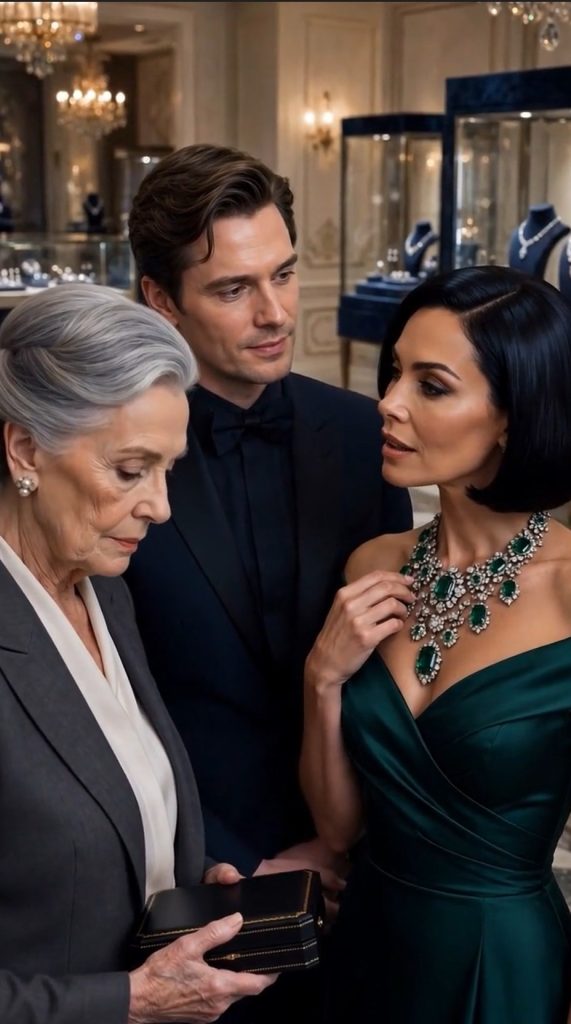
Around her, women in designer gowns and men in perfectly tailored tuxedos murmured their admiration. Crystal glasses chimed softly, a pianist played somewhere beyond the marble columns, and the evening seemed designed for the kind of people who never needed to ask how much anything cost.
Celeste was enjoying every second of it.
At thirty-two, she had perfected the art of looking as though the world had been arranged for her convenience. Her dark hair fell in a sleek bob just above her shoulders, her emerald satin gown matched the famous stones resting against her collarbone, and her smile suggested she had never been denied anything important.
“The necklace is extraordinary,” said a woman standing beside her. “I heard it belonged to your family for generations.”
Celeste lifted her chin slightly.
“Oh, it did,” she replied. “It’s practically part of my inheritance. Aunt Eleanor always intended for me to have it.”
A few feet away, Eleanor Vale stood perfectly still.
At sixty-nine, Eleanor possessed the sort of elegance money alone could never purchase. Her silver hair was arranged in a neat chignon, her charcoal suit had been tailored in Paris, and a simple pair of pearl earrings provided the only ornament she needed. She held a small black velvet presentation case in her left hand.
She had heard every word.
She said nothing.
Eleanor had spent forty years building a fortune that most of the guests in that room could only imagine. She had invested in commercial real estate long before Manhattan’s neglected neighborhoods became fashionable. She had acquired struggling hotels, restored historic properties, and quietly financed businesses whose owners had been rejected by more conventional investors.
Her late husband, Richard, had once joked that Eleanor could identify a profitable investment simply by watching how someone treated a waiter.
Richard had been wrong about many things, but not that.
Eleanor understood people. More importantly, she understood what happened when people began mistaking kindness for weakness.
And lately, her niece had been making that mistake with increasing confidence.
The emerald necklace had not been inherited from some distant aristocratic relative. Eleanor had purchased it herself twenty-eight years earlier, following the successful sale of her first major hotel development. At the time, she had been forty-one, exhausted, and still fighting to be taken seriously in rooms filled with men who called her sweetheart while asking her to fetch coffee.
When the sale closed, she walked into a jewelry salon on Fifth Avenue and bought the necklace without asking anyone’s permission.
It featured seventeen Colombian emeralds surrounded by old-cut diamonds, with a remarkable central stone that seemed to hold an entire forest inside it.
Richard had looked at the receipt and nearly dropped his glass.
“You bought that for yourself?”
Eleanor had smiled.
“Of course. I wanted to remember the day I stopped waiting for someone else to decide what I deserved.”
After Richard’s death, the necklace became one of her most treasured possessions. Not because of its considerable value, but because of what it represented.
Celeste knew none of that history.
Or perhaps she knew it and had decided the story was less interesting than the price.
Celeste’s mother, Eleanor’s younger sister Margaret, had died when Celeste was only fourteen. Eleanor had stepped into the empty space left behind, paying for schools, birthdays, summer programs, and eventually an expensive college education.
She had loved Celeste as though she were her own daughter.
When Celeste moved to New York after graduation, Eleanor helped her rent a beautiful apartment. When Celeste announced that she wanted to build a career in luxury branding, Eleanor introduced her to people who could open doors.
For several years, Celeste seemed grateful.
Then gratitude slowly gave way to expectation.
The apartment became too small. The introductions were no longer impressive enough. A birthday gift that would have delighted almost anyone was quietly exchanged for something more expensive.
Eleanor noticed, but rarely commented.
She believed young people deserved the freedom to make mistakes.
What she had never believed was that loving someone required financing their dishonesty.
Three weeks before the gallery event, Celeste had visited Eleanor’s penthouse overlooking Central Park.
She arrived carrying flowers and wearing the charming expression she reserved for occasions when she wanted something.
“Aunt Eleanor, I have the most exciting opportunity.”
Eleanor had been reading beside the living room windows.
“What kind of opportunity, darling?”
“The Whitmore Gallery is hosting its annual Legacy Collection evening. All the major collectors will be there. Editors, museum people, investors. Everyone.”
“That sounds lovely.”
Celeste sat beside her.
“They’ve asked me to help present the collection.”
Eleanor lowered her book.
“That is an impressive responsibility.”
Celeste smiled, then hesitated with practiced delicacy.
“There is one thing that would make it extraordinary.”
Eleanor already knew.
“The emeralds,” she said.
Celeste laughed.
“You always know what I’m thinking.”
“Not always,” Eleanor replied.
Celeste explained that wearing the necklace would help establish her credibility among collectors. She promised to treat it with extraordinary care. She even arranged for the gallery to provide insurance and professional security.
Eleanor agreed to lend the piece for one evening.
But she insisted on formal documentation.
The gallery’s director, Margaret Whitmore, prepared a signed agreement identifying Eleanor as the sole owner. The necklace could be displayed and worn during the event, but it could not be sold, pledged, transferred, or represented as belonging to anyone else.
Celeste had signed the acknowledgment without reading much beyond the first paragraph.
“It’s just paperwork,” she said cheerfully.
Eleanor remembered that remark now as she watched her niece accept another compliment.
Across the gallery, Julian Vale approached carrying two glasses of sparkling water.
At thirty-five, Julian was Eleanor’s nephew and Celeste’s older brother. He had inherited his father’s thoughtful brown eyes and his mother’s instinct for avoiding confrontation.
He handed Eleanor a glass.
“You look beautiful tonight, Aunt Eleanor.”
“Thank you, Julian.”
His gaze drifted toward Celeste.
“She certainly knows how to attract attention.”
Eleanor followed his glance.
“Yes. That has never been her difficulty.”
Julian gave a small, uncomfortable smile.
He had grown concerned about his sister’s ambitions over the past year. Celeste had begun speaking about the family’s possessions with a strange sense of entitlement, referring to Eleanor’s homes as future family properties and introducing herself to influential strangers as the next generation of the Vale legacy.
Julian had advised her to be more careful.
Celeste had dismissed him.
“You worry too much. Aunt Eleanor doesn’t care about these things.”
Julian had never been convinced.
That afternoon, he had discovered something else.
Celeste had already contacted a luxury lifestyle magazine and arranged a feature centered on what she called her family’s extraordinary emerald collection.
The preliminary headline read: Celeste Vale and the Jewels She’s Destined to Inherit.
Julian showed Eleanor the article on his phone.
She read the headline without expression.
“Did she approve this?”
“She sent them the photographs herself.”
“Has the article been published?”
“Not yet. It’s scheduled for Monday.”
Eleanor returned the phone.
“Thank you for telling me.”
Julian waited.
“Aren’t you upset?”
Eleanor looked toward the window.
“Upset is a feeling, Julian. What matters is what we do after the feeling passes.”
Now, standing beneath the gallery’s chandeliers, Julian wondered whether his aunt had already decided what to do.
The answer came a few minutes later.
Margaret Whitmore, the gallery’s director, stepped onto a low platform and welcomed the guests. Behind her stood illuminated glass cases containing antique diamonds, sapphires, and historic jewelry from private collections.
She thanked the lenders for making the exhibition possible and introduced Celeste as one of the evening’s special guests.
Celeste moved effortlessly toward the center of the room.
Her gown whispered against the polished floor.
She paused beneath the brightest chandelier, allowing every camera to capture the emeralds.
“The wonderful thing about family treasures,” she told the gathering, “is that they connect generations. They’re not just objects. They’re promises about the future.”
Eleanor listened from beside a marble column.
Celeste touched the central emerald.
“This necklace represents the future of our family. Aunt Eleanor has always understood that certain things belong with the younger generation.”
Several guests turned toward Eleanor approvingly.
Celeste continued.
“Some people hold on to beautiful things because they’re afraid of being forgotten. I believe real legacy means knowing when it’s time to step aside.”
The room remained polite.
But Julian stopped smiling.
He looked at Eleanor.
Her expression had not changed, though her fingers closed a little more firmly around the velvet case.
Celeste’s remarks were carefully delivered, wrapped in the language of gratitude and family continuity.
Yet Eleanor recognized them for what they were.
A public attempt to transform a temporary favor into a permanent obligation.
And worse, an attempt to make refusal seem selfish.
The applause was gentle and sophisticated.
Celeste stepped down, glowing with satisfaction.
She approached Eleanor accompanied by two potential business partners.
“Aunt Eleanor,” she said brightly, “I hope you didn’t mind my little speech.”
“Why would I mind?”
Celeste leaned closer.
“Well, obviously, I was speaking symbolically. Everyone understands the necklace will come to me eventually.”
One of the business partners laughed politely.
Eleanor regarded her niece.
“Do they?”
Celeste blinked.
“Of course.”
“Interesting.”
There was nothing threatening in Eleanor’s tone.
That made Julian more nervous.
Celeste, however, mistook the quietness for surrender.
She smiled at the others.
“Aunt Eleanor has never cared much for public attention. That’s why I handle these things for her.”
Eleanor slowly placed her untouched glass on a nearby table.
Then she addressed Margaret Whitmore, who was passing with a guest.
“Margaret, could you join us for a moment?”
“Certainly, Eleanor.”
Margaret approached with the composed professionalism of someone who had managed priceless collections for decades.
Eleanor raised the black velvet case.
“I believe we should clarify the status of this piece.”
Celeste’s smile weakened.
“What do you mean?”
Eleanor opened the case.
Inside, beneath the delicate velvet lining, rested the signed exhibition loan card.
Margaret glanced at the document and immediately understood.
“Is there a problem with the loan, Mrs. Vale?”
“Only a misunderstanding,” Eleanor replied. “My niece has been telling people that the necklace belongs to her.”
Celeste gave a sharp, embarrassed laugh.
“Aunt Eleanor, don’t be ridiculous. I never said that.”
Julian looked at his sister.
He had heard her say almost exactly that fifteen minutes earlier.
Eleanor remained calm.
“Celeste, you told Mrs. Harrington that it was part of your inheritance. You told the magazine the same thing. And just now, you announced that it represented your future ownership.”
A flush spread beneath Celeste’s makeup.
“I was speaking about family tradition.”
“Then we’re fortunate the actual arrangement is very simple.”
Eleanor turned the loan card toward Margaret.
“The necklace belongs to me. It was lent for exhibition tonight. There is no transfer of ownership, no promised inheritance, and no authority to represent otherwise.”
Margaret nodded.
“That is correct.”
Celeste’s fingers rose protectively toward the emeralds.
Several nearby guests had grown quiet.
Eleanor noticed, but she did not lower her voice or raise it.
“I think it’s best that the necklace be returned to its case now.”
Celeste stared.
“Right now?”
“Yes, darling.”
“But the evening isn’t over.”
“The evening may continue. The loan, however, has served its purpose.”
Celeste looked toward Julian, hoping he might intervene.
He said nothing.
She leaned toward Eleanor.
“Could we discuss this privately?”
“We are discussing ownership, Celeste. I would have preferred not to discuss it at all.”
For the first time that evening, Celeste appeared uncertain of how to arrange her face.
“Aunt Eleanor, you’re embarrassing me.”
Eleanor’s eyes softened slightly.
“No. I am correcting something that should never have been said.”
Margaret discreetly directed an attendant to close the nearby display cabinet, giving Celeste a measure of privacy.
Eleanor had no intention of creating a spectacle.
She simply would not permit the lie to continue.
With trembling fingers, Celeste reached behind her neck.
The clasp was more complicated than she remembered.
She struggled with it, growing increasingly aware of the silence around her.
Julian stepped forward.
“May I help?”
Celeste shook her head.
“I can do it.”
At last, the clasp opened.
The necklace slid into her hands, suddenly heavier than it had felt all evening.
Without the jewels, her carefully chosen gown looked almost unfinished.
She placed the emeralds into the velvet case.
Eleanor adjusted the central stone with one finger, closed the lid, and rested her hand on top.
“Thank you,” she said.
The simplicity of the words seemed to wound Celeste more than any accusation could have.
Margaret excused herself to record the early return.
The guests gradually resumed their conversations, though several were plainly reconsidering what they had heard earlier.
Celeste stood rigidly beside her brother.
“You could have warned me,” she whispered to Eleanor.
Eleanor looked at her for a long moment.
“I did, when you borrowed it. The agreement was quite clear.”
“You knew what this evening meant to me.”
“Yes.”
“And you still did this?”
Eleanor’s face grew serious.
“Celeste, I have spent eighteen years helping you build the life you wanted. I have opened doors for you, introduced you to people, and stood behind you when you needed support. Tonight, you tried to use my generosity as proof that you were entitled to something I never offered.”
Celeste looked away.
“I didn’t mean it like that.”
“Perhaps not at first.”
That last sentence settled between them.
Julian quietly cleared his throat.
“Celeste, you did tell everyone the necklace was yours.”
She turned on him.
“Whose side are you on?”
Julian hesitated.
Then he answered.
“I’m on the side of what actually happened.”
Celeste fell silent.
For most of her life, she had assumed Julian would soften any conflict between her and their aunt. His refusal to do so unsettled her almost as much as Eleanor’s decision.
Eleanor picked up the velvet case.
“There is something else you should know.”
Celeste’s eyes narrowed.
“What now?”
“I’ve been considering the future of the necklace for some time.”
A flicker of hope crossed Celeste’s face.
Eleanor continued.
“Next month, I’m transferring it into a charitable collection trust. It will remain available for museum exhibitions, and the income from its licensing and exhibition arrangements will help support a scholarship program for young jewelry designers.”
Julian looked surprised.
“You’re creating a scholarship?”
“Yes. In your grandmother’s name.”
Their grandmother, Margaret and Eleanor’s mother, had been a talented dressmaker who spent decades working with wealthy clients while struggling to afford proper tools for herself.
She had taught Eleanor to sew, save, and never confuse the price of something with its value.
Eleanor had been thinking about her more often lately.
“I want talented young people who can’t afford expensive training to have an opportunity,” she said. “Your grandmother would have liked that.”
Julian smiled.
“She really would have.”
Celeste stared at the case.
“So it’s just going away?”
“No. It will be doing something useful.”
“But I thought—”
“I know what you thought.”
Eleanor’s voice remained gentle.
“That is why we’re having this conversation.”
For a moment, something changed in Celeste’s expression.
Beneath the anger was disappointment, and beneath the disappointment was the realization that she had made herself look foolish in front of people whose approval she desperately wanted.
Yet even then, she could not quite bring herself to apologize.
Instead, she asked, “What am I supposed to tell the magazine?”
Eleanor gave her a faint smile.
“The truth would be an excellent beginning.”
She turned toward Julian.
“Would you walk me to the elevator?”
“Of course.”
They moved through the gallery together.
Behind them, Celeste remained motionless beneath the chandelier, her bare neckline catching none of the light.
At the elevator, Julian pressed the button.
For several seconds neither spoke.
Then he said, “I should have stopped her earlier.”
Eleanor looked at him.
“You tried to warn her.”
“I could have done more.”
“Perhaps. But she is responsible for her own decisions.”
Julian nodded.
When the elevator doors opened, Eleanor stepped inside, still holding the black velvet case.
“Aunt Eleanor?”
She turned.
“Do you think she’ll ever understand?”
Eleanor considered the question.
“I hope so.”
“Even after tonight?”
“Especially after tonight.”
Julian smiled sadly.
“You still love her.”
“Of course I do. Loving someone doesn’t mean allowing them to become the worst version of themselves.”
The doors closed.
On the ride down, Eleanor studied the velvet case in her hands. She remembered the day she had purchased the necklace, the pride she had felt, and the younger woman she had once been.
She had never needed the emeralds to make her powerful.
They had simply reminded her of a power she already possessed.
The next morning, Celeste woke to dozens of messages.
The magazine had placed its planned feature on hold after receiving a polite clarification from the gallery. A few acquaintances had asked awkward questions. One potential business partner had postponed a meeting.
None of it was the catastrophe she initially imagined, but the silence from people who had praised her the night before felt unbearable.
She sat on the edge of her bed, remembering the moment she had removed the necklace.
For the first time, she wondered whether her aunt had been protecting her from consequences for so long that she had forgotten consequences existed.
Across the city, Eleanor sat at her breakfast table overlooking Central Park.
Sunlight filled the room. A cup of coffee steamed beside a stack of papers.
At the top was a document establishing the Margaret Vale Emerging Jewelry Designers Scholarship.
Eleanor read the final page, picked up her favorite fountain pen, and signed her name.
Her phone vibrated.
A message from Celeste appeared.
I’m sorry for what I said last night. I made you look like you didn’t matter. You deserved better.
Eleanor read it twice.
Then she typed her reply.
Thank you, darling. We can have lunch next week.
She placed the phone beside her coffee and returned to the papers.
Outside, the city moved at its usual restless pace, filled with people chasing money, attention, and the appearance of importance.
Eleanor had spent most of her life among them.
She understood the appeal of beautiful things. She understood ambition. She even understood the desire to be admired.
But she also understood something Celeste was only beginning to learn.
A borrowed treasure did not become yours simply because everyone admired you wearing it.
And the person who could take it back without raising her voice had never been powerless.
Eleanor signed the final page, closed her pen, and looked out over the city with the smallest, calmest smile.
The emeralds were finally going to become part of a legacy worth leaving.