His eyes caught the stitched letters before anyone else had a chance to look — and in that single moment, the gleaming, composed facade of the hotel entrance felt like a curtain drawn over something that had been hiding in the dark for a very long time.
“What coat?” he asked, his voice barely above a whisper.
The old woman standing on the steps said nothing.
She was staring at the small wool glove the little girl held in her outstretched hand, staring at it the way a person stares at something they believed was buried forever — something that had no business appearing on a bright afternoon in front of witnesses.
The child’s fingers tightened around the glove.
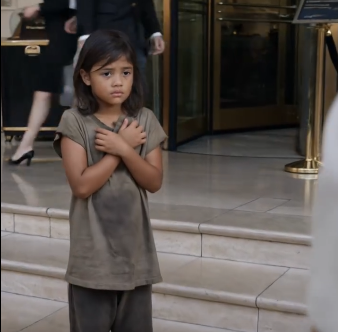
“My mom kept this hidden,” she said, her voice soft and careful, the way children speak when they’ve been rehearsing something important for a long time. “She told me that if I ever saw the lady wearing that ring, I had to show her this before I said my name.”
The woman closed her eyes.
That single gesture told the doorman everything he needed to know.
He stepped forward, closing the distance between himself and the child. “What name is stitched inside that glove?”
The little girl looked down at the worn fabric, then slowly lifted her gaze to the woman’s face.
“Clara,” she said.
The woman opened her eyes. Whatever composure she had managed to hold onto dissolved in an instant — not into confusion, but into something far heavier. Recognition settled over her features like a stone sinking through still water.
The doorman’s own expression shifted. “Clara was the maid who disappeared the winter of the fire.”
The little girl blinked, her eyes filling with tears she was too proud to let fall. “My mom didn’t disappear.”
The old woman’s voice came out low, uneven, as if the words were being pulled from somewhere she had kept sealed for decades.
“No,” she said quietly. “She ran.”
Silence fell over the hotel steps like snow — slow and absolute and suffocating.
The child stared. The doorman stared. The woman looked down at the ring on her finger, then back at the little girl’s face, as though she had spent years praying she would never have to compare the two.
“Your mother worked here,” she said at last, her voice barely holding together. “That glove belonged to my granddaughter’s coat. Clara took it the night she carried a child out through the service stairs — in the dark, in the cold, without telling a soul where she was going.”
The little girl’s lips parted but no sound came.
“She told me it was mine,” the girl finally whispered.
The woman nodded slowly, tears gathering at the corners of her eyes despite every effort to hold them back.
“Because the child she carried out that night,” she said, “was wrapped in that coat.”
The little girl went still — completely, utterly still — as if her whole body needed a moment to understand what her mind had just been handed.
The doorman looked back at the stitched name sewn neatly into the lining of the glove. He finally understood why the blood had drained from his face the moment he saw it. It wasn’t simply a name. It was documentation. It was a record of ownership — of which child the coat had belonged to — and therefore, proof of something far more terrible.
Proof that the wrong child had vanished into the night.
When the little girl spoke again, her voice trembled with a kind of grief that goes beyond what a child should ever have to carry.
“Then why did my mom tell me to find you?”
The elderly woman turned toward the glass doors of the hotel. Something moved behind her eyes — old fear, the kind that never fully leaves, the kind that simply waits. It returned to her face with sudden, overwhelming force.
She stood there for a long moment, the world moving quietly around her — a taxi pulling away, a bellhop passing through the door, pigeons startling from the ledge above — while she gathered herself for the answer.
Then she turned back to the child.
“Because if Clara finally gave you that glove…” she said slowly, each word placed with the deliberateness of someone who knows that once spoken, words cannot be recalled.
She looked the little girl directly in the eyes.
“…then she must have told you whose daughter was supposed to die in that fire.”
The doorman did not move. The little girl did not move. Even the traffic along the street seemed to hush for a breath — as though the world itself recognized that something enormous had just been said out loud for the very first time.
There are secrets that families bury not out of shame, but out of survival. There are choices made in smoke and desperation that reshape the lives of people who were never given a say. And there are moments — quiet, ordinary moments on hotel steps — where the past finally walks up and introduces itself, small and gloved and waiting to be believed.
A woman had run. A child had been saved. A name had been carried in a pocket across years and distance and silence. And now, standing in the pale afternoon light, a little girl held in her hands the one piece of evidence that tied every thread together — and the woman who had spent a lifetime hoping that thread had burned along with everything else in that fire was looking at her with eyes full of grief, guilt, and the awful relief of something long carried finally being set down.
Some stories end with answers. Some end with questions that are so large, so old, and so heavy that the asking of them is its own kind of reckoning.
This one was only just beginning.