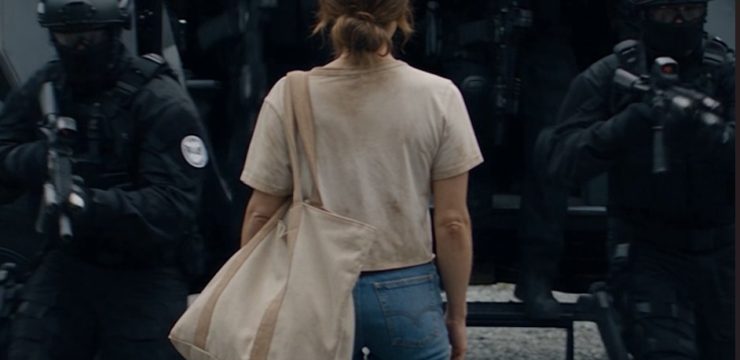
She stared at the handwriting for what felt like an eternity before her fingers finally broke the seal on the envelope.
The bank was so quiet that the soft rustle of unfolding paper echoed through the entire lobby. Every customer nearby seemed to hold their breath without even realizing it. Something was happening. Something that didn’t belong in a place like this — a place built on numbers, transactions, and the careful distance of professional courtesy.
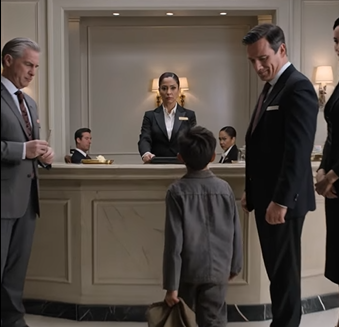
Her eyes moved quickly across the page at first.
Then they stopped completely.
Her knees went weak beneath her. One hand shot up to cover her mouth, as if to hold back a sound she wasn’t ready to let out. The boy standing across the counter watched her without blinking — calm in a way that seemed almost unnatural for someone so young, as though he had spent years preparing himself for exactly this moment.
“What does it say?” the young bank employee beside her asked, voice tight with confusion and concern.
The manager didn’t answer. She couldn’t. She looked up slowly from the letter and stared at the boy again — but this time, the shock in her eyes had shifted into something far more complicated. Something buried. Something she had clearly tried to leave behind a long time ago.
Recognition. Pain. Guilt.
The boy’s voice was quiet, but there was nothing fragile about it.
“My mother told me you made a promise to her,” he said.
The manager’s lips began to tremble. She pressed them together, trying to hold herself steady. Her grip on the letter tightened until her knuckles whitened.
“She came here,” the manager finally whispered. “In the middle of the night. She was frightened — truly frightened in a way I had never seen anyone be before. She told me that if anything ever happened to her, a boy would come through those doors one day. She said he would carry the truth with him.”
The customers who had been nearby drifted closer without meaning to. The young employee looked completely lost. The manager’s eyes glistened with tears she was fighting hard to keep in place.
The boy swallowed. His jaw tightened. And then he asked the question — the one that had clearly lived inside him for years, growing heavier with every birthday that passed without an answer.
“Who is my father?”
The manager closed her eyes. Two tears escaped and traced slow lines down her cheeks. She opened her mouth to speak.
But before she could say a single word, the heavy door to the private back office swung open.
An older man in a well-tailored suit stepped into the lobby. He had caught enough of the conversation through the closed door to recognize something — a name, a detail, a ghost from a chapter of his life he believed was finished. He moved confidently at first, the way powerful men tend to do when they walk into a room they own.
Then he saw the boy’s face.
He stopped as if he had walked into a wall.
The manager turned toward him slowly. The entire room went still in a way that felt almost physical, like the air itself had paused.
Because the boy had the man’s eyes.
Not similar eyes. Not eyes that could have been a coincidence or a passing resemblance. The exact same eyes — the same shape, the same depth, the same particular shade that belonged to only one person in that room.
Or so everyone had believed until that morning.
The older man’s voice broke when he finally spoke.
“That’s… that’s impossible.”
The manager looked at him, and in her gaze was something that carried the full weight of eighteen years of silence.
“No,” she whispered. “It isn’t.”
The boy reached into the worn canvas bag he carried on his shoulder one final time. His movements were steady, deliberate — the movements of someone who had rehearsed this moment in his mind so many times that it had become instinct. He pulled out a photograph. Old, faded at the edges, soft from being handled too many times over too many years.
He placed it on the marble counter between them.
The older man looked down at it.
The color drained from his face so completely and so quickly that the people nearest to him instinctively stepped closer, afraid he might fall.
The photograph showed him years younger — decades younger — his arm around a woman who was looking up at him with an expression that held every kind of trust a human heart is capable of. The image had been taken in a moment that was clearly meant to be private. A moment that was never supposed to be seen by anyone else.
But someone had kept it. Someone had pressed it carefully between the pages of a letter and sealed it away, holding onto it the way you hold onto something only when you know it might be the last thing that speaks for you when you no longer can.
The manager leaned forward and gently turned the photograph over.
Six words were written on the back in careful, faded ink.
Six words that seemed to fill the entire bank, the entire morning, the entire silence that had built up over eighteen years between a man who had walked away and a woman who had waited.
You promised you’d come back.
No one in that lobby moved. No one spoke. The young employee had stopped trying to understand what was happening and simply stood still, eyes wide, aware that she was witnessing something that would stay with her long after the day was over.
The boy looked at the man who shared his eyes.
The man looked at the boy who carried his face.
And somewhere in the space between them — in the silence that followed six words written by a woman who was no longer there to say them out loud — a lifetime of unanswered questions finally found the room they had always deserved.
Some promises don’t die when the person who made them walks away. They survive. They wait. And one day, without warning, they walk through a door and stand right in front of you — and there is nowhere left to go.