The only sounds in that grand hotel lobby were the soft hum of the chandeliers overhead and the barely controlled breathing of a young maid standing at the center of a storm she had never seen coming. The woman in the emerald gown — the one who had filled the marble hall with accusations just moments before — now looked as though the floor beneath her elegant heels had quietly disappeared. Her confidence didn’t shatter all at once. It cracked slowly, visibly, piece by piece, under the weight of a small brooch held in the hotel owner’s steady hand.
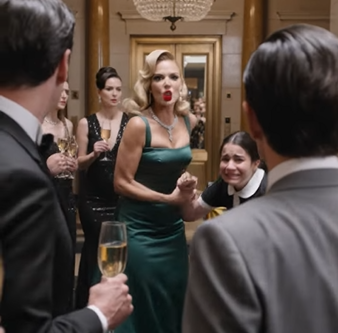
Around them, guests kept their phones raised. But no one was smiling anymore.
What had begun as a very public humiliation was becoming something far more dangerous — the kind of exposure that no amount of wealth or status can undo.
The hotel owner didn’t rush. Men who have spent decades managing the powerful rarely do. He let the silence fill the room first, then spoke with the measured calm of someone who already knew exactly how this would end. The brooch, he explained, had not been found in any staff corridor, housekeeping cart, or employee locker. It had been recovered just minutes earlier by hotel security during a quiet check of a private suite on an upper floor — a suite registered not to the maid, not to any staff member, but to the fiancé of the very woman now making accusations in the middle of his lobby.
That alone would have been enough to stop the scene cold. But the look on his face told everyone in the room there was more, and the air shifted accordingly.
The maid turned slowly from the brooch to the woman in green, still struggling to process what she was hearing.
“My fiancé?” the woman repeated, but the authority had drained completely from her voice. “That makes no sense.”
The owner’s gaze sharpened just slightly.
“It makes perfect sense,” he said quietly. “Especially when the suite camera shows he was not alone when the brooch disappeared.”
A ripple moved through the gathered guests — not loud, but unmistakable.
The woman’s expression changed in a way that couldn’t be taken back.
And in that exact moment, the maid understood something the crowd hadn’t caught yet. This had never truly been about a stolen brooch. The shouting, the grabbing, the very public search of her bag — all of it had been too fast, too aggressive, too perfectly staged. The woman in green hadn’t simply wanted someone blamed. She had needed blame placed immediately, before any other version of events had room to form. That realization hit the maid so hard she forgot, just for a breath, to cry.
The owner continued, each sentence calm and quietly devastating. Security had flagged unusual movement on the VIP floor earlier that evening. A man leaving a suite. A woman entering through the service corridor shortly after. A brief confrontation over something small and reflective. Then the same man — the fiancé — seen tucking an item into a velvet case before security intercepted him near the exit. When questioned, he denied everything. But the owner, who had spent a lifetime watching the wealthy lie with polished, practiced faces, noted that denial rarely survives real evidence. Eventually, the man admitted only one thing: that he had wanted to avoid a scandal.
A bitter irony moved silently through the room.
Because scandal was now the only thing anyone could see.
The woman in the emerald gown attempted to recover. She straightened. She tried to speak with the same commanding tone she’d carried at the start. But her voice gave her away. She insisted her fiancé would never steal, never deceive, never place her in such a position. The owner listened without interrupting, which somehow made everything worse. Then he said something that changed the atmosphere entirely: the brooch was not valuable simply because of its diamonds. It was a family heirloom on private loan to the hotel for the evening’s gala, and only a small number of guests had been made aware of that detail. Her fiancé had known. She had known. The maid had not.
That fact moved through the crowd like a wave of cold air.
The accusation now looked exactly like what it was — not instinct, not even anger, but deliberate calculation.
The maid stood very still among her scattered cart supplies, the bottles and cloths spread across the floor around her. The humiliation was still written plainly on her face, but something else had joined it now. Clarity. She looked down at the small photograph that had fallen from her bag when the woman tore it open in front of everyone — a picture of an elderly mother and a young boy standing outside a modest apartment building. A private life. A quiet dignity. Both had been thrown across the marble floor for a room full of strangers to witness. And suddenly, with all its chandeliers and champagne and polished cruelty, the lobby felt like the ugliest place she had ever stood.
The owner bent down, picked up the photograph carefully, and returned it to her.
That single small gesture shamed the room more than any raised voice could have managed.
He then turned back to the woman in green and explained what made the suite matter even more than most guests yet realized. It had not been paid for by the fiancé himself. It had been booked through an account connected to her own family office, with private instructions that his presence not appear on any official gala list. That wasn’t panic. That was planning.
The owner’s voice dropped lower as he revealed one final detail. The maid had been assigned to that floor only at the last minute, filling in for a colleague who had gone home ill. She had not been part of any original plan. She had simply been convenient — young enough to overpower, poor enough not to be believed, and invisible enough that the damage would be easy to walk away from.
He then unfolded a handwritten note that had been found in the suite, half-crumpled beside the brooch case. He had not intended to read it aloud. After what he had just witnessed in his lobby, he changed his mind.
If anyone asks, blame the maid. No one will question it.
A sound moved through the crowd — not quite a gasp, but something rawer and harder to name.
The woman in the emerald gown went still.
The maid stopped breathing for just a moment.
Because no matter what explanation came next, the truth was already standing in the center of the room for everyone to see. She had not simply been accused. She had been selected.
The owner stepped back then, as though even he understood that what came next no longer belonged to him.
The young maid, still shaking, still tear-streaked, slowly lifted her eyes to the woman who had grabbed her by the wrist and emptied her bag in front of a room full of strangers. And in a voice so fractured it made the entire marble lobby feel suddenly, impossibly small, she asked:
“You didn’t think I was guilty… did you?”
She swallowed once.
“You just thought no one would care what happened to me.”