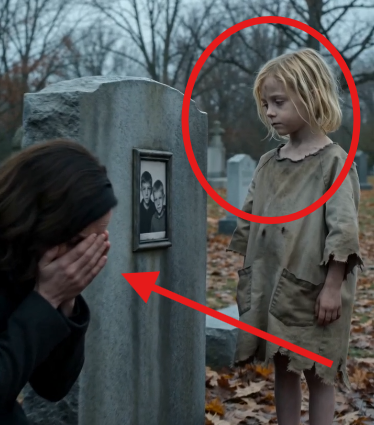
The cemetery was quiet that morning, draped in the kind of stillness that only grief can create. Fallen leaves clung to the wet ground between the headstones, and the air carried the sharp bite of a season turning cold. Two names were carved side by side into a single stone — young names, far too young — and the couple who stood before them had spent years learning how to breathe again after losing the boys they had called their sons.
They came every year. Same day. Same flowers. Same silence that swallowed whatever words they tried to find.
But this year, something was different.
A little girl was already there.
She stood just a few feet from the grave, small and still in a worn coat that didn’t quite fit her, her dark hair falling across her face. She wasn’t crying. She wasn’t moving. She was simply standing there, staring at the stone as if she had been waiting — not just for a few minutes, but for a very long time.
The mother’s steps slowed. The father reached for her hand.
“Sweetheart,” the mother said gently, “are you lost?”
The little girl turned around. Her eyes were calm, but there was something underneath the calm — something old and quiet and unbearably patient.
“No,” she said. “I’ve been waiting for you.”
Neither of them knew what to say. The father looked around the cemetery, half-expecting to see a parent rushing toward them, calling out her name. There was no one. Just the trees, the leaves, and the long gray rows of stone.
“How did you know we were coming?” the mother asked.
The child turned back toward the grave.
“They told me,” she said simply. “They said you always come. They said you wear a black coat.” She glanced at the mother’s coat. “You do.”
The mother’s throat tightened. She told herself it was the cold.
“Who told you, baby?”
The little girl reached into her coat pocket and pulled something out — a small tin soldier, the paint worn off along the edges, one arm bent from years of being carried and held. The mother recognized it immediately. She had given one just like it to each of the boys the Christmas before the fire. She had searched for those soldiers for weeks afterward and never found them. She had assumed they were lost in the damage, along with so much else.
Her hand flew to her mouth.
“Where did you get that?” the father whispered.
The girl held it carefully, the way a child holds something they know is precious.
“He gave it to me,” she said. “The night everything happened. The older one.” She paused, choosing her words with the kind of care that made her seem far older than her years. “He told me to keep it safe. He told me that someday two people would come here and I should give it to them.”
The father knelt down in the wet leaves so he was at her level.
“What did he tell you about us?” he asked, his voice barely holding.
The girl looked at him steadily.
“He said you weren’t their first family,” she said. “But he said you were their real one. He said you loved them like they were your own blood.” She tilted her head slightly. “He said to tell you that you were good…” She paused again, searching for the word he had given her. “Parents.”
That single word broke open something that had been sealed shut for years.
The mother let out a sound that wasn’t quite crying and wasn’t quite breathing — it was somewhere in between, the sound of a wound that had never fully healed splitting open again. The father caught her before her knees gave way, but his own hands were trembling badly now, and he wasn’t sure he was steadying her or she was steadying him.
The little girl stepped forward and held out the toy soldier.
“He told me not to be scared,” she said quietly. “He said I just had to wait.”
The father took it with shaking fingers. It felt heavier than something so small should ever feel.
He turned it over, and that’s when he noticed it — a tiny slit along the back seam. He worked it open carefully. Inside, folded small and protected from the years and the cold, was a scrap of paper.
The handwriting was uneven. A child’s hand, young but deliberate, every letter pressed hard into the page.
They are not our real parents. But they loved us like real ones. Please find our little sister. Don’t leave her here alone.
The mother cried out. She pressed both hands over her mouth, but the sound came anyway.
The little girl looked down at the wet ground.
“They said my name is Lily,” she whispered. “They said if I ever saw the lady in the black coat, I should tell her — they didn’t feel alone when they died.”
The mother stared at her through a blur of tears. She looked at the child’s face — really looked — and something shifted deep inside her chest.
The same eyes as the boys. The same set of the mouth. The same frightened courage trying to hold itself together.
The orphanage had told them the boys had no surviving family. They had believed it. They had adopted them, loved them, and mourned them without ever knowing that a younger sister had been placed in a separate building — hidden away by circumstance and paperwork and the careless machinery of institutions that move children like files.
The mother moved through the wet leaves on her knees.
“You’re theirs,” she breathed. “Oh, sweetheart. You’re theirs.”
Lily’s lower lip trembled for the first time.
“For a long time,” she said, so softly it was almost lost in the wind, “I thought nobody came because nobody wanted me.”
The mother didn’t speak. There were no words sufficient for that moment. She simply opened her arms and pulled the little girl into them, right there beside the gravestone, holding her the way she had once held the boys — fiercely, completely, without any intention of letting go.
And in the cold and the stillness of that cemetery, between the two names carved in stone, something extraordinary happened.
The family they had buried in grief — the family they had believed was gone forever — turned out not to be gone at all.