The young dog could wag its tail, but it could not move. Wedged between two walls at a narrow corner, the frightened animal had no room to turn around, move forward, or back away. Every attempt to struggle risked pressing its body more tightly against the rough masonry.
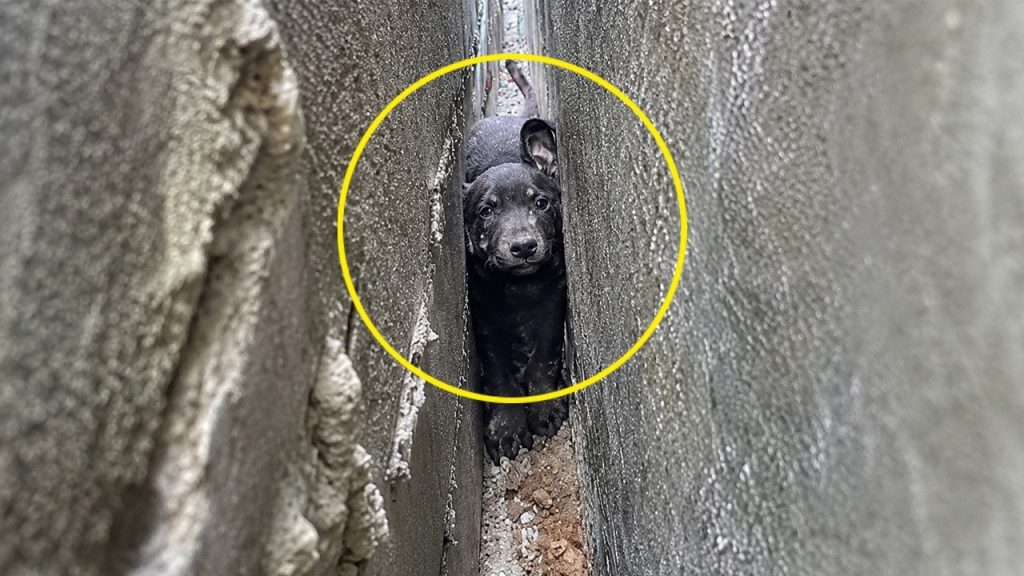
When rescuers discovered the dog, their first task was not pulling it free. It was keeping it calm. They spoke reassuringly and studied the cramped passage, aware that a frightened movement could make an already dangerous situation worse. A wooden beam lay across the dog’s body, further restricting the little space available. No one nearby could identify its owner.
The walls belonged to neighboring homes, and freeing the dog might require disturbing the structures themselves. The team gathered tools and sought permission from the property owner before beginning. They could see that the passage was uneven, the walls were not especially strong, and there was little margin for error.
At first, the most obvious solution might have been to pull. But the dog’s waist and hips were caught. Dragging the animal by force could cause serious internal injuries. Striking the walls too aggressively carried another danger: unstable masonry might collapse onto the dog or the people trying to help.
The rescuers needed a gentler way to make space. They considered removing small amounts of cement and earth from beneath the animal, widening the route without damaging the surrounding walls. Every decision had to account for the dog’s vulnerable position. A few inches of clearance could matter, but a sudden movement in the wrong direction could be devastating.
Then the team noticed another urgent need. The dog looked exhausted, and they suspected it might have been trapped since the previous day. Nobody knew exactly how long it had been there. Before continuing the difficult work, they found clean water and poured some onto the floor of the narrow passage where the dog could reach it.
The thirsty animal drank eagerly. It was a simple moment, but one that brought the rescue back to what mattered most: a living creature needed comfort as much as a solution. The dog could not explain its distress. Its exhaustion, the confined space, and the speed with which it drank were enough to show how desperately it needed help.
With the dog given water, the rescuers resumed their careful work. Using a crowbar, they chipped away at small areas of rough cement that rubbed against its body. They avoided heavy blows because the walls remained a serious concern. It was slow, awkward labor in a dusty, restricted space where even positioning a hand demanded care.
At one point, a team member accidentally dropped a phone into the gap. Retrieving it would have to wait. The trapped dog remained the priority, and there was still no clear path to safety. The rescuers kept concentrating on the narrowest points and how to ease the pressure without making the animal suffer more.
They turned to an unusual but practical idea: shampoo. Poured from above, it coated the dog’s fur and helped reduce friction against the surrounding surfaces. One rescuer reached into the tight opening, soothing the animal while helping it shift little by little. The goal was not a sudden escape. It was a controlled movement, with the dog’s body protected at every stage.
Gradually, the dog began to move. That progress brought another difficult choice. Pulling the head forward would leave the shoulders and chest caught against the opposing wall. The team also had to handle the head carefully, since pain and fear might cause the dog to bite without intending to hurt anyone.
Instead of forcing the obvious route, they changed the angle. By gently turning the dog’s body, they worked to bring its hindquarters out first. The shampoo made the tight passage more manageable, but the back legs still caught painfully as the animal crossed the narrowest section. The rescuers continued adjusting their hold, determined not to trade a quick escape for an injury.
And then the impossible space finally gave way. The dog was free of the walls. The team guided it past a low beam near the exit and offered water again. What had seemed like an unforgiving trap was now behind it. The animal that had been unable to take a step could finally move beyond the narrow passage.
Once outside, the rescuers checked the dog’s legs and recorded its condition. Fortunately, they found no broken bones, and the dog was able to walk normally. Those first steps mattered more than any dramatic celebration. After the strain of being pinned between two walls, ordinary movement was a welcome outcome.
The team also considered how the accident might have happened. The entrance to the gap was wide enough for a dog to slip through, perhaps while playing or chasing something. Farther inside, however, the walls narrowed toward a bend. A passage that looked open at first became a place where the animal could neither advance nor retreat. The exact reason it entered remained unknown.
Before finishing, the rescuers recovered the phone that had fallen between the walls. They also discussed washing the shampoo from the dog’s coat and trying to find out whether someone owned it. Its future arrangements were still uncertain. What was clear was that the immediate danger had ended, and the young dog had escaped without a broken bone.
There was no single heroic gesture that saved this animal. There were thoughtful choices: giving water before demanding more effort, removing rough cement slowly, reducing friction, changing direction when the first approach would not work, and refusing to pull recklessly. Each choice helped turn a frightening predicament into a safe release.
Sometimes compassion looks less like a grand rescue and more like patience in a place too small for mistakes. A trapped dog needed people willing to think carefully, work gently, and keep trying. Because they did, it could walk away.