He didn’t breathe.
For one long, unbearable second, the entire lawn seemed to hold still right along with him — as if the garden itself understood that something irreversible was about to happen, something that could not be taken back once it was said out loud.
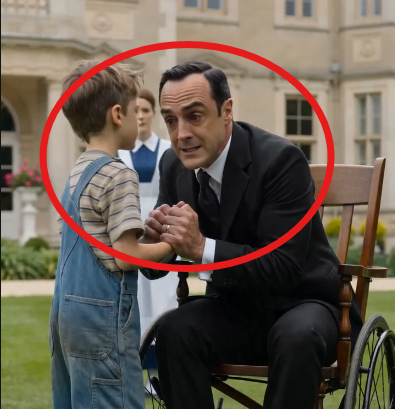
The maid’s hand slipped from her mouth. Her face had gone white as chalk, drained of color the way a person looks when a secret they’ve guarded for years suddenly walks right up to the front door in a pair of worn overalls and an innocent face.
The little boy standing on that perfectly trimmed lawn was shaking. Not from fear anymore. He had moved past fear. What was shaking him now was something far heavier — the ache of finally releasing words he had carried alone for far too long, words his mother had pressed into his heart like a folded letter meant for someone else to open.
“She told me,” he whispered, his voice barely rising above the sound of the wind moving through the hedges, “that if I ever found you… I should ask you to touch my hand before I asked you for the truth.”
The man’s legs nearly buckled beneath him.
He grabbed the handles of his wheelchair to steady himself, staring at the child the way a person stares at something they recognize but cannot bring themselves to name — because naming it would make it real, and making it real would change everything.
“No,” he said. But the word came out hollow. Not angry. Not certain. Just hollow, the way a man sounds when the story he has told himself for years begins to crack at the seams.
The boy blinked back tears and kept going, because his mother had told him to be brave, and so he would be.
“My mom worked here,” he said quietly. “She wore the same uniform.”
The man’s eyes snapped to the maid standing a few steps behind the child. She looked absolutely wrecked. He knew that expression — he had seen it on people who had buried something for years and had finally realized the ground would no longer hold it down.
His voice cracked when he spoke her name.
“Margaret…”
The maid’s eyes filled with tears. She stepped forward slowly, her hands trembling at her sides.
“I wanted to tell you,” she said. “I tried. More times than you know.”
The boy looked between them, confused and hurting in the way only a child can hurt — openly, without armor, without pretense.
The man’s face tightened. “What is she talking about?”
Margaret’s throat worked before she could answer.
“His mother was Clara.”
That name landed like a stone thrown into still water. Clara. The former housemaid with the soft laugh and the gentle way of moving through a room. The woman he had loved quietly and completely, in the way young men love when they don’t yet know how to protect the people they care for. The woman who had vanished the same week his father discovered she was carrying a child.
He had searched for her. For months, he had searched. Then he was told she had left with another man and had no desire to be found. He had believed it. Or perhaps he had simply been too broken to keep not believing it.
The little boy took one small step closer.
“She didn’t run away,” he said.
The man looked at the child and felt something inside him come completely apart.
“She got sick. And before she died… she told me your name.”
Margaret broke into full, open tears, pressing her hand over her mouth for just a moment before she found the words she had held back for so long.
“She came to the gate carrying him, weak and frightened, begging for a chance to see you. But your father was still alive then. He turned her away. He told her you never wanted the child. He gave her money and made sure she understood what would happen if she came back.”
The man stood there on the sunlit lawn and felt the ground tilt beneath everything he thought he had known about his own life.
“He told her those things,” he said, barely above a whisper.
Margaret nodded through her tears. “I found her later. She was already leaving. There was nothing I could do.”
The boy reached into the front pocket of his overalls with careful hands, the way children reach for something they have been told is precious and irreplaceable. He pulled out a tiny silver button hanging on a worn, threadbare chain — old and simple, the kind of thing that means nothing to the world and everything to the person who kept it.
The man’s hand moved instinctively to his own vest. One button had been missing for years from an old watch-chain he had once pressed into Clara’s palm as a quiet promise between two people who believed they had more time than they did.
He dropped to his knees in the grass.
Not because his body failed him. Because something deeper did.
“She kept it,” he breathed.
The boy nodded, crying freely now without shame or apology. “She said if you ever looked at it and cried… then I should forgive you.”
The man reached forward with trembling hands, stopping just short of touching the child’s face, as if the distance between them was a penance he was not yet sure he had the right to close.
“I didn’t know,” he whispered. “I swear to God, I didn’t know.”
The little boy’s mouth trembled, but he held the man’s gaze with a steadiness that seemed far beyond his years.
“For a long time,” he admitted, “I hated you.”
The man closed his eyes. Tears fell without restraint.
“I know,” he said softly. “You had every right.”
“But Mom said sick hearts make bad fathers.” The boy paused, letting those words breathe in the open air between them. “And she said… maybe one day yours would wake up.”
The silence that followed was not empty. It was full — full of every lost season, every unanswered question, every night that child had fallen asleep in a home that should have been his wondering about a father who should have been there.
Then the boy lifted his hand. Slowly. Deliberately. Offering it across the distance his grandfather’s cruelty had placed between them.
This time, the man did not hesitate.
He took his son’s hand. And then the boy stepped into him, and the man wrapped both arms around that small, brave body and held on as though he could compress every missing year into a single moment of presence.
The boy wept into his shoulder. The man wept harder.
When the boy finally pulled back just enough to look up at him, his eyes were red but clear.
“Do you still mean it?” he asked. “The fortune?”
The man almost laughed through his tears. “Every single cent of it is yours.”
But the boy shook his head gently, glancing once at the great white mansion standing behind them like a silent keeper of buried things, then back at the father he had only just found.
“I don’t want the fortune,” he said simply. “I just want to live somewhere nobody lies to me again.”
That undid the man completely.
He pressed a kiss to the boy’s forehead and pulled him close once more.
“You will,” he promised. “You’ll live right here with me.”
Then he looked at Margaret, eyes wet but steady, and spoke loud enough for the walls of that house to hear.
“And no one under this roof will ever bow their head again for telling the truth.”
On that sunlit lawn, three impossible things happened at once: a man finally stood in the fullness of who he was supposed to be, a child found the father he had crossed the world to reach, and a house full of long-buried lies finally, quietly, came undone.