When he walked through the front door that evening, he expected to find his home the way he had left it — quiet, orderly, and safe. What he found instead would change everything he thought he knew about the life his daughter had been living while he was away.
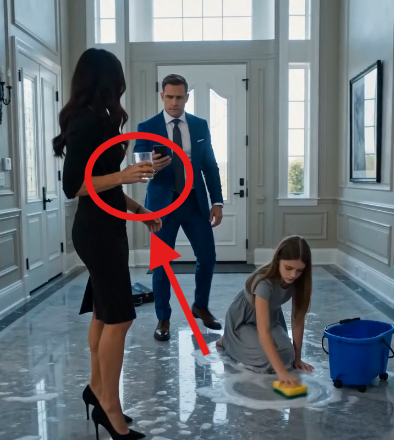
For one long second, nobody in the foyer moved.
Not the woman standing in the hallway.
Not his daughter, frozen near the base of the staircase.
Not even him.
Because what he saw around his little girl’s ankle was not just a piece of jewelry.
It was a message.
And the moment he understood that message, something colder than anger settled deep inside his chest — the kind of cold that doesn’t burn, doesn’t shout, doesn’t shake. The kind that simply decides.
He had seen that anklet before. Not on a child, but resting inside a velvet jewelry box upstairs, tucked among the woman’s monogrammed collection. A decorative little piece she had once laughed about over dinner, casually mentioning that she liked putting her initials on everything she “kept close.”
Now that anklet was clasped around his daughter’s ankle.
The little girl curled her toes inward the moment she noticed him looking. That single, tiny movement — that instinctive flinch of shame — told him more than any words ever could have.
This was not one bad afternoon.
This was a system.
He knelt in front of his daughter slowly, not as a businessman, not as a man protecting his reputation or his pride. He knelt as a father who had come home too late and was only now beginning to understand what that truly meant.
His voice softened the way it only ever did for her.
“Who put this on you?”
Her lip trembled. She glanced at the woman in black first — just for a fraction of a second — before her eyes came back to him. That hesitation alone was answer enough. But she whispered it anyway, her small voice barely filling the room.
“She said I had to earn my room.”
The room changed after those words.
He closed his eyes for one breath.
Because suddenly, everything that had seemed slightly off over the past several months snapped into focus with devastating clarity. The way his daughter had grown quieter on phone calls. The nervous little smiles that never quite reached her eyes. The way she always insisted she had been “helping” when he asked how she had spent her day. The strange, careful distance in the woman’s voice whenever he called from work trips.
He had mistaken silence for adjustment. He had read obedience as maturity. He had confused fear with shyness.
He had been away, and something had grown in his absence — something that wore the face of discipline but carried the weight of cruelty.
The woman in black found her footing again, her voice thinner than before but still reaching for control.
“You’re overreacting,” she said.
He stood up slowly.
And that was the moment she understood the worst thing possible — that he was no longer angry in a way she could argue with, redirect, or talk her way around. He was not the kind of furious that could be managed. He was done. He was decided. And decided men in moments like this one do not negotiate.
He reached into his pocket, made a brief call, and turned the screen in her direction. She did not need to read every detail to understand what she was looking at. The access had already been revoked. The arrangements had already been made. There was nothing left to talk around.
“Please,” she tried one final time, her voice searching for an angle that might still work. “She needed discipline.”
He looked at her the way a person looks at something they can no longer believe they once trusted near everything they loved.
Then he answered her — quietly, without raising his voice even slightly.
“She needed a mother. You gave her chores.”
That was the end of it.
His daughter was still crouched on the cold marble floor, not because anyone was holding her there anymore, but because she had not yet learned — not yet allowed herself to believe — that she was safe.
He bent down, placed one arm beneath her knees and the other around her back, and lifted her up from that wet floor. She grabbed onto him immediately, far too quickly, far too tightly — the grip of a child who had learned that moments of safety could be taken away without warning.
She pressed her face against his shoulder.
And in the smallest possible voice, she said the sentence that undid him completely.
“I scrubbed before you came so she wouldn’t be mad.”
He held her closer. Tighter. And he said nothing, because there was nothing in the English language adequate for that moment.
The woman in black had gone quiet. Because some truths are delivered so completely by a child’s whispered words that no adult in the room can add anything to them.
Standing in that cold white foyer, among soap streaks on the marble and the ruins of a pretense he had been too trusting to question, the truth was impossible to look away from.
He had not come home to find a child helping around the house. He had come home to find his daughter — his little girl — being carefully, methodically trained to feel grateful for cruelty. To believe that affection was something earned. That shelter was something owed. That love came with conditions and a silver chain around your ankle to prove it.
He did not put her down for the rest of that night.
And she did not let go.