She was not what anyone expected. Small in frame, dressed in quiet, worn clothing that had seen better decades. Her shoes were scuffed at the toes. Her coat was faded at the shoulders. She moved slowly, one careful step at a time, her hands wrapped around something small — something she held the way a mother holds a photograph of a child who is gone.
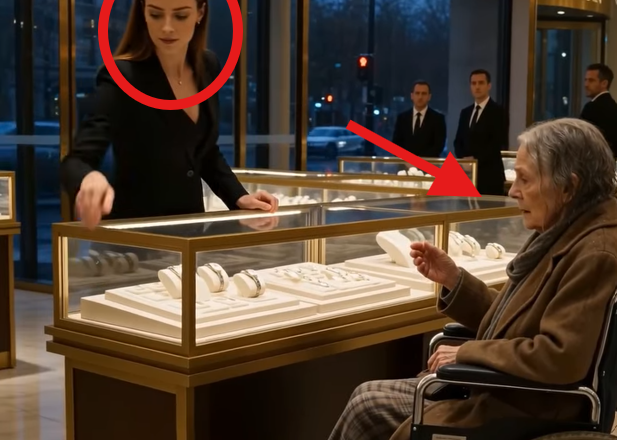
The saleswoman behind the counter glanced up. Her expression shifted in an instant — the kind of shift that speaks before words ever do. She looked at the old woman the way certain people look at things they consider beneath their attention. A polite but distant smile. A barely concealed judgment wrapped in professional courtesy.
The old woman set the object on the glass counter.
It was a watch. Old. Scratched. The kind of piece that had no obvious monetary value left in it — no sparkle, no shine, just the quiet dignity of something that had lived through real life. The saleswoman barely looked at it. She murmured something dismissive about the store’s policy regarding antique assessments and non-luxury items. She slid it back across the counter without care.
And then a young employee named Jonah stepped in.
He had been watching from a few feet away. He was not a senior associate, not a manager, not someone with authority or impressive titles. He was simply a young man who had learned — from somewhere deep in his upbringing — that every person deserves to be treated with dignity. He knelt down beside the old woman, who had nearly lost her footing in the moment of quiet humiliation. He picked up the watch from where it had nearly fallen. He held it gently, turned it over, and began to clean it carefully with a soft cloth.
He asked her about it.
And she told him.
Her husband had worn that watch the day he opened the store — this very store — many years ago. He had believed, with everything in him, that every piece sold should carry someone’s story, not just someone’s money. That behind every object brought through those doors was a human being who deserved to be seen.
When her husband died, she had stepped away. She had trusted others to carry on what he had built.
She had not come in that day to sell the watch. She had come because someone on the staff had discarded it — thrown it into a trash bin after she had left it for an appraisal during a previous visit. Jonah had found it. He had taken it out of the trash and set it safely aside, waiting for her to return.
He had not known who she was.
He had simply known it was wrong to throw away something that clearly meant everything to someone.
Behind the glass office door at the back of the store, the director appeared. He was not surprised to see her. He was afraid. The old woman noticed. So did Jonah. She looked through the glass and said, softly, “You knew.”
The director came out slowly. He spoke her name — Mrs. Hart — and that name moved through the staff like a current, like a secret none of them had been meant to hear.
She was the founder’s wife. The woman who had helped build the very walls around them.
She held up the watch. Her voice trembled, but she did not stop speaking. She told them what it meant. She told them what her husband had believed. And then she looked toward the trash bin and said the thing that silenced every person in the room.
“Today I learned what they did with trust.”
The director tried to smooth it over. He spoke of brand protection, of policy, of managing appearances. And she answered him with four words that carried the full weight of a life spent watching people choose wrong.
“You protected the price.”
From her cream-colored envelope, she removed a handwritten letter — one her husband had written before his final surgery. He had asked her to read it in the store if the store ever forgot him.
She unfolded it with steady, careful hands.
If a poor hand brings you something broken, treat it as if it is gold. Because once, we were the poor hands.
No one moved.
She turned to the young woman behind the counter who had first dismissed her. She turned to Jonah, still kneeling, still holding the cloth. And she told them what she saw. Not with cruelty. With the kind of heartbroken clarity that only comes from a woman who has outlived someone she built her whole world alongside.
“You saw junk,” she said to one.
“You saw memory,” she said to the other.
Then she placed the old watch into Jonah’s hands.
He shook his head. He told her he could not accept it.
“You already did,” she whispered. “When you took it out of the trash.”
She turned toward the security camera on the wall and asked, in a steady voice, that the day’s footage be sent to the board of directors.
The director went pale.
The saleswoman wept.
But the old woman did not look at either of them. She looked only at the young man still kneeling beside her — the one who had stopped, in a busy store, on an ordinary day, to treat a stranger’s treasure like it mattered.
“My husband built this store with one watch and one promise,” she said.
Her eyes filled with the kind of tears that hold an entire marriage inside them.
“Maybe it is time someone kept it.”
Some people spend their whole careers learning to recognize what is valuable. And some people are simply born already knowing. The difference, as it turns out, has nothing to do with what is behind the counter. It has everything to do with what is inside the person standing in front of it.