The yard went still.
Not the kind of quiet that settles between conversations — the kind that falls when something irreversible is about to happen. Every man standing in that dusty lot seemed to forget how to move, how to speak, how to even draw a proper breath.
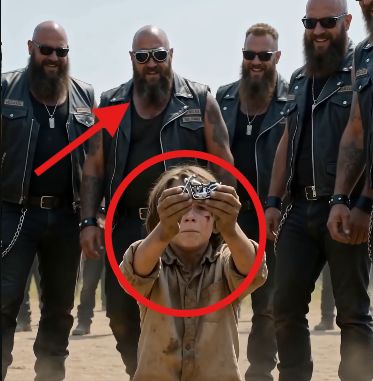
The biker stared down at the tiny silver motorcycle resting in his calloused palm. Such a small thing. Barely the length of his thumb. Then his eyes shifted to the boy kneeling in the dirt in front of him — small shoulders trembling, chin tipped down, hands folded in his lap like a child who had been taught to be patient in the presence of dangerous men.
His eyes went glassy. Something moved across his face that none of his crew had ever seen before — not in all their years riding beside him. It looked like grief. It looked like recognition.
“What’s your father’s name?” he asked.
The boy wiped his face with his sleeve, smearing more dust than tears across his cheek. His voice came out barely above a whisper.
“Eli.”
The biker closed his eyes.
A curse broke softly from his lips — not angry, not threatening. The kind a man says to himself when the weight of something finally lands.
One of the men standing behind him shifted forward instinctively. “Boss…”
The big man raised one hand without turning around. Not a command. A boundary. Whatever this was, it was his to carry.
“When did you last see him?” he asked, voice gone low and careful.
“This morning,” the boy said. “He was cold. He couldn’t get up.” His small mouth trembled at the edges. “He told me… he told me if something happened to him, I had to bring this to the man with the wolf mark.”
Slowly — like he already knew what he’d find — the biker turned his wrist over.
Beneath the worn leather cuff on his forearm, a faded wolf emblem was tattooed deep into his skin. Edges soft with age. The kind of mark a young man puts on himself when he believes he and his brother will be side by side forever.
The boy’s eyes filled all the way up.
“That’s you,” he breathed.
The biker looked like someone had driven a fist straight through his chest. Years of road and silence and the particular kind of hardness a man builds to survive — all of it cracked open at once, right there in the open air, in front of everyone.
“Eli…” he murmured. “That fool.”
The boy looked up at him. “You knew him?”
The biker’s throat worked hard before the words came out. And then he did something none of his men had ever witnessed. He dropped down — both knees in the dirt — until he and the child were eye to eye.
“I should have known him better,” he said, voice splitting at the seam. “He was my brother.”
The yard went dead silent behind him.
The boy’s whole face crumpled like paper.
“He said you were gone.”
“I was.” The biker didn’t look away. He didn’t flinch from the guilt settling heavy in his eyes. “Too long. Far too long.”
The child nodded slowly, the way children do when they understand something they’re too young to carry. Then he reached inside his dusty shirt pocket with careful fingers and pulled out a folded piece of paper — bent at the corners, soft with sweat, like it had been held and refolded many times before this moment.
The biker took it with hands that weren’t quite steady.
He unfolded it carefully.
His eyes moved across the first line.
Then the second.
Then they stopped.
All the color drained from his face like water pulling back from shore.
“What is it?” one of the other men asked from behind him.
The big man didn’t answer right away. He read the page again — slower this time — as if he needed the words to mean something different than they did.
They didn’t.
He looked up at the boy. And when he did, the expression on his face was not the one of a hardened man standing on familiar ground. It was the face of someone standing at the edge of something vast and unfamiliar, with no map and no road back.
His voice came out rough. Broken at the edges.
“Your dad didn’t just send you to me for help.”
The boy’s breathing caught in his small chest. His eyes searched the man’s face.
“Then why?”
The biker reached out with a shaking hand and placed it on the child’s shoulder — gently, the way you touch something you’re afraid might disappear.
He looked down one more time at the name written at the bottom of the letter. Just a name. Just ink on paper. But names carry weight when the truth inside them has been buried for years.
He looked back into the boy’s eyes.
And whispered, “Because if what’s written in this letter is true…”
The words caught in his throat for just a moment. Around them, the world held its breath.
“…you’re not just Eli’s son.”
Nobody moved. Nobody spoke. The dust settled soft and slow around them both, the way it always does after something that cannot be undone.
And the boy — this small, dirt-streaked child who had walked into a yard full of hard men carrying nothing but a silver toy and a crumpled letter — stared up at the only person left in the world who knew what any of it meant.
Waiting. Steady. As if somewhere deep inside him, he had always known this moment was coming.