Jonathan reached the bottom stair before Grace did. He planted himself directly in front of her, blocking the staircase with the same arrogant certainty he had used moments earlier to order her outside. His voice was sharp, his posture commanding.
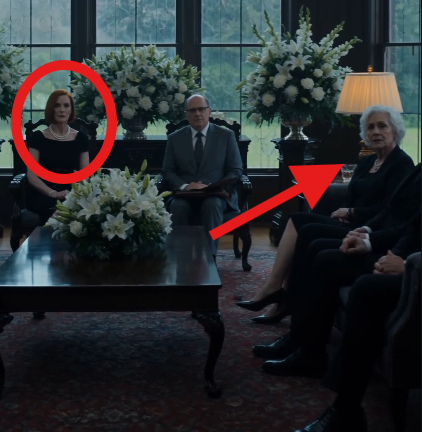
“You are not going up there.”
Grace looked at him quietly.
For thirty-four years, she had lowered her eyes whenever a Whitmore raised their voice. She had served dinners while people who shared her blood casually discussed how difficult it was to find loyal staff. She had polished family portraits that included everyone except her. She had ironed linens, arranged funeral flowers, and made herself invisible inside the very walls that held her deepest secret.
But now, somewhere above them, a frightened woman was standing behind a locked door.
Grace did not look down.
“Move.”
Jonathan blinked, almost startled that she had spoken to him as an equal. “She is ill,” he said sharply. “My mother was protecting her from public humiliation.”
Grace held up the brass key she had found in Evelyn Whitmore’s private drawer the evening before the old woman drew her last breath. “No,” she said calmly. “Your mother was protecting this family from the truth.”
Olivia, seated across the room, slowly rose from her chair. “Who is upstairs?”
The attorney removed his glasses and wiped them with a trembling hand. “I was instructed to open a sealed file only if Mrs. Grace Carter remained present in the room during the reading.”
Jonathan turned on him. “You knew?”
“I knew enough,” the attorney replied quietly, “to be ashamed of my silence.”
Grace stared upward. A muffled sound drifted from behind the closed door at the top of the stairs. A small, broken sob. That sound pulled her back across three decades in an instant.
She had been twenty-six years old when she gave birth to a baby girl in a county hospital. At that time, she was already working in the Whitmore mansion, still completely unaware that Evelyn — the powerful woman who employed her — was also the mother who had surrendered her at birth. Grace had named her daughter Naomi. She had held her for one single night.
By morning, the baby was gone. A doctor told Grace the child had stopped breathing. Evelyn arranged the burial and quietly offered Grace permanent work at the estate, presenting it as a gesture of compassion toward a grieving employee. Grace had stayed because she had nowhere else to go. Because a woman mourning a lost child does not easily walk away from a secure roof over her head. Because she had no idea she was being kept inside the very house where her stolen daughter would eventually be raised in secret and silence.
Olivia’s voice trembled. “Grace… what are you saying?”
Grace turned toward her slowly. “Your mother told me my newborn baby had died.”
Jonathan’s jaw tightened. “That has nothing to do with this family.”
Grace looked at the key again. “While your mother was dying, she asked me to sit beside her bed.” Her voice softened, carrying the weight of something long buried. “She called me her daughter for the first time in my life.” Olivia pressed her hand over her mouth. “She said she had committed the same sin twice. First, she allowed her own parents to take me away when I was born. Then, when I gave birth, she took my baby so she could raise one piece of me without ever admitting what I truly was to her.”
Jonathan shook his head. “No.”
The attorney placed a sealed envelope on the table. “She confessed everything. In writing and on video.”
Jonathan turned sharply. “Destroy it.”
Olivia stared at her brother. “What did you just say?”
He stopped. Too late. Grace could see it clearly now — not surprise on his face, but recognition. He had known.
“You were aware there was a woman locked upstairs,” Grace whispered.
Jonathan clenched his fists. “Mother said she was unstable. She said the woman suffered from delusions about belonging to this family.”
Grace swayed at what came next from his lips — a name she had whispered over an empty hospital blanket for thirty-one years. A name no one in this house had ever once permitted her to say aloud.
Naomi.
From above came the creak of a door opening wider. A pale woman appeared in the hallway — thin and terrified, dressed in a simple nightgown beneath an oversized cardigan. Her dark hair was streaked prematurely with gray. Around her neck hung a small bracelet woven from blue thread.
Grace recognized it instantly. She had made it while waiting for her baby to be born.
Her knees nearly gave way.
Naomi stared down at her. Her voice was fragile from disuse. “Are you Grace?”
“Yes,” Grace breathed.
Naomi’s lips began trembling. “She told me you did not want me. She said you accepted money and left. She said I was lucky she saved me from you.”
Grace shook her head desperately, tears streaming freely. “I thought you were dead.”
“Why didn’t you find me?”
“Because the woman who took you placed a tiny coffin in front of me and told me my baby was inside it.”
A broken sound escaped Naomi. She crossed the distance herself.
The moment she fell into Grace’s arms, Grace let out a cry that silenced the entire mansion. She held her daughter’s thin body against her worn black dress, rocking her the way a mother’s arms remember — without instruction, without thought, across thirty-one years of unanswered grief.
“My baby,” she sobbed. “I never left you.”
Naomi clutched her tightly. “I waited for someone to come.”
“I would have come every day.”
Below them, two officers entered the front door before Jonathan could reach it. Olivia watched her brother be led away, then looked up toward the staircase with tears streaming down her face.
“Is it true?” she asked. “Are you my sister?”
Grace studied the woman below — someone who had never been deliberately cruel, but who had never once wondered why an older housekeeper seemed to belong in this mansion more naturally than the family members who visited it.
“Yes,” Grace said.
Olivia removed her pearl bracelet and set it beside the attorney’s folder. “I want nothing from that will tonight. Our mother kept one daughter in servitude and another in a locked room. There is nothing in this house worth claiming before they are free.”
Naomi whispered, “Can we leave?”
Grace touched her daughter’s cheek gently. “Yes.”
Naomi glanced nervously at the staircase. “I’ve never gone out the front door.”
That single sentence broke the last remaining silence in the room. Olivia wept openly. The security man lowered his head. Even the attorney had to turn away.
Grace guided Naomi down the stairs, one careful step at a time. At the bottom, she paused beside the funeral flowers she had arranged so many times for so many Whitmores — while carrying inside her a grief no one in this family had ever acknowledged.
Naomi looked at the brass key still resting in Grace’s palm.
“Do you need that anymore?”
Grace studied it for a long moment. Then she placed it gently on top of Evelyn Whitmore’s closed leather folder and wrapped her fingers around her daughter’s hand instead.
“No,” she said softly. “I have what it was meant to open.”
Outside, the rain had softened to a quiet mist. At the mansion steps, Naomi hesitated beneath the open sky as if the world beyond those walls still seemed uncertain. Grace removed her own cardigan and draped it carefully around her daughter’s shoulders.
“It isn’t much,” she whispered.
Naomi touched the worn fabric. “It smells like you.”
Grace wept again — not from sorrow, but from something she had not been permitted to feel inside that house for thirty-four years.
Olivia stepped forward from the doorway. “Grace… I don’t know how to make any of this right.”
Grace looked at the polished windows, at the flowers visible inside, at the place she had given her life to without understanding why she could never bring herself to leave.
“You cannot make it right,” she said. “But you can decide what happens next.”
Olivia nodded through her tears. “The estate will provide for her care, her freedom, and everything that was taken from both of you. Not as charity.” Her voice cracked. “Because it was always yours to choose.”
Grace looked at Naomi. Her daughter’s frightened eyes were slowly beginning to believe she would not be pulled back upstairs. For the first time, Grace allowed herself a small, trembling smile through her tears.
“I have a little apartment,” she told Naomi. “It isn’t grand. The radiator complains all winter. The kitchen table is barely big enough for two.”
Naomi’s lips trembled. “Can I sit there with you?”
Grace lifted her daughter’s hand and pressed it gently to her cheek. “For as long as you want.”
Naomi leaned into her mother’s shoulder.
Together, they walked away from the mansion.
Grace had entered the reading as a servant holding a key to a secret room. She left as a mother holding the daughter that wealth had hidden from her. And behind them, in the house where blood had been treated as something shameful whenever it arrived without money, an upstairs doorway stood open for the first time in thirty-one years — letting in light, and air, and the quiet truth that some doors, once unlocked, can never be closed again.