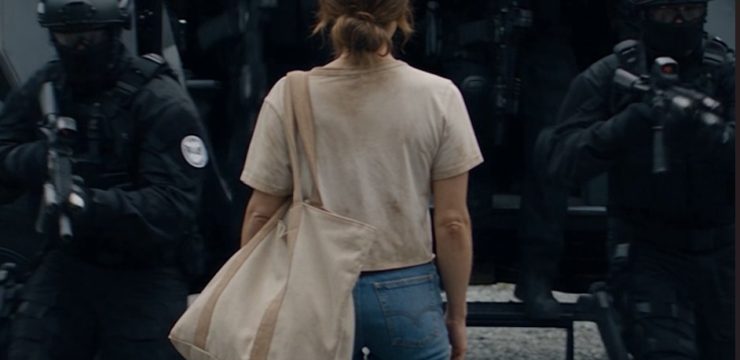
Nobody noticed her when she walked in.
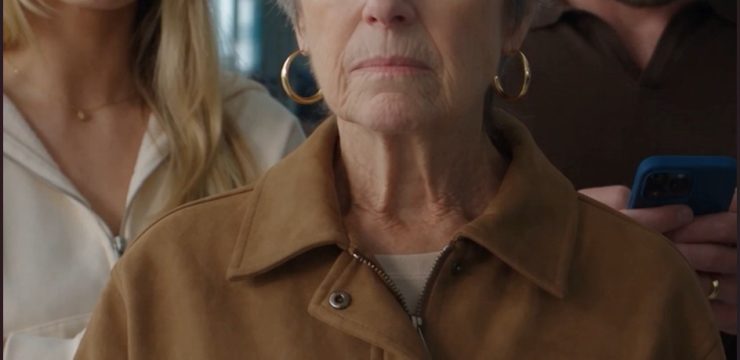
She was just the cleaner — the woman with the mop and the faded uniform, moving quietly along the edges of the grand wedding hall while guests in silk dresses and tailored suits laughed and clinked their champagne glasses. She kept her eyes down. She always kept her eyes down. That was how you survived when the world had decided you didn’t matter.

The flowers were stunning. The chandeliers dripped with light. Everywhere you looked, there was beauty and celebration and the kind of joy that only a wedding can hold. The groom was handsome and nervous in the best possible way. The bride was radiant, clutching her bouquet with trembling fingers, her smile so wide it looked like it might break her face open.
It was supposed to be the most perfect day.
And then the groom’s father saw her.
He stopped mid-sentence. His champagne glass hovered in the air, forgotten. The color left his face so quickly that the woman beside him reached out to steady him, thinking he might faint. But he didn’t faint. He just stared — stared at the cleaning woman like she was a ghost that had crawled out of a grave he had personally dug.
Because in his mind, she had.
“I buried you,” he said, and his voice was barely a sound at all. Just broken air pushing past broken words.
The cleaner closed her eyes.
She had carried this moment in her chest for thirty years. She had rehearsed it in the dark, in tiny rooms, in sleepless hours when the grief was so heavy she couldn’t breathe through it. She had imagined rage. She had imagined collapse. But now that it was here, all she felt was a deep and aching exhaustion.
“No,” she said quietly, opening her eyes and meeting his. “Your family buried the truth.”
The wedding hall went silent.
Not the polite silence of a ceremony about to begin — this was something else entirely. This was the silence of two hundred people suddenly understanding that they were witnessing something they were never supposed to see. Guests exchanged glances. Nobody moved. Even the musicians, who had been mid-note, seemed to freeze.
The groom stepped forward. His voice cracked on the single word. “Dad… what is this?”
His father couldn’t answer. He was still staring at her — at this woman he had dismissed as nobody, as background, as invisible — and seeing instead the face that had haunted him for three decades.
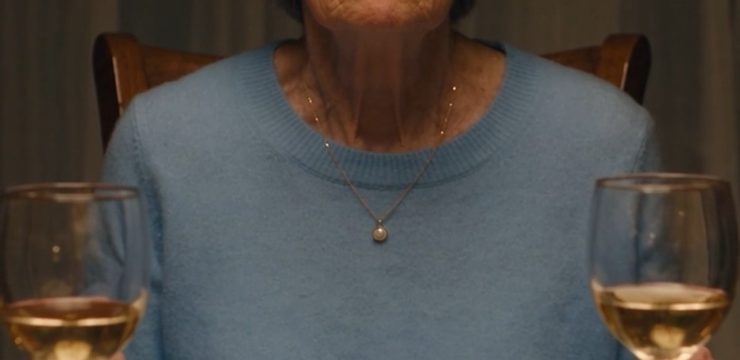
The cleaner reached up and touched something at her neck. A ring, hanging on a thin chain, worn smooth from years of being held during hard moments. She had never sold it. Even when the money ran out and the walls closed in, she had never sold it.
“I came once,” she said. Her voice was steady now, steadier than anyone could have expected. “I came to your door. I had your baby in my arms. Your mother answered. She looked at me like I was something she had stepped in.” She paused. “She told me you had moved on. That you had chosen a different life. A better one. She pressed money into my hand and closed the door.”
The groom’s face had gone completely still.
“Our baby?” he whispered.
The cleaner turned to him then. It was the first time she had really looked at him — truly looked — and what happened to her face in that moment was not something that can be easily described. It was grief and wonder and a love so old it had turned into something almost unbearable. Her eyes filled, and she didn’t try to stop it.
The groom’s father turned slowly. He looked at his son. He looked at the woman he had spent thirty years not thinking about, or trying not to think about. He looked at the bride, who had pressed her hand over her mouth, her bouquet hanging forgotten at her side.
The aisle between them felt like a canyon.
Everyone in that room had arrived expecting a celebration. They had come to witness two people begin their life together, to eat good food and dance to good music and go home with full hearts. Instead, they were standing at the edge of a story that had been hidden for an entire lifetime — a story of a young woman turned away at a door, of a man who perhaps never knew, of a family that had decided to simply erase her rather than deal with the inconvenience of her existence.
The poor cleaning woman that guests had barely glanced at — the one some had spoken to impatiently, the one who had been invisible by design — was not a stranger to this family.
She was the groom’s mother.
She had spent thirty years on the outside of the life that should have been hers. She had worked hard jobs and quiet jobs and jobs that left her invisible, and she had survived. But she had never stopped carrying the weight of what was taken from her. Not the money. Not the status. The child. The chance to be known. The chance to matter to the person she had loved.
And now here she stood — mop set aside, back straight, eyes clear — in the middle of a wedding that belonged, in ways no one had yet fully understood, to her.
The truth had finally walked through the door.
And no amount of chandeliers or champagne or carefully arranged flowers was going to put it back outside.