Vanessa had always believed Daniel’s silence meant weakness.
That was her first mistake.
Her second was underestimating how much a child notices when the adults around her assume she is too young to remember, too small to matter, and too broken by grief to speak up for herself.
By the time the lawyer arrived at the house that evening, Emma was wrapped inside her father’s coat, sitting on the staircase with red-rimmed eyes and trembling hands. Daniel stood in the center of the foyer like a man exercising every last ounce of self-control he possessed, holding himself completely still while something enormous moved beneath the surface.
Vanessa kept reaching for control the way she always had — with words, with framing, with the calm, rehearsed confidence of someone who had never been caught before.
“It was discipline,” she said evenly. “She made a mess.”
Emma flinched at the word.
Daniel saw it.
The lawyer saw it too.
And when Daniel slowly knelt down in front of his daughter and asked, quietly and gently, “What mess, sweetheart?” — the entire lie began to crack open at its seams.
Emma’s lower lip trembled. Her small voice barely filled the room.
“I spilled nothing,” she whispered. “She dropped the soap. Then she told me to clean it up. And she said if I cried, you would think I was bad… like my mommy.”
Silence fell over the foyer like a held breath.
Vanessa went completely still.
Because that name — that wound — Emma’s mother had been gone only eighteen months. The grief was still raw, still tender, still the deepest and most private pain in that child’s heart. And Vanessa had reached into it deliberately, without hesitation, and used it as a tool.
Daniel rose to his feet slowly.
“You said what to her?”
Vanessa attempted a laugh. It came out thin and unconvincing.
“She’s emotional. She makes everything bigger than it is. You know how she gets.”
Then Emma said the rest of it.
Still small. Still frightened. Still achingly clear.
“She makes me kneel on the floor when the cameras are turned off, Daddy.”
Daniel turned toward the ceiling. He turned toward the hallway. He turned back to Vanessa.
And the expression on her face in that moment told him everything he had not been home to see.
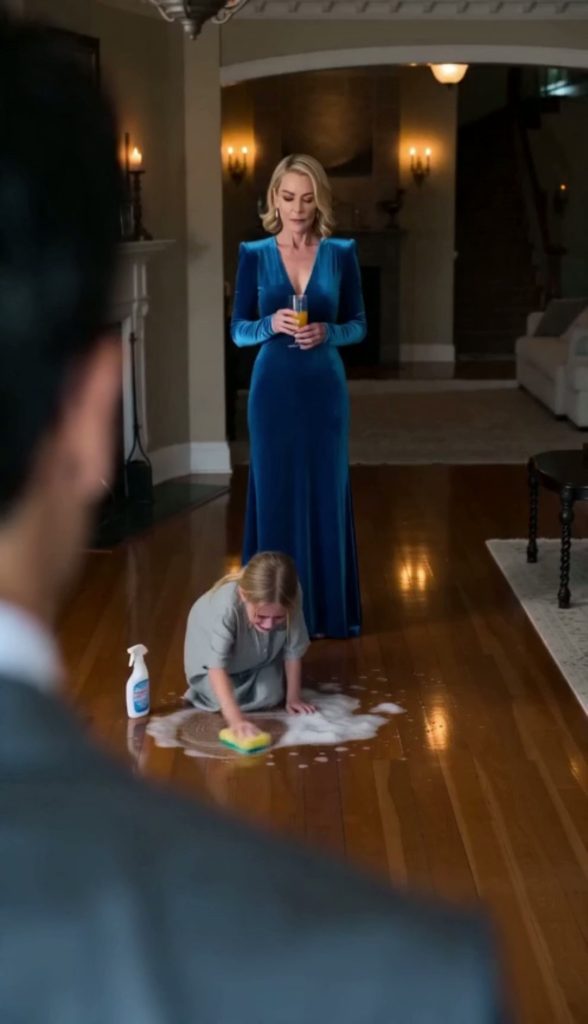
This was not impulse. This was not frustration. This was something far colder — something planned, timed, and hidden with care. She had constructed a version of the house that existed only when he was away. A private space where a grieving little girl could be humiliated without witness, without record, without consequence.
But Vanessa had made one critical mistake.
Daniel had come home early that day because the security company had sent him an automatic alert — a test notification triggered by a brief power flicker that caused the foyer camera system to restart. The camera had come back online for only a few minutes. Just long enough to capture a single frozen image: his daughter beside a blue bucket on the marble floor.
That image had brought him home.
That image was already costing Vanessa everything.
The security technician arrived while the lawyer was still standing in the foyer. He carried a laptop with a partial footage restoration — only three minutes recovered from the interrupted recording.
Three minutes were more than enough.
The footage showed Vanessa placing the bucket deliberately near the hallway. It showed her pointing Emma down toward the floor without a word of explanation. It showed the child dropping to her knees and obeying without protest, the way a child obeys when she has learned that resistance only makes things worse. And it showed Vanessa settling comfortably into a chair with her drink, watching, while Emma scrubbed the marble in silence.
The footage ended there. But it did not need to go further.
Daniel watched the screen once. He looked at Vanessa. Then he picked up the pen the lawyer offered and signed the first document without asking a single question.
“What is that?” Vanessa asked. Her voice had lost its steadiness.
“The order removing you from this house,” Daniel said.
She went pale. “You cannot do this over a misunderstanding.”
He gave a short, hollow laugh — the kind that carries no humor at all.
“I’m not doing this over a misunderstanding,” he said. “I’m doing this because you looked at my daughter’s grief — the most painful thing she carries — and you found a use for it.”
On the staircase, Emma had begun to cry. Not the frightened, contained crying of a child who has learned to cry quietly so no one will punish her for it — but something softer, something releasing, like a knot finally coming undone.
Daniel crossed the foyer, knelt in front of her again, and gently moved the wet hair back from her face with both hands.
“Listen to me,” he said, his voice gentler than she had heard it in months. “No one will ever make you kneel in your own home again. I promise you that.”
Emma looked up at him with tears still spilling over her cheeks.
“Really, Daddy?”
He nodded slowly, firmly, without looking away from her face.
“Really.”
She threw both arms around his neck and buried her face against his shoulder and sobbed — fully, finally, without holding anything back. Daniel held her with the quiet, desperate tenderness of a father trying to make up for every single hour he had not been standing in that hallway.
Behind them, Vanessa stood alone in the center of the polished marble floor and understood too late what she had never actually grasped: the real power in that house had never been hers. It had never been the money, the image, the access, or the authority she had so carefully cultivated. It had always been the small, grieving girl she had tried so hard to make feel worthless.
The moment Daniel chose that child — openly, in front of the lawyer, in front of the cameras, without hesitation — Vanessa lost every single thing she had believed was secured.
As she was escorted toward the door, Emma lifted her tear-streaked face from her father’s shoulder and asked in a trembling whisper:
“Daddy… can I stop being good now?”
Daniel’s composure broke completely and quietly.
He pressed his lips to her forehead and pulled her closer.
“Baby,” he whispered, his voice rough with everything he hadn’t said for eighteen months, “you never had to earn love. You only ever had to come back to me.”
And in the gleaming white foyer where she had been made to scrub the floor on her knees — where someone had tried to teach her that she was small, and lesser, and lucky to be tolerated — a little girl finally, completely, put down the weight of a lie that had never belonged to her in the first place.