Mr. Vale stopped breathing the moment he saw her eyes.
Sophie slowly pulled off her sunglasses with trembling hands, and for the first time in what felt like a lifetime, her gaze found her father’s face. She stared at him the way only a child can stare at someone they have been waiting years to truly see — with raw, unguarded longing.
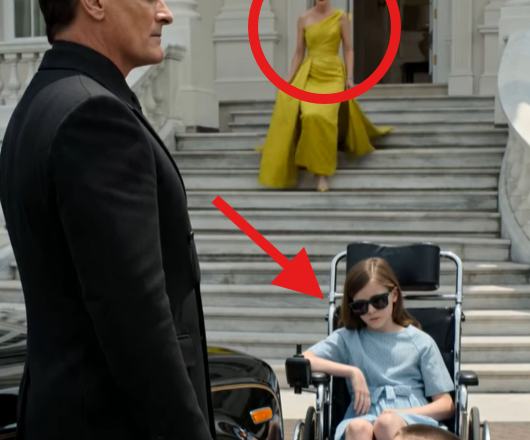
“Your tie is black,” she whispered. “And you’re crying.”
A broken sob tore itself free from deep inside Mr. Vale’s chest. His hand flew to cover his mouth, but it was too late. The sound had already escaped — ragged, desperate, the kind of cry that only comes when a man realizes he has lost something precious without ever knowing it was being taken.
Behind him, Helena stepped back.
“No,” she said quickly, her voice sharp and practiced. “She’s confused. Her condition comes and goes. You know how she gets.”
The boy standing in the doorway shook his head slowly.
“That’s not true.”
Helena turned on him like a woman who had spent years perfecting the art of dismissal. “You know absolutely nothing about this family.”
“I know Sophie used to wave at me from her window,” he said quietly. His voice didn’t waver. “She told me she could see perfectly fine — right up until you brought her breakfast every morning.”
The silence that followed was the loudest sound in the room.
Mr. Vale looked down at the small brown bottle in his hand. Then he looked at the woman who had sat beside his daughter’s hospital bed for four long years. The woman he had trusted completely. The woman he had thanked, again and again, for her devotion.
“Why?” he asked. Just that one word.
Helena’s eyes filled with tears, but her voice went cold and hard as stone.
“Because the trust only stays under my control while Sophie requires full-time care.”
The words didn’t land like words. They landed like a verdict.
Mr. Vale stared at her, his face cycling through disbelief, confusion, and then something far darker — the slow, shattering recognition of betrayal so deep it had no name.
“You kept my child sick,” he said. “For money.”
Sophie began to cry silently, her small shoulders shaking, her tears falling without sound — the way a child cries when she has learned that crying out loud brings no one.
The boy moved before anyone else. He crossed the room and took Sophie’s hand in both of his, kneeling beside her chair.
“It’s okay,” he whispered close to her ear. “You told the truth. You were so brave.”
Sophie squeezed his fingers tight. “Don’t let her make me drink it again.”
Mr. Vale’s legs gave out beneath him.
He dropped to his knees on the cold stone floor in front of his daughter — this beautiful, fragile girl he had believed was fading from a cruel and mysterious illness. His hands shook uncontrollably as he reached up and touched her cheek with the kind of gentleness that only grief can teach a person.
“She never will,” he said, his voice barely holding together. “Sophie, I am so sorry. I am so deeply sorry I didn’t see you. I didn’t see what was happening right in front of me.”
Sophie leaned into him and let herself cry against his shoulder — openly, fully, the way she perhaps hadn’t been able to cry in years.
For a long moment, neither of them moved.
Then Mr. Vale lifted his eyes to the boy still holding his daughter’s hand.
“How did you know where to find the bottles?” he asked.
The boy reached into his shirt and pulled out a torn, faded photograph. In it, a younger Mr. Vale stood beside a woman — a housekeeper — someone who had worked in this house long before Helena arrived and quietly began rewriting everything.
The boy turned the photograph over. On the back, written in ink that had faded almost to nothing, were the words: Tell his father when it is safe.
His lip trembled.
“My mother worked here,” he said. “Before she died, she made me promise. She told me to protect my sister.”
Mr. Vale went very still.
The color drained from his face slowly, like water leaving a glass.
“Sister?” he whispered.
The boy nodded. Tears finally broke free and ran down his face — quiet, dignified tears, the kind that have been held back for far too long.
“She said you never knew I existed,” he said. “She said you never knew I was yours.”
No one in that room made a sound.
Sophie turned from her father’s arms and reached out to take the boy’s hand again — this boy who had stood at her window, who had listened when no one else would, who had risked everything to walk through that door with the truth.
And Mr. Vale, kneeling on the cold driveway stones, pulled both children into his arms at the same time. He held them against his chest and could not speak. There were no words left — only the shaking of his shoulders and the tears that fell onto the tops of two heads he was only now, finally, beginning to know.
Behind them, Helena remained on the mansion steps alone.
The grand house rose up behind her like a monument to everything she had built on another family’s suffering. But the life she had so carefully constructed — the control, the access, the power — was already gone.
And the worst part, the part that would stay with her long after everything else faded, was this: the truth had not come from a lawyer, or a doctor, or an investigation.
It had come from a little girl by a window.
And a boy who had made a promise to his mother.