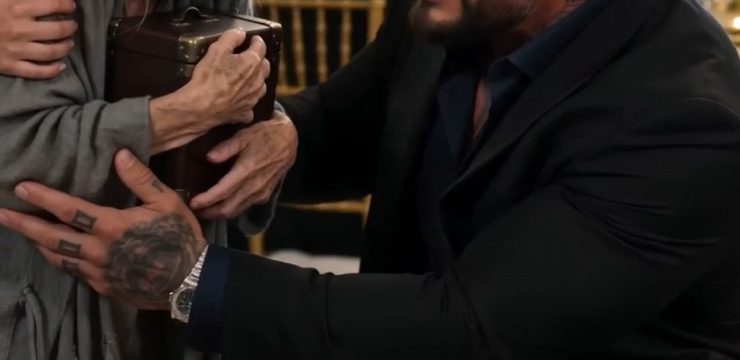
There are moments in life when a single act of cruelty pulls back the curtain on who someone truly is. No warning. No second chances. Just the raw, ugly truth standing in the middle of a room full of people pretending not to see it.

This is one of those moments.
The kitchen was warm, humming with the quiet efficiency of people who had spent their lives making other people’s evenings beautiful. Matteo Romano had grown up watching hands like these — steady, tired, capable hands — and he had never once forgotten where he came from, no matter how high he had climbed.
Tonight was supposed to be a celebration. The kind of evening that gets talked about for years. Crystal glasses. Pressed linens. Soft music drifting through rooms that cost more per night than most people earn in a month. Matteo had planned every detail carefully, because that was the kind of man he was. A man who paid attention. A man who remembered what mattered.
His mother had come dressed in her finest. She was not a woman of wealth or status, but she carried herself with the quiet dignity of someone who had earned every gray hair, every calloused finger, every line on her face. She had worked in professional kitchens for thirty years — not for recognition, not for applause, but because it was honest work and she had a son to raise. She had poured her whole life into giving Matteo something better, and he had never once been ashamed of that.
His fiancée, however, had other ideas about the evening.
The woman in the rose gold dress was everything the room expected — polished, beautiful, draped in the kind of confidence that comes from never having been told no. She moved through the party like she owned it. And perhaps, in her mind, she did.
What happened next was not witnessed by the full room. It happened in the quieter corners, where the staff moved like shadows and the guests barely noticed them at all. Matteo’s mother had stepped slightly out of place — or perhaps simply existed in a space where the woman in rose gold did not think she belonged. Words were exchanged. Low, sharp, dismissive words. And then, something worse than words.
She shoved her. The woman in rose gold put her hands on Matteo’s mother.
She said things that should never be said to any human being, let alone a woman who had given everything she had to raise a good man. She called her old. She said that wealthy sons should not bring working mothers to formal events. She instructed the kitchen staff to stay silent, counting on the fact that people who serve are rarely believed over people who shine.
She miscalculated.
When Matteo came around the corner and saw his mother’s face — the shame in her eyes, the way she held herself smaller, as if she had spent a lifetime being taught that rooms like this were not meant for her — something shifted in him that would never shift back.
He looked at the woman he had planned to marry and asked one quiet question.
“Who saw it?”
The staff stood still at first. Fear has a way of doing that. But then, one young dishwasher raised his hand. He could not have been more than nineteen years old, and he was shaking slightly, but he held his arm up and told the truth. And then another. And then another. One by one, the people who had been told their silence was required found their voices.
The woman in rose gold felt the floor change beneath her feet.
Matteo Romano did not raise his voice. He did not need to. The quieter a person speaks in a moment like that, the more the room leans in. He turned to the woman who had humiliated his mother and said the words that every person in that doorway would carry home with them.
“My mother worked in kitchens for thirty years so I could stand in rooms where people like you pretend they were born above her.”
His mother whispered for him not to make a scene.
He turned back to her then, and whatever composure he had been holding finally broke — not in anger, but in something far more powerful than that. He told her the truth. The whole truth, spoken simply and without apology.
“You were never the scene, Mama.”
He took off his jacket. He wrapped it around her shoulders. And then he said the line that made the entire doorway go silent.
“You were the reason I got invited to one.”
There is a particular kind of heartbreak that comes from seeing someone you trusted reveal themselves to be exactly who you hoped they were not. Matteo had loved this woman, or believed he had. He had placed a ring on her finger. He had imagined a future. He had brought her into his world without ever imagining she would use that access as a weapon against the person who built him.
She reminded him she was his fiancée.
He looked at her hand. At the ring. At everything he had been willing to become for someone who saw his mother as an embarrassment.
He reached into his pocket. He took out the ring box. And he closed it.
“Tonight was supposed to announce our engagement,” he said.
The room held its breath.
“Instead, it announced who you become when you think servants have no sons.”
Some people spend their whole lives performing goodness while never actually practicing it. They dress it up beautifully. They say the right things in the right company. But put them in a room with someone they consider beneath them, and the mask slips every time.
Matteo Romano had almost married that mask.
He walked his mother out of that kitchen and into the warm night air, her hand in his, her dignity fully restored — not because he had defended her, but because she had raised a son who never stopped seeing her worth, even when the world told her to make herself smaller.
That is not a small thing. That is everything.