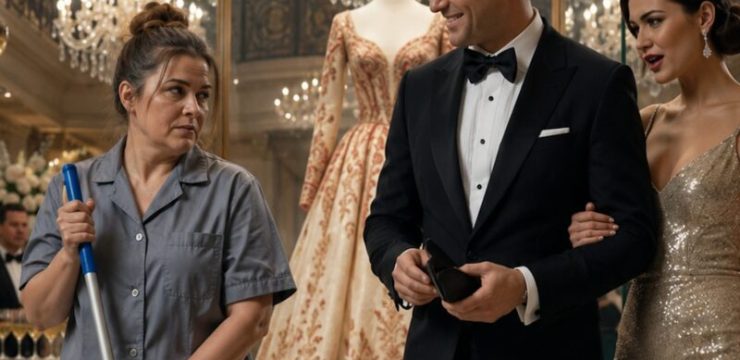
For one second, nobody moved.
The city lights blinked on below the rooftop terrace, one by one, as if the entire skyline had quietly decided to hold its breath. The guests stood frozen around the dinner table — crystal glasses still raised, conversations half-finished, laughter dying on lips that had forgotten how to close.
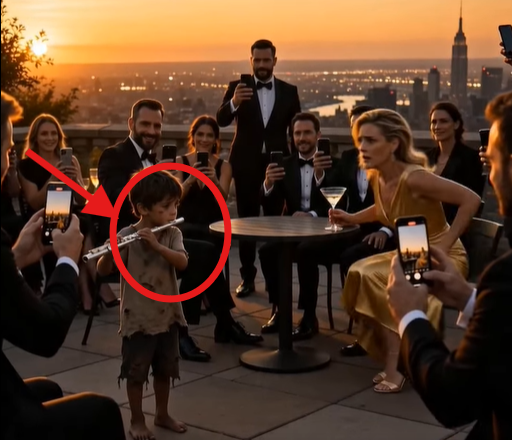
Nobody had expected a child to walk through that door.
And nobody had expected what the child was carrying.
The small fingers tightened around a silver flute, worn at the edges, polished by years of careful hands. It was the kind of instrument that didn’t belong at a party like this — a party of marble floors, tailored suits, and a hostess in a gold dress who had spent two decades learning how to smile without meaning it.
The woman looked from the leather case in her husband’s hand to the terrified face of the child standing at the edge of the terrace. And in that single, breathless moment, something cracked open inside her chest. Every carefully constructed version of her life — every story she had accepted, every silence she had swallowed — began to fall apart all at once.
“You knew Anna,” she said.
Her husband gave a small, practiced shrug. “A long time ago.”
The child shook their head slowly. “You promised her.”
The guests went completely still.
The husband’s smile faded, just barely. “You shouldn’t be here.”
The child took one step back, voice trembling but steady enough to carry across the rooftop. “My mom said if I ever found the woman in the gold dress, I had to play the song.”
The woman covered her mouth with both hands.
“What woman?” a guest whispered somewhere behind her.
The child looked straight across the table, past the flowers and the candles and the untouched plates of food.
Looked straight at her.
“You.”
Tears came before she could stop them.
Years ago — before the money, before the rooftop parties, before the polished, practiced version of herself she wore like a second skin — she and Anna had been inseparable. They had studied flute together at a small conservatory, sharing music stands and late-night coffee and the particular kind of friendship that only forms when two people are young and dreaming at exactly the same time.
Then Anna vanished.
Her husband had explained it calmly, the way he explained everything. Anna had run away. Anna had stolen money. Anna had disappeared with another man and never looked back. He had said it so many times, in so many quiet, reasonable tones, that eventually she stopped asking questions. Eventually, she believed it.
But now the child reached into the torn pocket of their jacket and pulled out a small, folded photograph.
With hands that wouldn’t stop trembling, the woman opened it.
The photo was old. Creased. Faded at the corners as though it had been carried a very long time, through very difficult places.
Two young women stood side by side. Each one held a silver flute. Each one was smiling the way people smile when they don’t yet know what’s coming.
Anna.
And her.
She turned the photograph over.
On the back, in handwriting she still recognized after all these years, were eight words:
If he finds me, protect my son.
The sound that came out of her was barely human.
Her husband stepped forward immediately. “Give me that.”
She stepped away from him.
“No.”
His face changed in a way she had never seen before, or perhaps had simply never allowed herself to see. The polished surface slipped. What was underneath was something harder, something colder.
“You have no idea what she was involved in,” he said, his voice dropping.
But the child did.
The child turned the silver flute over carefully and held it toward the light. Near the mouthpiece, scratched delicately into the metal, were two small initials.
A.M.
Anna Maren.
The same initials engraved on the inside of the photograph’s worn frame. The same initials the woman had once helped carve herself as a joke when they were nineteen years old and absolutely certain that life would be kind.
Her knees nearly gave out beneath her.
“He lied to you,” the child said, crying openly now, making no effort to hide it. “My mom said he took everything from her. Her music. Her name. And then he came back for me.”
The woman raised her eyes slowly to her husband’s face.
She was not confused anymore.
She was not afraid anymore.
She was something far quieter than either of those things, and far more final.
Behind them, one of the guests lifted a phone — not to record the child, but to record him. The husband heard it. He turned. And for the first time that entire evening, panic moved across his face like a shadow.
The woman stepped in front of the child.
“You are not touching this child.”
The rooftop erupted. Guests shouted. Footsteps crossed marble in every direction. Security flooded in from the elevator with the particular urgency of people who had waited too long to be needed.
But the child simply pressed their face against the gold dress and whispered through soft, broken sobs.
“She said you’d know the song.”
The woman pulled the child close and held on the way you hold on when you are trying to make up for years of absence in a single second.
“I know it,” she whispered into the child’s hair, crying without any attempt at grace. “I know every note of it.”
And as security pulled the man in the black suit away from the table, away from the terrace, away from the life he had so carefully built on top of someone else’s silence — the child raised the silver flute one final time.
And played the second half of the melody.
The half Anna never got to finish.