For one long second, nobody in the ballroom moved.
Not the guests draped in silk and diamonds. Not the servers frozen mid-step with their silver trays. Not even the man standing beside the grand piano — the man who had spent years convincing himself that certain chapters of his life were permanently closed.
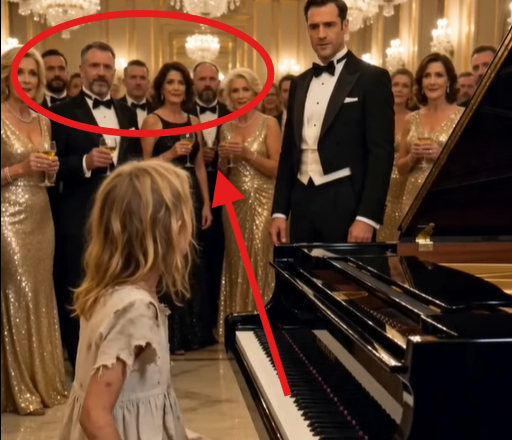
Because the little girl at the keys had just played something no one in that room was prepared to hear.
And it wasn’t the melody that stopped them cold.
It was the key.
The small, tarnished silver key hanging around her neck.
A melody could be learned by anyone willing to practice. It could be copied, passed down, stolen from memory, and performed by a stranger. Music travels. Music survives. Music finds its way into the hands of people who never deserved it.
But that key — that particular key — was something else entirely.
It was impossible. And every soul in that chandelier-lit ballroom who mattered knew exactly why.
Years before this night, a young pianist had vanished from the estate without warning. The story that circulated through the drawing rooms and dinner parties was neat, simple, and terribly convenient: she had stolen from the family before she disappeared. Jewelry. Cash. Documents pulled from the private office upstairs. The accusation spread through high society the way wildfire moves through dry grass — fast, total, and consuming everything in its path.
But rich families have a particular talent for dressing cruelty up in the language of fact. Convenience, when spoken with enough confidence behind mahogany walls, has a way of becoming what everyone calls truth.
Only three people on earth knew what had actually happened.
The pianist herself. The man in the tuxedo standing frozen beside the piano. And the dead owner of the ballroom, who had carried his secrets all the way to his grave without a single apology.
That silver key opened a hidden compartment built into the old piano bench — a compartment where the pianist had sealed away letters, signed legal papers, and a private marriage certificate the family had gone to extraordinary lengths to erase from existence. Not a thief’s hiding place. A wife’s insurance policy.
Because she had not been a thief at all.
She had been his wife. Secretly. Legally. And catastrophically inconvenient to every inheritance arrangement the family had carefully constructed around her absence.
The little girl at the piano looked up at the man with steady, unblinking eyes that were far too old for her face.
“My mother told me,” she said softly, her voice carrying across the sudden silence of the room, “that if you saw the key first — you’d know I was telling the truth.”
The guests had gone quiet for an entirely different reason now.
This was no longer about pity for a hungry child who wandered in off the street with extraordinary musical talent. This was no longer a touching story to share over brandy after the evening ended.
This was blood. This was scandal. This was something buried deep and deliberately — something clawing its way back up through the polished marble floor in the middle of one of the most elegant rooms in the city.
The man’s lips parted. No words came.
Because standing before him was not some starving girl with a gift for music and unfortunate timing.
She was his daughter.
The daughter the family had quietly informed him had perished alongside her mother during what they carefully referred to as her attempt to flee. A tragedy, they had called it. Unfortunate. Unavoidable.
A lie so complete and so long-tended that he had eventually stopped questioning it, because some men find that grief is easier to live with than guilt.
But the pianist had not perished. She had run because she was pregnant, because she was hunted, and because she was brilliant enough to understand that a family willing to erase a marriage was willing to erase far more than paperwork.
She had survived. She had raised this child. And then, when the time was exactly right, she had sent her daughter back.
The little girl reached beneath the piano bench without a moment’s hesitation. Her small fingers found the hidden keyhole in the dark without searching, the way a person finds something they were taught to find before they were old enough to understand why. She slid the silver key in.
A sharp, clean click echoed through the ballroom.
Every person in that room flinched.
She opened the compartment and lifted out a folded packet wrapped carefully in faded cloth. Resting on top was a handwritten note — a woman’s handwriting, unhurried and deliberate, as though she had written it knowing exactly what moment it was meant for.
If she returns here hungry, then none of you deserved us.
That was the moment the man broke.
Not dramatically. Not in a way that gave anyone in the room the satisfaction of spectacle. Just quietly, completely — the way something breaks when it has been holding far too much weight for far too long.
The girl held the packet against her chest and looked up at him one final time.
“My mother said to ask you one thing,” she said. “Before I take the food and go.”
The room held its breath.
“Why did you leave us in the dark — while you kept all the lights?”
The chandelier above them blazed. The crystal caught the light and scattered it across every beautiful, guilty face in that room.
And for the first time all evening, the ballroom did not look grand.
It looked exactly like what it was.
A monument to everything these people had chosen to protect instead of love. A cathedral built on a foundation of silence, denial, and the quiet devastation left behind whenever powerful people decide that inconvenient truths are easier buried than faced.
The little girl asked for nothing more. She had already given them something they could never unfeel — the reflection of who they had all agreed to become, seen clearly at last through the eyes of a child who had every right to hate them and had chosen, somehow, simply to ask.
Some silences are louder than any music a room has ever held.
This was one of them.