For one long second, nobody in the garden moved.
Not the husband. Not the wife. Not the little girl standing there in her yellow dress, holding something small and silver in her trembling hand.
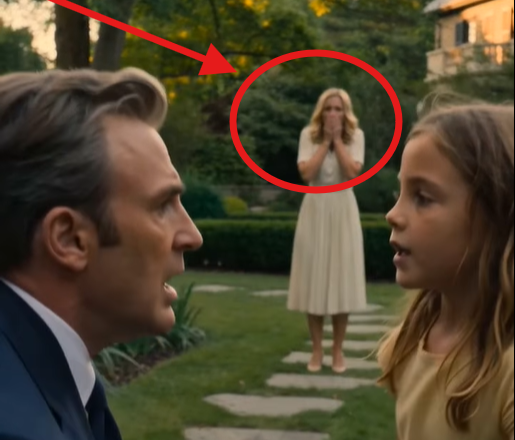
Because that silver spoon changed everything.
It wasn’t a child’s wild imagination anymore. It wasn’t an accusation born from hearsay or neighborhood gossip. It was physical proof — cold, undeniable, and pulled from deep inside the walls of a home where secrets had been living far too long.
The wealthy man stared at the crest engraved on the handle and felt the ground shift beneath him. Not dramatically. Not all at once. But in that slow, sickening way that happens when a person realizes the life they thought they understood has been something else entirely.
That spoon belonged to the private tea service kept inside the estate. Not the guest collection. Not the trays used by household staff during their daily routines. The family silver — the kind reserved for intimate meals, for quiet mornings, for moments no outsider was meant to witness.
Which meant this child hadn’t invented a single word of what she’d said.
She had been there. Or someone she loved had been.
The wife’s face drained of whatever composure she had left.
The man’s voice dropped lower, rougher, carrying the weight of a question he wasn’t sure he was ready to have answered.
“Where did you get that?”
The little girl swallowed hard before she answered.
“In the laundry room. By the sink.”
Those words landed with terrible precision — because they gave the story a location. A real one. A hidden one. Not a vague claim floating in the air, but a specific place where something secretive had been handled, then lost, then found by a child too young to understand what she was carrying and old enough to know it mattered.
The man rose slowly from the garden bench. Not transformed. Not suddenly healed. But standing in a way that made every carefully constructed lie collapse again under his gaze.
He had spent years moving through his own home like a man lost in fog. His wife had chosen his routes through the estate, selected his clothing, managed his meals, controlled his schedule with the quiet efficiency of someone who believed she was helping. She spoke for him in rooms where he had once commanded the attention of powerful people. She had taken his confusion and turned it into her influence — so gradually, so gently, that it had felt like care instead of control.
Now, for the first time in longer than he could measure, he was looking directly at her.
The little girl tightened her grip on the spoon.
“My mother worked here,” she said softly. “She washed your cups.”
The wife closed her eyes for just one second.
That single second said everything.
Because now he understood who this child was — and why she had come on this particular afternoon to this particular garden. Not by accident. Not out of childhood bravery alone.
She had been sent. By someone who had seen far too much and ran out of time to say it herself.
“Your mother told you this?” he asked.
The girl shook her head slowly.
“She died before she could. But she hid the spoon.”
That was the devastating brilliance of it. A woman who knew she was running out of time had not left behind a written statement. She had not arranged for a witness. She had hidden one small silver object in a place where it did not belong — trusting that someday, somehow, the right person would find it and understand what it meant.
The garden, which had felt peaceful and sun-warmed just moments before, now felt like the backdrop for a reckoning that had been building for years without anyone naming it out loud.
The wife’s voice finally broke through, thin and desperate.
“You don’t understand —”
He stopped her simply by turning his gaze toward her. No words required.
Then the little girl spoke the sentence that quietly destroyed whatever remained between them.
“She said you still read the paper when nobody watches.”
The man went completely still.
Because that was true.
Some mornings, when the house was quiet and he believed himself unobserved, he would let his eyes move across newspaper headlines, across numbers and names, in stolen moments of clarity he had never been able to explain. He had begun to wonder if he was imagining things. If the confusion that seemed to come and go was something wrong inside him — something he had done to himself through age or grief or weakness.
Now he understood. The confusion had not come from within. It had been carefully introduced from outside, by someone who needed him dependent, uncertain, and grateful for her guidance.
The wife stepped backward once. Then again. But there is no distance wide enough in any garden to outrun a truth that has finally been spoken aloud.
The little girl stood her ground — trembling, yes, but unbroken — holding that silver spoon like it was the key to a door that had been locked from the inside for far too long.
And the man, staring at the woman who had quietly built her entire world around his diminishment, finally understood with absolute clarity what this child had actually come to do.
She had not come to accuse anyone.
She had come to return something that had been stolen from him slowly, quietly, and with tremendous patience.
She came to give him back his sight — before the woman standing across the garden found a way to take everything else that remained.