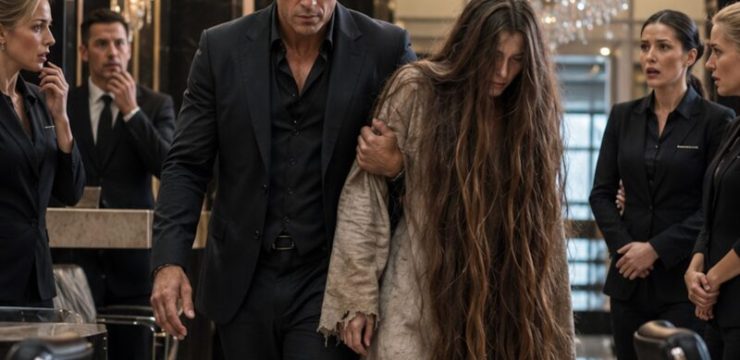
Nobody in that auditorium expected what was about to happen. Parents had settled into their seats, chatting quietly. Teachers were shuffling papers near the stage. Children in their pressed recital clothes fidgeted nervously backstage, waiting for their names to be called. It was supposed to be an ordinary evening — one of those small-town school concerts that parents attend out of love and leave with pride.
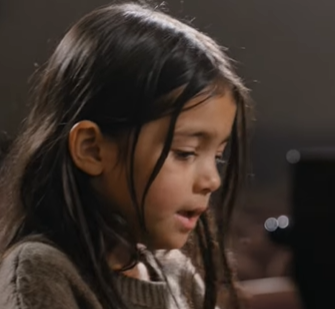
But the moment that little girl sat down at the piano bench, something in the room shifted.
She didn’t look like the other children. Her sweater was worn at the elbows. Her shoes were too big. She sat with the quiet stillness of someone who had learned very early that the world wasn’t always a gentle place. And when her fingers touched the keys, she didn’t play something from the program. She played something else entirely — something soft, and searching, and achingly familiar to exactly one person in that room.
A businessman in the front row went completely still.
His chest stopped moving. His hands, which had been resting loosely in his lap, slowly curled into fists. Because the melody floating through that auditorium — the one this unknown little girl was playing with such heartbreaking tenderness — was a private song. One he had composed himself, alone, sitting at the piano in his home during the worst winter of his life. He had written it for his daughter after her very first recital, in the months before she was taken from him.
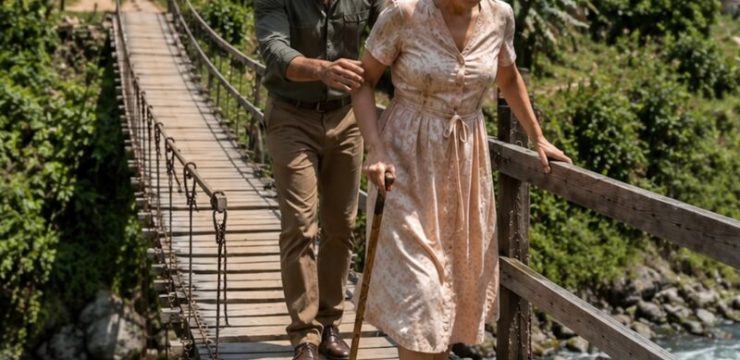
His daughter had died years ago in a terrible car accident on a bridge outside the city. The vehicle had gone over the railing into the river below. No body was ever recovered. Officials had told him she could not have survived. He had spent years learning to live with that loss — building a new life, remarrying, trying to find a way to carry a grief that never fully lifted.
He had shared that melody with no one. Or so he believed.
When the last note faded, the auditorium was completely silent.
The businessman rose from his seat, his voice barely holding together.
“Who taught you that song?” he asked.
The little girl looked down at her hands. When she finally spoke, her voice was just above a whisper.
“My mother did,” she said. “Before she passed away.”
A murmur moved through the crowd like a wave. The music teacher, standing near the side of the stage, stepped forward with tears already forming in his eyes.
“I taught that piece only once,” he said quietly. “Only to your daughter.”
The man looked as though the floor beneath him had simply ceased to exist.
Then the little girl reached into the pocket of her sweater. She pulled out something small and silver — a tiny charm in the shape of a piano key. The moment he saw it, something inside him broke wide open. He recognized it instantly. He had given that charm to his daughter after her very first performance. On the back were two initials engraved in careful script.
A and M.
Anna. His daughter’s name.
Michael. His own.
The little girl’s lip trembled as she held it out in her small hand.
“My mother told me I wasn’t abandoned,” she whispered. “She told me I was hidden.”
The room went absolutely still.
Every head slowly turned toward the elegant woman seated beside the businessman in the front row. His wife. His second wife. She had gone the color of chalk. Her hands were motionless in her lap, but her face told the entire story before a single word was spoken.
The child continued, even though each sentence seemed to cost her something.
“My mother used to work in your house. She said that after the accident, someone paid to make sure you never found me. The woman who found me afterward — she couldn’t give me back to those people. So she ran. She raised me the best she could.”
The businessman slowly turned to look at his wife.
She shook her head. But it was too late. The truth was already visible — in her eyes, in the rigid set of her shoulders, in the way she could not hold his gaze.
She had known, in those early days after the crash, that as long as his daughter existed, part of him would remain somewhere she could never reach. And in the chaos and confusion that followed the accident, she had used that opportunity. She had arranged for the child to vanish — not to be harmed, but to disappear. The poor woman who rescued the little girl from that situation had refused to hand her over to strangers with unclear intentions. So she had done the only merciful thing she knew how to do. She had taken the child and run, and loved her, and raised her quietly until she, too, was gone.
The businessman walked slowly to the front of the stage. He lowered himself to his knees on the hard floor, right there in front of everyone. His eyes, red and overwhelmed, found the little girl’s face.
“All this time,” he whispered. “You were alive.”
She looked at him with an expression that held everything at once — fear, hurt, longing, and something fragile and hopeful underneath it all. Then she asked him the question that would stay with everyone in that room for the rest of their lives.
“I grew up with nothing,” she said softly. “Do you still want me?”
The sound that came out of him was not dignified. It was raw and broken and completely human. He reached out and pulled her into his arms, and he held on like a man who had been drowning for years and had finally found solid ground.
“I wanted you when I thought you were gone,” he wept. “I wanted you every single day.”
The concert never happened. The program was forgotten. No one looked at the stage or the piano or the curtains.
Because a little girl had walked into that room as a stranger — and walked out as living proof that some truths cannot be buried, no matter how carefully someone tries.
There are betrayals that wound. And then there are betrayals that steal years — years of bedtime stories, birthdays, skinned knees, and quiet evenings that belong to a father and his child and no one else. The question that lingers, long after the auditorium emptied and the lights went dark, is one only the heart can answer: when someone takes all of that from you, is forgiveness even possible? Or are there some wrongs that simply live forever in the space they left behind?