I had never heard anyone call her that before.
Not once in all the years since the funeral. Not once in the quiet mornings when I made breakfast for one little girl instead of two. Not once in the long, hollow evenings when I sat at the kitchen table and tried to remember what my wife smelled like.
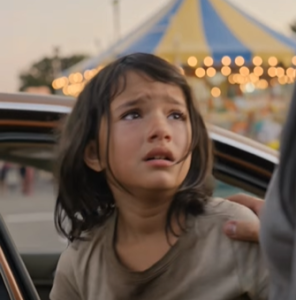
But there we were — my daughter and I — standing in the middle of a summer carnival, surrounded by laughter and spinning lights, and everything changed in the space of a single breath.
My daughter was nine years old. She had her mother’s eyes and her mother’s way of tilting her head when something confused her. We had come to the carnival because I was trying. That’s all I ever did after losing my wife — just trying. Trying to give my daughter good memories. Trying to fill the space that grief had carved out of our little family.
She had wandered off for only a moment toward a fortune-teller’s tent at the edge of the fairgrounds. I found her standing outside it, pale as paper, her small hand clenched tight around something.
She opened her fingers.
There was a ring in her palm.
My stomach dropped straight through the ground.
I knelt in front of her and asked, very carefully, where she had gotten it. She pointed toward the tent, but when I turned to look, the lights inside had already gone dark. The line of people waiting was gone. The tent flap swayed gently in the evening breeze, like nothing had happened at all.
“She knew my name,” my daughter whispered. “Before I even said anything.”
I took the ring from her trembling hand and held it close to the carnival lights.
There was a scratch on the side — a small, curved mark from the day my wife caught her hand on a car door.
There was a date engraved on the inside of the band — the date of our wedding, worn but still perfectly legible.
It was the same ring. The exact ring. The one I had pressed my lips to before they closed the casket.
The world around me went very quiet.
I grabbed my daughter’s hand and we walked — fast, then faster — through the crowd toward the tent. The flap was half open now, moving in the wind like it was breathing.
Inside, there was no woman. No fortune-teller. No candles burning or cards laid out on a velvet cloth.
Just one wooden chair, worn smooth from years of use.
One candle, nearly burned down to nothing, still giving off a thin thread of smoke.
And an old photograph sitting alone on the table.
I picked it up with hands that would not stop shaking.
My daughter looked at it and began to cry — not the soft, confused tears of a child startled by something strange, but deep, broken sobs that came from somewhere I had never heard from her before.
It was a photograph of me. Younger. Terrified. Standing in a hospital room beside my wife, who was lying in the bed with her eyes full of exhausted joy.
And in her arms were two newborn baby girls.
Not one.
Two.
I had always been told we lost one in delivery. A complication. Something that happened too fast for anyone to fully explain. The doctors had been kind but brief. Grief had a way of blurring the edges of things, and I had never pushed. I had my daughter. I had held onto her like a life raft in a storm.
But the photograph did not lie.
My daughter looked up at me, her face wet, her voice barely above a breath.
“Dad… if I had a twin…”
She could not finish the sentence. Neither could I.
That was when we heard a voice.
It came from the doorway of the tent — quiet, steady, almost gentle — and it said:
“You were only meant to lose one of them.”
I turned around slowly, the way you do when some deep part of you already knows what you’re about to see and is trying to prepare itself.
She was standing in the entrance of the tent.
She had my daughter’s face. Every detail. The same set of the jaw, the same slight unevenness of the brows, the same way her chin lifted just a fraction when she was uncertain.
But her eyes were older. They carried something in them that my daughter’s eyes had never held — a long, specific kind of sadness that only comes from years of not knowing where you belong.
Around her neck, on a thin silver chain, hung my wife’s ring.
Not the one in my hand.
Another one. Identical.
My daughter stepped forward before I could move, before I could speak, before I could do anything at all. She reached out and took hold of the other girl’s hand like it was the most natural thing in the world — like her body remembered something her mind had never been told.
The two of them stood there, holding hands in the doorway of that small tent, while the carnival spun on around us and the music played and the world continued as if it had not just been completely remade.
I looked at them both.
And I understood, finally, what my wife must have known when she looked at me from that hospital bed all those years ago — that last long, loving look I had never been able to fully explain.
She hadn’t been saying goodbye to life.
She had been trusting me with more of it than I knew.