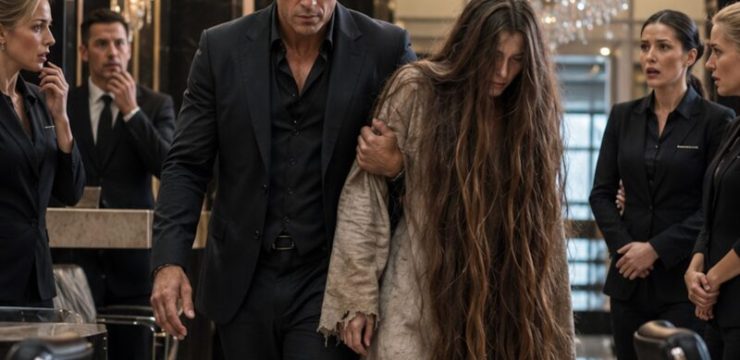
He watched his daughter’s feet rise from the wheelchair, and for a moment, the entire room forgot how to breathe.
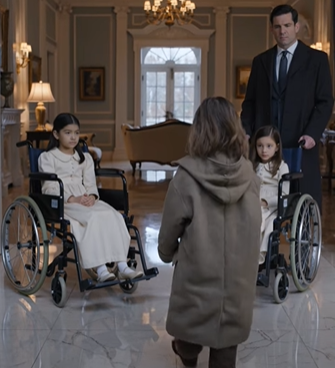
It wasn’t the movement itself that stopped everyone cold. It was the look on the little girl’s face — the one standing there in that oversized coat, holding the child’s hand with a calm that no child her age should ever possess. It was the way she stood perfectly still while a miracle unfolded in front of her, as if she already knew it would happen. As if she had been sent here precisely for this.
The father stood behind both wheelchairs, one hand pressed flat against his mouth.
He had brought in therapists, doctors, specialists from three different cities. None of them had done what this small, quiet stranger had done in under ten minutes simply by walking through his front door.
“What is happening?” he whispered.
His older daughter, still in her wheelchair, began to cry before anyone could answer. Not from sadness. From something closer to recognition — the kind that lives deep in the chest and surfaces only when something long buried finally pushes its way back into the light.
“She knows things,” the girl said through her tears. “Things only Mom knew.”
The room went completely silent.
Their mother had passed away the year before the accident that left both girls unable to walk. The father had carried that grief the way a man carries a stone he doesn’t know how to put down — quietly, heavily, and alone. He had buried her. He had stood at that graveside in the rain and made promises to take care of what she left behind. He had come home to a mansion full of money and silence and raised two daughters who flinched at loud noises and stopped finishing their sentences whenever someone mentioned her name.
He thought he knew the full shape of his loss.
He was wrong.
The little girl in the oversized coat turned her head slowly toward him. And what he saw in her expression was not the face of a child. It was something older. Something familiar in a way that made his knees go soft.
She reached into the pocket of her coat.
She pulled out a small silver charm on a delicate chain.
The father staggered back against the wall.
He knew that charm. He had held it in his hands on the worst day of his life. He had placed it gently in his wife’s hands before they closed the casket. He had kissed it once and whispered goodbye.
His younger daughter began shaking in her wheelchair.
“That’s Mommy’s,” she said. Her voice was barely sound.
The little girl nodded, just once, slowly.
“My mother gave it to me,” she said softly. “Before she died.”
The father stared at her. Every thought he had ever had about the world suddenly felt unstable, like furniture someone had quietly been moving in the dark while he slept.
“What mother?” he managed.
The child’s eyes filled with tears that she did not let fall.
“The woman who cleaned your winter house,” she whispered. “The one your wife visited in secret, every year, for a long time.”
The room tilted.
The father had known his wife kept money separate from their accounts. He had discovered it after she was gone and spent weeks wondering why. He had assumed the worst — the kind of worst that grief turns to when a person is desperate for something to make sense. But the explanation he had built in his mind was nothing like the truth that was now standing in front of him in a secondhand coat, holding proof of a life he never knew existed.
His wife had hidden that money. Not for any reason he had imagined.
For protection. For a promise she had made to someone who had very little and trusted her completely.
The little girl looked down at the silver charm resting in her small palm.
“She told my mother,” the child said quietly, “that if anything ever happened to her, I should come here one day. She said your daughters would know me.”
The father’s voice broke completely.
“Why?” he asked. “Why would they know you?”
The little girl looked at the two girls in the wheelchairs. She looked at them the way you look at people you have wondered about your entire life. The way you look at the missing pieces of something you’ve always known was incomplete.
Then she looked back at the father.
And she told him the truth that his wife had spent years protecting, carrying, and ultimately trusted the universe to deliver at the right moment.
“Because I am the daughter your wife had before she ever married you.”
No one in that room moved.
The older daughter reached out from her wheelchair and took the little girl’s hand — the same hand that had helped her sister rise only minutes before. She held it with the kind of grip that says I am not letting go of this. That says I have been waiting, even without knowing I was waiting.
The father slid down the wall until he was sitting on the floor.
He thought about his wife. About all the quiet mornings she had disappeared for hours with no explanation. About the particular sadness that lived behind her eyes on certain days every year. About the way she used to hold their daughters sometimes — tightly, desperately, as if she were counting what she had and grieving what she’d left behind somewhere else.
She had loved them all.
Every one.
She had simply never found the courage to let one world meet the other.
And so she had done the next best thing.
She had left a charm, a whisper, a promise, and trusted that love — real love — eventually finds its own way home.