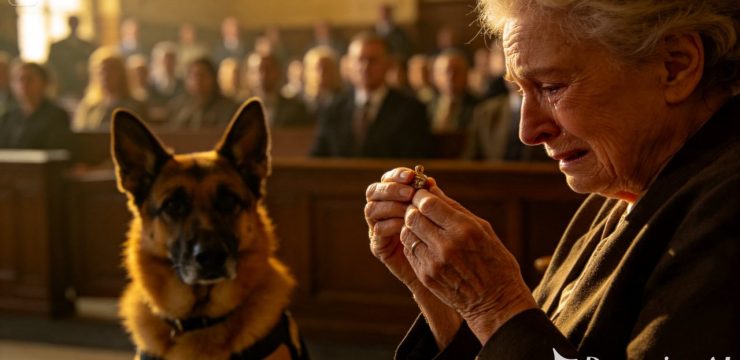
It wasn’t on purpose.
Her fingers simply stopped obeying her.
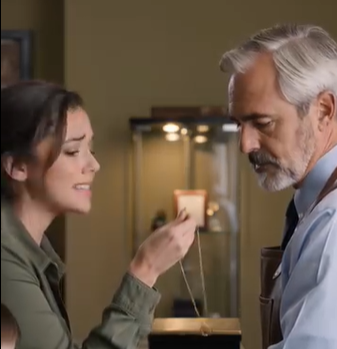
The small silver pendant slipped from her hand and landed against the glass counter with a faint metallic sound — a tiny, delicate noise that felt absurdly small for the moment it marked. Because in that same breath, the old man standing across from her had just spoken eight words that cracked the foundation of everything she had ever believed about herself.
“I buried your mother twenty years ago.”
Her son pressed closer to her side, sensing something wrong the way children always do before they fully understand what wrong even means. She stared at the photograph lying on the counter. Then at the old man’s face. Then back down at the pendant resting against the glass, as if one of those three things simply had to be lying.
“No,” she whispered. “That’s impossible.”
The old man’s eyes filled with tears, but his expression held no confusion. Only exhaustion. The deep, hollowed-out weariness of someone who had carried the same secret for far too long and no longer had the strength to keep holding it upright.
“She was supposed to disappear,” he said quietly. “That was the plan they forced on us. But she refused to leave without you.”
The woman’s heartbeat turned jagged and uneven.
“My mother raised me,” she said, her voice barely holding together. “She passed away last winter.”
The old man closed his eyes for a moment, as if bracing himself.
“Then the woman who raised you was not the woman who gave birth to you.”
The small pawn shop suddenly felt too tight for breathing. The air thickened. The fluorescent lights above seemed to hum louder. He pushed an old metal box slowly across the counter toward her. Beneath a faded photograph lay hospital papers, worn receipts, and a single folded note, its corners gone soft from years of being handled and put away and handled again.
On the outside, in ink that had faded to the color of old rust, someone had written only:
For my daughter, if she survives them.
Her hands were shaking as she unfolded it. The handwriting inside was familiar in the most disorienting way — the same careful slant her mother used to use when labeling jam jars, marking sweaters before school trips, writing names inside the covers of textbooks.
But the words inside were nothing she had ever read before.
The note said she had been born during a fierce winter storm in a private clinic far outside the city. It said that powerful people — people with money and influence and everything to lose — had wanted her gone before sunrise. It said the pendant was the only proof of who she truly was, in case anyone with enough courage and enough kindness remained alive to one day speak the truth out loud.
And at the bottom, a name.
Elena Varela.
Not the name of the woman who had packed her school lunches and stayed up through her fevers. Not any name she had ever known at all.
The old man rested one hand gently near the silver ring beside the letter.
“She was my sister,” he said. “She fell in love with a married man from one of the wealthiest and most powerful families in the province. When she became pregnant, they moved quickly to erase what they called a scandal.”
The woman’s eyes widened. “Erase?”
He nodded once, slow and grave.
“They arranged for the clinic records to be destroyed. They paid someone on the medical staff to officially report that both the mother and the child had not survived. They told the father the baby was gone. And they told my sister she had one choice — disappear, or face consequences far worse than exile.”
Her son tugged at her sleeve now, frightened by the tears moving silently down her face.
The old man’s voice grew rough at the edges.
“She brought you to me for one single night. Just one. She said she was going to find the child’s father and force him to face the truth face to face.”
He looked down at the photograph for a long moment.
“She never came back.”
The woman could barely form the words. “Then — who was buried?”
His jaw tightened visibly.
“A body was found wearing her coat and her pendant chain, burned beyond any real identification. The right people wanted the matter closed and forgotten. I was young, I was terrified, and I was foolish enough to believe what they needed me to believe.”
He slid one final piece of paper across the counter. A newspaper clipping, yellowed and cracked with age. A smiling, elegantly dressed couple photographed at a charity gala. And there in the background, half out of frame, stood an older man — younger in this photo, powerful-looking, one hand resting casually on the shoulder of a small boy beside him.
The caption beneath named him clearly.
She read it once. Then read it again.
Because the name was not unfamiliar.
It was the same surname that appeared on her son’s school enrollment papers. The same surname as the man who had walked out on both of them two years ago without so much as a backward glance.
Her voice went completely cold.
“You’re telling me that my son’s father—”
The old man looked at her with an expression that held both horror and profound sorrow in equal measure.
“I’m saying,” he replied slowly, “that you didn’t fall in love with a stranger.”
He paused, and the silence in that small shop was absolute.
“You fell in love with your half-brother.”
Some truths don’t arrive with warning. They don’t knock. They don’t give you time to sit down or catch your breath or prepare your heart for impact. They simply fall — like a pendant against glass — with a sound far too small for the devastation they carry. And once that sound fades, nothing in the room looks the same as it did before.