She forgot the store.
She forgot the clerk standing behind the register, the low hum of the refrigerator, the smell of old linoleum and cigarette smoke clinging to the walls. She forgot to breathe.
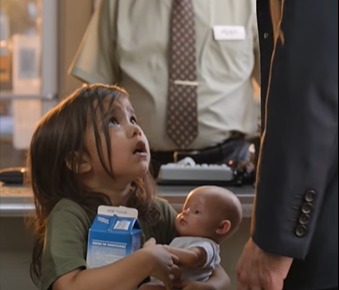
Her arms locked around the baby so tightly that the child let out a small, sleepy protest and squirmed against her chest. She didn’t loosen her grip. Not even a little. She just stood there, frozen in the middle of that quiet little corner store, staring at the photograph the stranger had placed in front of her face.
It was her mother.
Younger. Thinner. And terrified in a way that no photograph should ever capture — the kind of fear that lives behind the eyes long after the camera clicks. And there in her arms, wrapped in the same worn blue-and-white blanket the baby had been sleeping in for weeks, was a tiny infant who looked exactly like the child she was holding right now.
The man who held the photograph had seen the moment it registered.
He watched the fear arrive first. Then the confusion. Then something harder — something that looked like a daughter who had been trained her whole short life to protect a secret she didn’t fully understand yet.
“That’s my brother,” she whispered, her voice barely above a breath.
The man didn’t answer right away.
That silence was the most frightening thing in the room.
The old clerk behind the register shifted his weight but didn’t move otherwise. He was the kind of man who had seen enough of the world to know that some moments balance on a razor-thin edge, and the wrong word from anyone could send everything crashing.
The girl’s voice shook harder when she spoke again.
“Who are you?”
The man didn’t look at her. He looked at the baby.
“My sister’s son was taken from the hospital three months ago,” he said quietly. “Your mother’s photograph was found in the possession of a nurse who disappeared the same night.”
The color drained from the child’s face.
She shook her head immediately, instinctively. “No. My mom didn’t steal him.”
It was the wrong answer for someone lying.
It was exactly the right answer for a daughter.
The man noticed that difference. His expression shifted — not toward suspicion, but toward something more complicated.
The baby fussed again, and the girl rocked him with the automatic, imperfect rhythm of someone who had learned to care for a child before she had finished being one herself. She rocked him like a girl who hadn’t slept a full night in weeks. She rocked him like someone who would walk through fire before she put him down.
The man watched all of it.
Then he asked the question that changed the entire room.
“Where is your mother now?”
The girl opened her mouth. But no sound came. Her lips moved around words that wouldn’t form, and in that silence — in the gap between breath and speech — the truth sat heavy and unmistakable.
The clerk looked down at the counter.
The man’s face changed completely.
The suspicion drained away. What replaced it was grief. Raw, recognizable, bone-deep grief.
The little girl blinked hard, fighting to hold herself together, and forced the words out one at a time.
“She told me to get milk first,” she whispered. “She said if she wasn’t back by the time the streetlights came on… I had to keep walking. And I couldn’t tell anyone his real name.”
The store went absolutely still.
The refrigerator hum seemed to disappear. The traffic outside seemed to fall back. Every ordinary sound in that ordinary little store evaporated, leaving nothing but the weight of what a child had just admitted she was carrying alone.
The man looked at the baby again. Then at the girl. Then back at the photograph in his hand.
And then he understood something far more devastating than theft.
The mother hadn’t been running away with the baby.
She had been running to protect him.
The girl’s fingers tightened around the handle of the milk carton until her knuckles went white.
“My mom told me some people would come saying he belonged to them,” she said softly, her chin lifting just slightly. “But she said only one side of those people actually wanted him alive.”
The man went perfectly still.
The clerk’s head snapped up.
Because in that single sentence, this stopped being a missing-child case. It stopped being a story about a stolen infant and a grieving family. It became something older and darker — an inheritance dispute, or a protection story, or something uglier still, living in the shadowed space between the two.
Power. Money. Secrets that certain families spend generations burying.
The kind of secrets worth running from.
The kind of secrets worth disappearing for.
The little girl looked directly at the man then — really looked at him, the way children sometimes see adults more clearly than adults see themselves — and she asked the one question that finally cracked his composure wide open.
“If he really belongs to your family…” she said, her voice steady in a way that was almost heartbreaking, “then why did my mom tell me to never let your last name find him?”
The man had no answer.
And the silence that followed said everything a courtroom never could.
Outside, the streetlights flickered on, one by one, down the length of the quiet street. The girl noticed. She pulled the baby closer and closed her eyes for just a moment — one small, private moment of grief that no child should ever have to hold.
Then she opened them again.
Because there was no one else left to stand between that baby and whatever had been chasing them both.