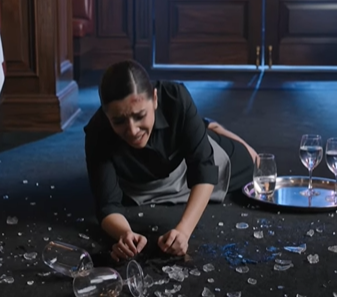
The old woman closed her eyes.
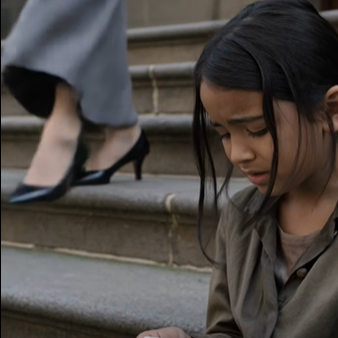
It lasted only a second — just one quiet, trembling second — but in that silence, the little girl understood something far worse than any spoken answer ever could have been. This was not a coincidence. She had not wandered to the wrong place. She had been guided, deliberately and with purpose, to the exact right one.
The caretaker extended his hand with quiet caution. “May I see it?”
The girl hesitated. Then, slowly, she placed the worn ribbon into his palm.
He lifted it toward the light filtering through the old church windows — pale, unforgiving light that revealed every stitch, every thread, every secret the fabric had been holding for years without anyone asking the right questions.
What he saw made his breath catch.
The stitched lily was not decorative. It was a marker — specific to the old St. Agnes infant registry, a system used decades ago to log the names of newborns brought through those church doors. The small cross beside it indicated a private baptism, the kind performed quietly, without witnesses, without celebration. And the three numbers embroidered so carefully along the fold — numbers the girl’s dying mother had touched every single day of her life — were not ornamental at all.
They were a file code.
The caretaker’s fingers tightened around the ribbon.
“This record was sealed,” he whispered.
The old woman said nothing.
And that silence — deep, deliberate, and devastating — was the only answer she was willing to give.
The little girl’s eyes filled with tears for the second time that afternoon. “My mom said the lady with the ring would know.” Her voice was barely above a whisper, fragile as old lace. “She said to find the lady with the ring.”
The caretaker turned sharply toward the woman. “Know what, exactly?”
The old woman did not look at the child. She stared at the ribbon as though it were something that should have burned long ago.
“That the file,” she said at last, “should have been destroyed.”
The wind moved across the church steps like something restless and unfinished.
The little girl reached out and clutched the woman’s sleeve. “What file? What are you talking about?”
The caretaker looked up slowly. Something had drained from his face — color, certainty, the comfortable distance a man keeps between himself and other people’s pain.
“A baptism file,” he said carefully. “For a child whose name was entered into the record… and then removed.”
The girl went completely still.
The old woman’s hand had begun to tremble — not the small nervous shake of age, but something deeper, something that came from a place she had been trying to forget for a very long time.
“My mom said it belonged to me,” the girl whispered.
The caretaker looked from the ribbon to her face. Then back to the old woman. And whatever he understood in that moment — whatever truth assembled itself quietly behind his eyes — made his voice drop to almost nothing.
“She wasn’t trying to return a keepsake,” he said softly. “She was trying to return an identity.”
The child blinked through her tears.
The old woman finally looked at her. Really looked at her. And the grief written across that weathered face was complicated — threaded through with something that looked unmistakably like fear.
“Your mother worked in my house,” the woman said, her voice low and careful. “The night of the fire, she took you out before the record could be corrected.” She paused. “Before anyone could change what had been written.”
The little girl barely breathed.
The caretaker frowned. “Corrected to what?”
The old woman answered too slowly. A beat too late. The way people answer when the truth has been rehearsed but never actually spoken aloud.
“To the dead child’s name.”
Silence fell over the church steps like a curtain dropping at the end of an act no one had expected to witness.
Even the noise of the distant city seemed to pull back, to give that moment its proper weight.
The caretaker looked down at the file code again. And now — now it made a terrible, horrifying kind of sense. The ribbon had not been kept because it was sentimental. It had not been passed from a dying mother’s hands because it was beautiful or meaningful in the ordinary way that keepsakes are meaningful.
It had been saved because it was the only surviving key to a church record that proved something unthinkable — that one living child had been baptized, documented, and registered under the name of another child who had not survived.
The little girl’s lips trembled. Her voice, when it finally came, was the smallest sound in the world.
“Then who am I?”
The old woman’s composure collapsed entirely. The careful, guarded expression she had carried onto those steps crumbled at its edges and then all the way through.
Before she could answer — before either of them could find words for something that had no good ones — the caretaker turned the ribbon over one final time.
And he noticed something none of them had seen before.
Tucked nearly invisible in the fold, hidden in the seam where the fabric doubled back on itself, was one more stitch. Deliberate. Precise.
A second number.
A burial ledger number.
The color left his face entirely.
Because a burial ledger number meant the ribbon did not point only to a baptism record — to a living child given another’s name.
It pointed to a grave.
The old woman looked at what he had found. Her hand rose slowly to cover her mouth.
And her voice, when it came, carried the full weight of every year she had spent hoping no one would ever find both files at once.
“She found both files,” she whispered.
And no one on those church steps had any idea what happened next.