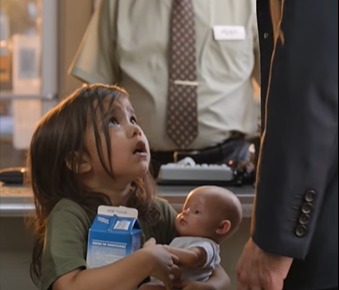
Nobody in that supermarket expected their afternoon to turn into something they would carry with them for the rest of their lives. It started the way most moments do — quietly, unremarkably, with a little girl standing in front of a bread display, clutching something tightly in her small fist.
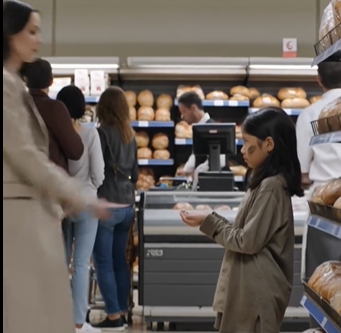
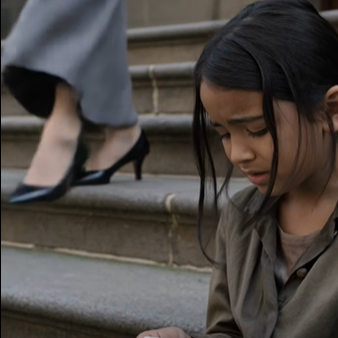
She looked no older than seven or eight. Her clothes were clean but worn. Her eyes were red and swollen, the kind of red that comes from crying so hard for so long that the body simply runs out of strength. She wasn’t making a scene. She wasn’t asking for anything. She was just standing there, staring at the loaves of bread on the shelf as if she were trying to solve a problem far too heavy for someone her age.
That was when the woman in the expensive coat made her first mistake.
She had been watching the girl from two steps away, and rather than feeling compassion, she felt something else entirely — impatience, irritation, and something uglier underneath that she was careful not to let show on her polished face. When the little girl finally whispered to the bakery worker that she didn’t have enough money, the woman clicked her tongue loud enough for everyone nearby to hear.
“That’s ridiculous,” she said sharply. “She’s just saying anything for pity.”
But nobody was listening to her anymore.
Every single eye in that aisle had shifted to the bakery worker — a middle-aged man with flour still dusted on his apron and the kind of tired face that belongs to someone who has seen enough of life to know when something important is happening right in front of him.
His hands were trembling. So badly, in fact, that he had to set his tray down on the nearest shelf before he dropped it entirely. He was staring at the little girl the way a person stares at something they believed was gone forever — the way you look at someone you lost and somehow never expected to see again.
Then, slowly, he knelt down in front of her.
“What did your mother tell you?” he asked, and his voice cracked on the last word.
The girl was still crying when she opened her small fist. Resting in her palm was a single coin — one she had clearly been protecting with everything she had.
“It’s not for bread,” she whispered. “She said if the man who bought two loaves sees me, I should give him this.”
He took the coin from her hand with the kind of gentleness that makes grown adults want to look away because it feels too private, too sacred to witness.
The second he turned it over, every bit of color drained from his face.
Taped to the back was a tiny, carefully folded piece of paper.
The aisle went completely still. Shoppers who had been reaching for items stopped mid-motion. Even the ambient noise of the store seemed to hold its breath.
With fingers that would not stop shaking, he unfolded it.
The paper was old. Worn thin at the creases. Nearly torn through in places, as though it had been folded and unfolded many times over many years, kept close to someone who needed the words inside.
And written in faded ink that had once been dark and deliberate were these words:
If she comes back alone, don’t let them see her before my father does.
A collective gasp moved through the small crowd that had gathered without anyone realizing it.
The bakery worker looked up at the little girl, and what was on his face was not just recognition — it was horror. The quiet, sickening horror of understanding something that you wish you didn’t.
“Your grandfather,” he whispered. “Your mother was trying to get you to your grandfather.”
That was the moment the elegant woman took a sudden step backward.
It was the cashier who noticed first. “Why are you leaving?” she called out, and her voice carried.
Everyone turned.
The rich woman’s face had gone completely white. Not pale — white. The kind of white that happens when a person realizes the walls they built around themselves are falling, and they are out of time.
The bakery worker rose to his feet slowly, never taking his eyes off her. The disbelief on his face was something that everyone watching would struggle to describe later — because it wasn’t just shock. It was recognition mixed with rage mixed with grief, all colliding at once.
“You were there that night,” he said.
She tried to laugh. The sound that came out wasn’t one.
The little girl looked between the two of them, trembling, her eyes darting back and forth as if trying to understand a conversation happening in a language just beyond her reach.
Then the worker raised a shaking hand and pointed directly at the woman.
“She wasn’t just in the parking lot,” he said, his voice steady now in the way voices get when a person stops being afraid and starts being certain. “She was the one your mother was running from.”
The supermarket erupted. Whispers, gasps, the sharp intake of breath from people who had just witnessed something they could not have prepared for.
The little girl’s lips trembled. Her eyes filled again with fresh tears.
And just before the woman could turn and walk out those sliding glass doors — just before she could disappear back into the life she had so carefully constructed — the child looked straight at her.
And in a voice so soft it should not have reached a single ear, but somehow reached every single one, she said the first word she had spoken in years.
“Auntie.”
The word landed in that supermarket like a stone dropped into still water — and the ripples it sent out touched everyone standing there in ways none of them would ever fully put into words.
Some secrets don’t stay buried. Some children carry messages the rest of us weren’t meant to understand until the very last moment. And sometimes, the truth walks into a grocery store on a quiet afternoon and refuses to leave until it has been seen by everyone who needs to see it.