She didn’t smile like a girl who had just won something.
She looked like a girl who was trying very hard not to cry.
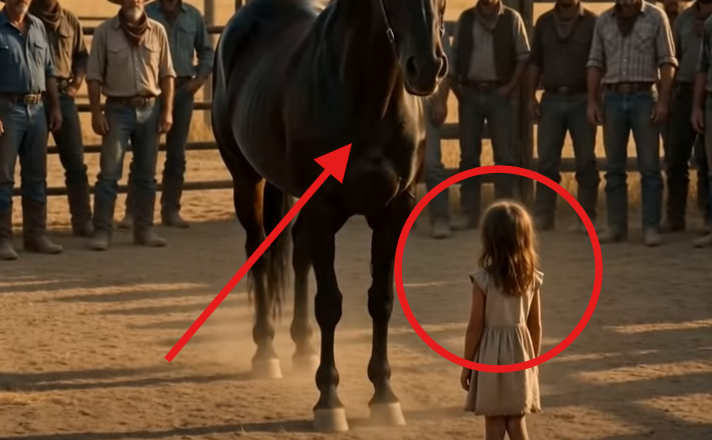
Her eyes stayed fixed on the black stallion — still, careful, the way you look at something precious you’ve waited a long time to find. The horse was massive, dark as a midnight sky, and worth more money than most people in that county would ever see in a lifetime. The rancher held the lead rope with a firm hand, the kind of grip that said this animal wasn’t going anywhere. Buyers had come and gone. None of them had made the horse do anything but pin his ears back and stomp the earth with contempt.
But the girl had walked up to the fence, and the stallion had gone quiet.
Nobody could explain it. The workers had stopped what they were doing. The rancher watched with narrowed eyes as the girl — maybe ten years old, wearing a simple cotton dress, her hair loose around her shoulders — stood at the railing without fear.
Then she whispered something.
“My mama said he would remember our song.”
The rancher’s jaw tightened. “What song?”
The girl reached into the small pocket of her dress and pulled out something so tiny it almost got lost in her fingers. A silver horseshoe charm. Old and scratched, the shine worn down to a dull glimmer, tied to a piece of frayed string that had been knotted and re-knotted more times than anyone could count. It looked like something a person had carried for years. Not as jewelry. As a lifeline.
The rancher stared at it.
His grip loosened on the rope without him meaning to.
“Where did you get that?” he asked, and his voice had changed — lower, rougher, like the words had to push through something heavy just to get out.
“My mama wore it,” the girl said simply. “She told me if I ever found this ranch, I should show it to the man who owned the black horse. She said he would know what it meant.”
The workers behind the fence didn’t move. Nobody spoke. The afternoon sun pressed down on all of them like it was holding its breath.
The rancher took one slow step closer, and when he spoke again, his voice was careful — the way a man speaks when he already suspects the answer and isn’t sure he’s ready for it.
“What was your mother’s name?”
The girl looked up at him with eyes that were too steady, too old for someone her age. Eyes that had seen grief long before they should have.
“Rose,” she said.
That name hit the corral like a thunderclap in a clear sky.
Rose. The name carried weight no one had spoken out loud in years. Rose had been the only person the stallion had ever truly obeyed — not out of training, but out of something deeper, something no bit or rein could manufacture. She had a gift with horses, and with this one in particular, she had something that looked almost like love.
Then she was gone.
Rose had disappeared quietly, without fanfare, after the rancher’s family made it clear that she didn’t belong in their world. She was too different. Not the right name, not the right background, not the right anything — according to the people who believed they had the right to decide such things. She had left without asking for anything. Without making a scene. She had simply disappeared, carrying something with her that no one had known about at the time.
Now her daughter was standing in the dust of the same ranch, holding a little silver charm on a piece of worn string.
“She waited for you,” the girl whispered, and her voice trembled for the first time. “She waited for a long time. Until she couldn’t anymore.”
The rancher’s eyes filled. He blinked, but it didn’t help.
The stallion — that proud, unpredictable animal who had thrown grown men and refused every stranger — lowered his great head slowly and pressed it against the little girl’s chest. Gently. As if he recognized something in her that his instincts understood before his eyes could confirm it.
The girl placed one small hand on the side of his face.
She didn’t flinch. She had done this before.
Her voice broke open like something that had been sealed too long.
“My mama said my father would know the charm.”
And the rancher — a man who had built his whole life on being in control, who had weathered droughts and losses and years of silence — dropped to his knees right there in the dirt of his own corral.
He didn’t care who was watching.
He didn’t care about any of it.
He looked up at this child with her mother’s eyes and her mother’s quiet courage, and he whispered the only truth that mattered anymore.
“I do,” he said. “Because I gave it to her.”
The workers turned away to give him something close to privacy. The stallion stood perfectly still. The girl looked down at the man kneeling in the dust, and something in her small face shifted — not relief exactly, but the beginning of it. The first unlocking of a grief she had carried alone for too long.
Some doors close so quietly, you don’t hear them shut until years later — when a little girl walks across a dusty corral carrying a silver charm, and the whole world stops to listen.