Margaret was not the kind of woman who made excuses.
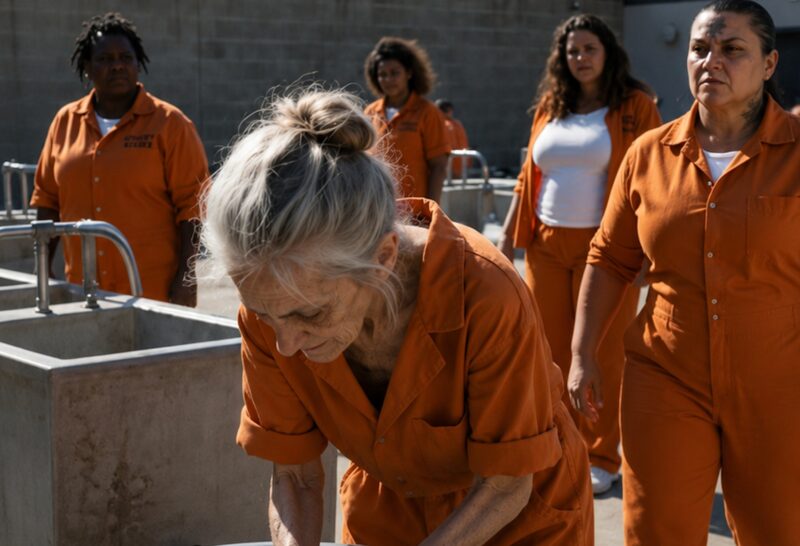
At seventy-four years old, she had arrived at the correctional facility quietly, without drama, without complaint. Her gray hair, her slow and careful movements, her worn hands — everything about her spoke of a life that had known both struggle and dignity. The prison was loud, unpredictable, and merciless to the weak. Margaret knew she was not built for heavy labor. Her body reminded her of that fact every single morning. But she never said a word about it. She simply showed up, day after day, and did what needed to be done.
Her routine was the same each day. She rose early, made her way out to the yard, filled a large plastic container with water, and quietly washed her own prison-issued clothes. She asked nothing of anyone. She kept to herself. She caused no trouble. In a place where survival often meant being louder, meaner, and more ruthless than the person next to you, Margaret simply chose to remain herself.
Most of the other inmates left her alone. Some even respected her, in the quiet, unspoken way that prisoners sometimes respect those who carry their suffering without making it everyone else’s problem. But not everyone in that yard operated on respect.
Vanessa was the kind of woman who fed on fear.
She had spent years establishing herself as the most dangerous inmate in the entire cell block. She intimidated, manipulated, and terrorized. She had perfected the art of making people feel small, and she had done it for so long that almost no one in the facility dared to look her in the eye. Women who had once stood up to her had learned, the hard way, that it was not worth the cost. So they kept their heads down. They handed over what she wanted. They stayed quiet. And they prayed she would find someone else to focus on.
On the morning that would change everything, Vanessa walked across the yard and dropped a heavy pile of dirty clothing right next to Margaret’s washing container.
“Wash mine too,” she said. No please. No question. Just an order, delivered like it had never occurred to her that anyone might refuse.
Margaret looked up at her slowly. She was tired. She was already struggling just to manage her own laundry. And still, she answered with complete calm.
“I’m sorry. I can barely keep up with my own. You’ll need to wash yours yourself.”
The yard went silent.
Every woman within earshot understood what those words meant. Everyone knew what Vanessa did to people who told her no. They had all seen it before. Some of them had experienced it themselves. Nobody spoke. Nobody moved. They just waited, the way you wait when you already know something terrible is about to happen and you feel powerless to stop it.
Vanessa’s expression changed in an instant. The coldness in her eyes turned into something uglier. She grabbed Margaret by the hair and forced the elderly woman’s face into the dirty, soapy water. Margaret struggled. She clawed at Vanessa’s grip. She couldn’t breathe. The water splashed. And still, for what felt like an eternity, no one intervened.
But then something shifted.
One woman — a woman who had endured Vanessa’s cruelty for years, who had given up packages, swallowed humiliation, and stayed silent long past the point where silence felt like survival — took one step forward.
“Enough,” she said. Not a whisper. Not a plea. A declaration.
Another inmate stepped up beside her. Then another. And another. Within moments, nearly the entire yard had closed in around Vanessa. Women who had not dared to make eye contact with her in years were now standing their ground, shoulder to shoulder, staring her down without flinching.
For the first time in longer than anyone could remember, Vanessa had nowhere to go.
She released Margaret slowly, took several steps back, and said nothing. Because for once, there was nothing she could say.
What followed changed the entire facility.
Prison staff had heard the commotion and responded quickly. Surveillance footage from the yard was immediately secured and reviewed. The recording showed everything with perfect clarity — Margaret washing her own clothing, Vanessa approaching uninvited, issuing her demand, and then attacking an elderly woman without provocation. There was no ambiguity. There was no version of events that could spin it any other way.
The administration called each woman from the yard in separately. And what happened next stunned everyone involved. One by one, the inmates began to speak. For the first time, they described what Vanessa had really been doing — the beatings, the stolen packages, the forced labor, the threats against anyone who considered going to the guards. Years of silence broke open all at once, because for the first time, they believed it was finally safe enough to tell the truth.
Vanessa was moved to solitary confinement that same day. Her privileges were stripped. A formal disciplinary investigation was launched. Shortly after, she was transferred to a higher-security facility. She did not say goodbye. No one asked her to.
Margaret returned to the yard the following morning, washing basin in hand, as though the previous day had simply been another day.
But the yard was different now. Women who had never once offered her a kind word came over to help carry the water. They offered to lift the heavy items. They stayed close. They made sure no one raised their voice in her direction.
A younger inmate pulled her aside and said softly, “I’m sorry we didn’t step in sooner.”
Margaret looked at her with the kind of warmth that only comes from someone who has truly lived, and smiled.
“The important thing,” she said gently, “is that you finally found the courage.”
Sometimes the most powerful thing in the room isn’t the loudest voice. Sometimes it’s the quiet dignity of someone who simply refuses to become something lesser — and the moment when the people watching finally decide they refuse to look away.