Julian did not turn toward his brother right away. He didn’t need to. He had already seen everything he needed in the faint reflection cast across the glass — not confusion on his brother’s face, not irritation, not the mild inconvenience of an interrupted evening. What stared back at him was something far more telling, far more damning than any of that.
Fear.
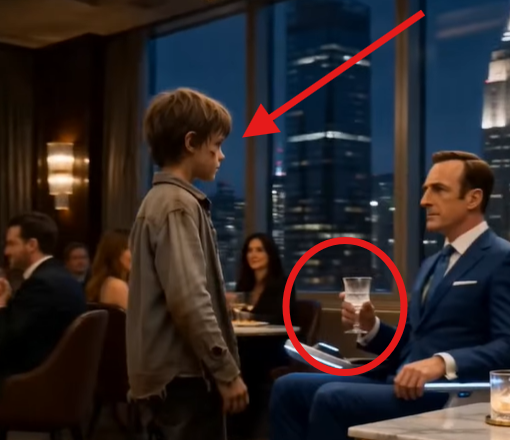
The boy rose slowly from beside the wheelchair, still clutching the small pendant in one hand. He was young, maybe nine or ten, with dark eyes that held a steadiness most grown men never develop. And as Julian took him in — the jaw, the brow, the careful way the child held himself — something shifted inside him. A recognition so deep it bypassed thought entirely and landed somewhere raw and irreversible.
His brother moved too quickly, trying to reassert control before the room could fully understand what it was witnessing.
“Julian,” he said, his voice slicing low and sharp through the quiet. “You need to come inside. Now.”
Julian finally looked at him. Not with confusion. Not with the polite detachment he had perfected over the years. He looked at him the way you look at someone when the last page of a long story finally makes every chapter make sense.
“Who is he?”
His brother’s jaw tightened like a man squeezing a wound shut.
“A mistake.”
The word hit the room like something physical. Several guests flinched. The boy didn’t step back, but his eyes filled with a hurt so familiar it was almost ancient, like a child who has heard himself described as a burden one too many times and has learned to absorb it without collapsing.
Julian stared at his brother as if seeing him clearly for the very first time.
“A mistake,” he repeated, the words hollow and slow.
His brother lowered his voice, but the silence around them was so complete, so absolute, that every syllable still carried.
“Elena was unstable. I solved a problem you were too weak to solve. You were injured, broken, in no condition to think clearly. She was pregnant and desperate. Father would have burned everything to the ground to keep her away from this family. I made sure it was handled quietly. I protected you.”
Julian felt something dangerous rise inside his chest — not anger exactly, but something older and more honest than anger.
“You hid my child from me,” he said.
“I protected your future.”
Julian laughed once. It was a short, broken sound that had nothing to do with humor. Then he looked down at his foot. He moved it. A full, deliberate movement — small, trembling, but undeniable.
And Elena’s words came back to him with the force of something long suppressed finally breaking through:
Your body isn’t dead, Julian. Your truth is.
He had let her go for saying that. Sent money as a substitute for accountability. Let his brother handle the loose ends. Let silence do the slow, thorough work of erasing what he hadn’t had the courage to face.
The boy wiped his face with the back of his sleeve. When he spoke, his voice was quiet and steady in the way children become steady when they have been carrying too much for too long.
“My name is Noah.”
Julian repeated it the way you repeat something that has just broken you open.
“Noah.”
The boy nodded once.
“My mom said you picked it before I was born.”
That was when Julian Voss — billionaire, patriarch, untouchable — pushed down on the arms of the wheelchair and stood up. Not smoothly. Not powerfully. He shook. He swayed. He nearly stopped halfway. But he forced himself all the way upright, and the gasps that spread through the restaurant had nothing to do with wealth or spectacle.
They had everything to do with watching a man stand up inside the ruins of the life he had built on top of his own silence.
His brother stepped forward. “Sit down.”
Julian’s voice came out low and absolutely without negotiation.
“No.”
Just that word. But it landed with the weight of every year he had spent sitting down when he should have stood.
He turned to Noah, eyes wet now, every shield stripped away.
“Is she really downstairs?”
Noah nodded, tears falling freely.
“She kept asking what the skyline looked like from up here.”
Julian closed his eyes for one brief second. When he opened them again, something irreversible had settled into his expression — not redemption, not yet, but the first honest step toward it.
He looked at his brother one final time.
“All these years?”
His brother said nothing. And that silence answered everything.
Julian knelt in front of Noah — awkwardly, without grace, without the polished dignity he had spent decades curating. He held out one hesitant hand.
“I should have found you,” he said.
Noah’s lower lip trembled.
“You should have found her.”
Julian bowed his head.
“Yes.”
Then he opened both arms, and the boy — after one long, searching pause, as if deciding whether this broken man deserved even that — stepped into them.
Julian held his son for the first time. Right there, with the whole city cold and glittering beyond the glass, and an entire room of witnesses who had come for dinner and instead received something far more honest than they had bargained for.
He rose again, one hand on the table, the other resting gently on Noah’s shoulder. Then he turned to the nearest staff member and said, with complete calm, “Call the board. Call my lawyers. And make sure my brother does not leave this building.”
No one questioned him. Because the room already understood that the man who had walked in that evening and the man now standing here were not the same person.
Julian looked down at Noah.
“Take me to her.”
“Are you really coming?” the boy asked.
“Even if she hates me.”
Noah cried harder at that.
“She told me you might say that.”
And so father and son moved toward the elevator together — one limping, one in torn clothes, both carrying more grief than either should have had to carry alone. Julian Voss was no longer moving toward power, or performance, or the careful management of his own image.
He was moving toward a woman waiting three floors below, and toward the truth that had just, after all this time, taught his body how to stand.